Steel fencing holds its shape, holds its finish, and doesn't require the annual maintenance callbacks that wood generates. Here's how to spec and install it right the first time.
Custom steel fencing has become one of the stronger upsells in residential landscape construction. Clients who've had wood fences for 10 years and watched them rot, lean, and warp are ready to pay more for something that won't. Steel delivers that. But only if it's fabricated and installed correctly.
Most landscape contractors who do steel fencing buy pre-fabricated panels from a metal supplier and install them. A smaller number fabricate custom designs in-house or work with a local welding shop. This article covers both paths.
Steel Tube Sizing: What to Use and When
Most residential steel fence panels use square tubing. Here's the standard sizing guide:
- Pickets/infill: 1/2" x 1/2" or 3/4" x 3/4" square tube at 16 gauge. Fine for decorative vertical infill where structural load is minimal.
- Rails (horizontal members): 1" x 1" or 1.25" x 1.25" square tube at 14 gauge. Rails carry the picket load and need more section modulus than pickets.
- Fence posts (line posts): 1.5" x 1.5" square tube at 11 gauge minimum. These are structural — they carry the panel load and resist lateral force. Don't go lighter.
- Gate posts: 3.5" x 3.5" square tube at 11 gauge, or 2" x 2" for lighter single-swing gates. Gate posts carry dynamic load every time the gate swings — undersizing gate posts is one of the most common installation failures we see.
Wall thickness matters as much as tube size. 11 gauge (0.120") is the minimum for structural posts. 14 gauge (0.083") works for rails. Never use 16 gauge (0.065") for anything structural — it will flex noticeably under fence panel weight.
Post Setting for Steel Fence Posts
Steel fence posts set in concrete. No exceptions for posts carrying panel weight. Diameter of the hole: 3x the post width for standard soil, 4x for sandy or soft soil. Depth: minimum 1/3 of total post height, plus 6 inches. A 6-foot exposed post needs a minimum 30-inch hole depth.
In Central Texas clay soil, dig at least 36" deep on anything structural. The clay expands in wet weather and contracts in drought — shallow posts will heave and twist. Hit caliche at 18"? You need a masonry bit or a rented rotary hammer to break through before setting the post.
Pour concrete to 2" below grade, not flush. This prevents water pooling around the post base. Slope the concrete crown slightly away from the post on all sides. Let cure a minimum 24 hours before attaching panels — 48 hours before applying any panel weight if temperatures are below 65°F.
Panel Attachment Methods
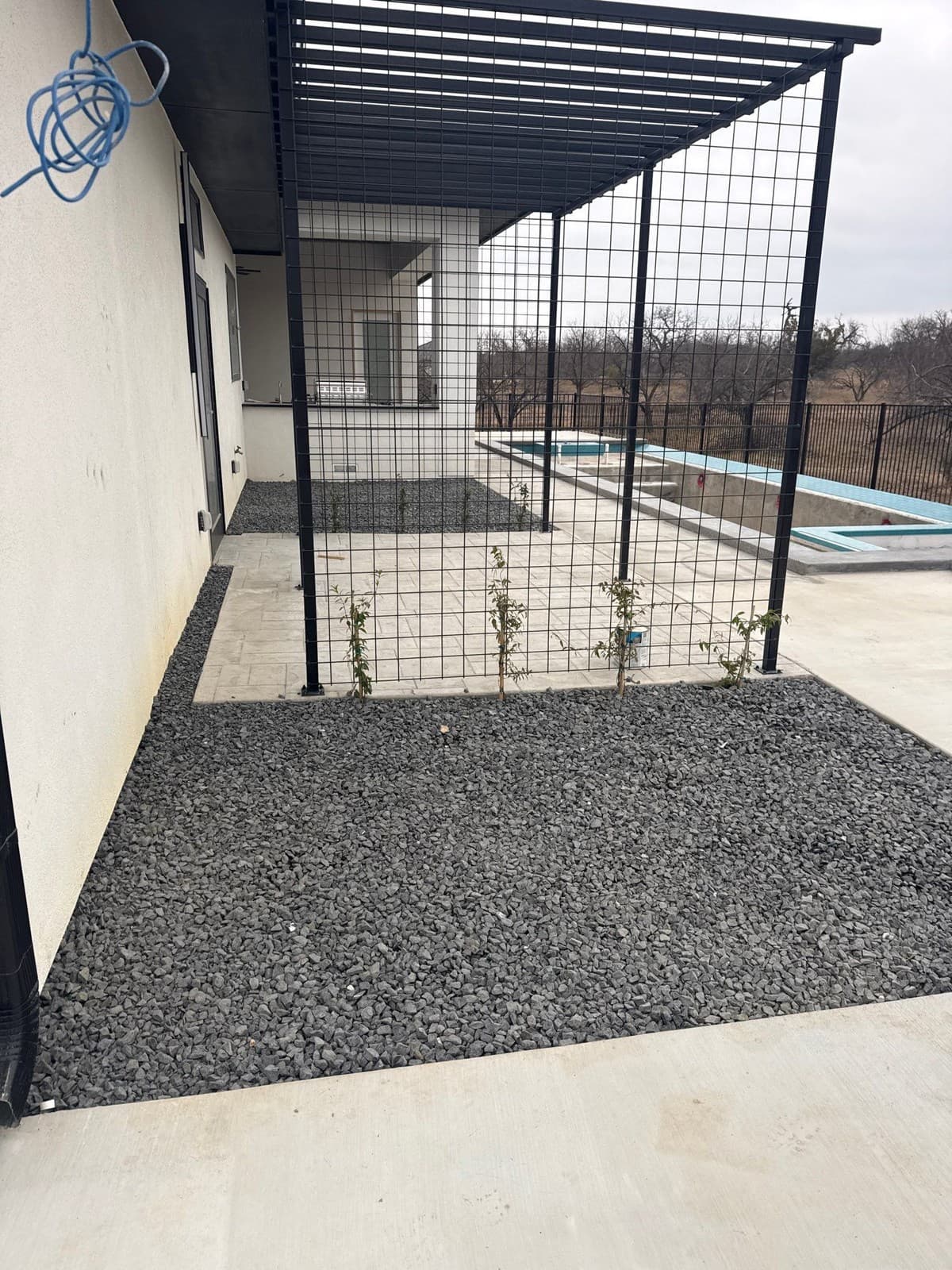
Steel fence panels attach to posts by welding, bolting, or bracket. Each has trade-offs:
- Welding: Strongest connection, clean look. Requires a welder on-site or shop fabrication. Powder coat application happens after welding, which means any on-site welds need touch-up with cold galvanizing spray or matching paint.
- Bolted flanges: Shop-fabricates a flange plate onto the panel rail, bolt through to the post in the field. No welding on-site, good for panel replacement if needed later. Visible hardware on both sides — acceptable on commercial, less clean on high-end residential.
- Z-brackets or U-brackets: Pre-made brackets welded or screwed to the post, panel rails slot in. Faster installation, good for standard panel heights. Less adjustable for raked or stair-stepped applications.
"We weld every connection on custom residential work. A bolted fence looks like a commercial fence. Clients paying for custom steel are paying for the clean look — deliver it."
Powder Coat vs. Paint: Which Finish Lasts
Powder coat is the correct choice for exterior steel fencing. It's a dry powder electrostatically applied to the metal and cured in an oven at 400°F, creating a finish that's 2–4x thicker than liquid paint and chemically bonded to the substrate. A quality powder coat on properly prepped steel lasts 15–20 years in outdoor conditions without significant fading or rust.
Liquid paint is thinner, chips more easily, and doesn't protect cut edges as well. If you're buying pre-powder-coated panels from a supplier and making field cuts, touch up cut edges immediately with cold galvanizing compound, let it cure, then apply exterior metal primer and paint to the cut area. Bare steel edges rust within weeks in humid conditions.
Standard colors: flat black is the most requested for modern landscape design. Dark bronze is a close second. Custom colors from a powder coat shop typically add $150–300 to the panel cost but allow exact color matching to the client's house or other metalwork.
Estimating Custom Steel Fencing
Material cost for standard residential steel fence panels (4' or 6' tall, flat top, 4" picket spacing) runs $35–65 per linear foot depending on height and infill density. Gate panels are priced separately — typically $350–700 for a single-swing gate, $600–1,200 for a double-drive gate.
Installed price in Central Texas for 6-foot tall powder-coated steel fencing with concrete post setting runs $65–120 per linear foot. Custom designs with decorative elements, specific picket patterns, or arched tops add 20–40% over standard panel pricing.
Estimate steel fencing jobs in Ledge
Line out panels, posts, concrete, powder coat, and gate hardware as separate items. Professional proposals that close faster.
Frequently Asked Questions
How do you handle grade changes with steel fence panels?
Two options: step the fence (horizontal panels installed at different heights, stepping down with the grade) or rake the fence (panels fabricated with a diagonal bottom rail to follow the slope). Stepped works for most applications and is simpler to fabricate. Raked requires custom panel fabrication and more complex post height calculations.
Does steel fencing need a permit?
In most Texas municipalities, fences over 6 feet tall require a permit. HOA approval may be required regardless of height. Always check local ordinances and HOA rules before installation. In Austin, fence permits are required for 8'+ fences; under 8' typically does not require a permit but confirm with the local building department.
How far apart should steel fence posts be set?
Standard panel widths are 4, 6, or 8 feet. Post spacing matches the panel width. For 6-foot tall fencing, don't exceed 8-foot post spacing without increasing post size. Longer spans between posts increase panel flex and put more stress on the post connections.
Can steel fencing rust through the powder coat?
Quality powder coat on properly prepped (blasted) steel won't rust for 15+ years in normal conditions. Rust starts at uncoated edges, scratches, or weld points that weren't fully coated. Inspect annually and touch up any bare spots immediately with cold galvanizing compound to stop rust before it spreads under the coating.
Where do you source custom steel fence panels in Central Texas?
Austin and San Antonio have several steel fabricators who stock standard residential fence panels and do custom work. Central Texas Steel, Texas Iron and Metal, and local weld shops are starting points. Call ahead and ask about lead times — custom panels typically take 2–4 weeks from order to delivery.
Edgar Galindo
Co-founder, Ledge
Edgar built Ledge while running a landscape construction company in Central Texas. He writes about installation techniques, estimating, and building a profitable field operation.