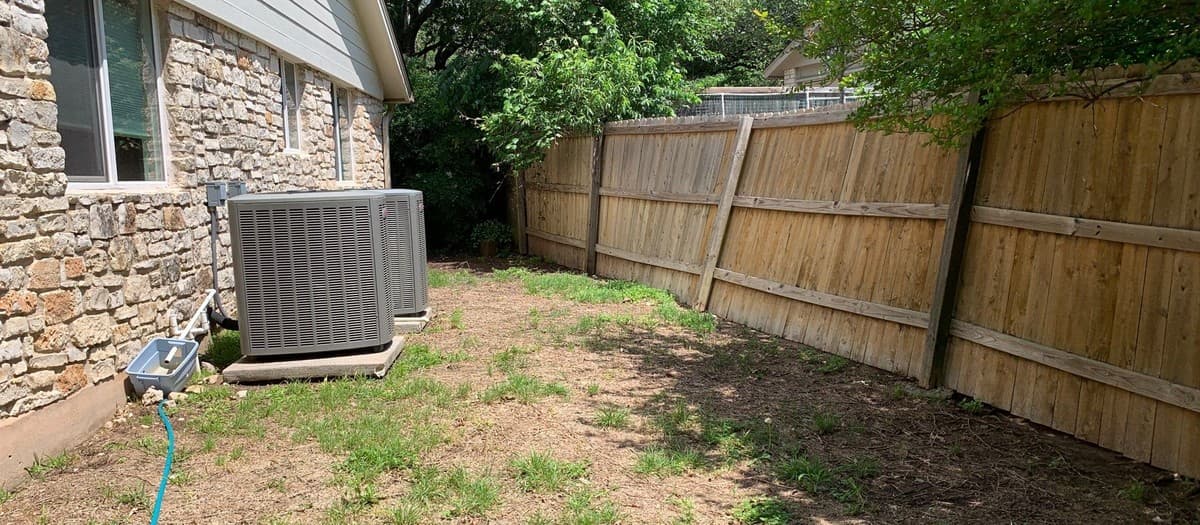
A leaning fence is almost always a post problem. Here's the math on post depth, what concrete footing to use, and how to build a wood fence that stays straight for 10 years.
Wood fencing is the most common residential fencing job landscape contractors take on. It's also the source of more callbacks than almost anything else. Leaning posts, rails pulling away from pickets, boards cupping and warping. Most of those problems are installation problems, not material problems.
Get the post depth right, use the right concrete, space your rails correctly, and choose quality lumber. Those four decisions account for 90% of fence longevity. The picket style is just cosmetics.
Post Depth: The Math That Matters Most
The standard rule: post depth equals 1/3 of the total post length, plus 6 inches. For a 6-foot tall fence using a 9-foot post (6' above grade, 3' below), that's 30–36 inches in the ground. In Texas clay soil, err toward 36 inches.
4x4 posts work for fences up to 6 feet tall at 6-8 foot spacing. At 8-foot spacing in a high-wind area (Central Texas gets strong spring storms), use 4x6 posts or reduce spacing to 6 feet. 6x6 posts are required for gates and corner posts regardless of fence height.
Post hole diameter: 3x the post width. For 4x4 posts, that's a 12-inch diameter hole minimum. Use a gas-powered auger for anything over a few posts. Hand-digging 30-inch deep holes in Central Texas caliche will destroy your crew's productivity and morale.
Concrete Footings: Dry Mix vs. Mixed Concrete
Quikrete Fast-Setting Concrete No-Mix (the dry-pour method) works well for fence posts in most soil conditions. Pour the dry mix in around the post, add water, let it cure. It reaches 4,000 PSI in 4 hours and full cure in 24 hours. This is the fastest method in the field and produces good results.
Standard mixed concrete is better for corner posts, gate posts, and any post carrying significant lateral load. Mix a 60-lb bag of concrete per post for 4x4 fence posts. Gate posts need 80–90 lb bags or multiple bags per post depending on post depth and gate weight.
In either case: set the post first, pour concrete around it, brace the post plumb from two directions with 2x4 stakes, and leave the braces for 24 hours minimum. Don't attach rails the same day you set posts. That move has caused more fence failures than almost anything else.
Rail Spacing for 6-Foot Privacy Fencing
Three rails for any fence 5 feet or taller. No exceptions. Two-rail fences on 6-foot privacy panels allow pickets to flex and warp excessively. Three rails keep pickets straight and distribute wind load properly.
- Bottom rail: 6–8 inches above grade. Keeps the rail out of the soil where rot starts.
- Top rail: 4–6 inches below the fence top (below the picket tops).
- Middle rail: Centered between top and bottom — typically 30–34 inches from grade on a 6-foot fence.
Rail attachment: use 2x4 rails attached to posts with fence rail brackets (nail-on or screw-on) or by toenailing directly into the post. Rail brackets are faster and more consistent — the rail sits in the bracket rather than relying entirely on fastener shear strength. Use hot-dipped galvanized or stainless hardware throughout.
"Every fence we've had called back for leaning had two rails on a 6-foot panel. We switched to three rails on everything over 4 feet and the callbacks went away."
Picket Options: Cedar, Pine, and Cedar Dog-Ear vs. Flat Top
Picket choices are primarily aesthetic, but material choice affects longevity:
- Cedar dog-ear: The Texas default. Dog-ear top sheds water better than flat top, which holds moisture and rots faster. Heartwood cedar at 5/8" or 3/4" thickness. Avoid lightweight cedar at 1/2" — it warps fast.
- Cedar flat top: Cleaner, more modern look. If using flat top, apply end grain sealer to every cut end before installation. End grain absorbs moisture 10x faster than face grain.
- Pressure treated pine pickets: Less expensive, heavier, and more prone to checking and cupping than cedar. Works fine for privacy fencing where appearance is secondary to function.
- Board-on-board: Alternating pickets overlapping on each side of the rails. Better wind resistance (no solid wall to catch full wind load), no gaps, and no visible gaps as pickets dry and shrink. Costs 15–20% more in materials but reduces cupping complaints significantly.
Maximum Post Spacing: 8 Feet OC
4x4 posts should not exceed 8 feet on center for 6-foot fencing in standard conditions. In high wind areas or on exposed hillside lots, reduce to 6 feet OC. The 8-foot limit is based on the lateral deflection capacity of a 4x4 post in typical soil — exceed it and you'll get visible post flex in strong winds.
Corner posts are set independently from the span calculation — a corner post is always set first and the panel spacing is measured from there. Never let a span-calculated post position fall at a corner. Corner posts carry biaxial load (fence force from two directions) and need full concrete footings.
Build better fence proposals in Ledge
Line out posts, rails, pickets, concrete, and labor. Send a professional proposal in minutes, not hours.
Frequently Asked Questions
Should I use a post base anchor or set posts in concrete?
Concrete for structural fence posts. Post base anchors (Simpson ABU or similar) work for deck posts where the load is primarily compressive, not lateral. Fence posts resist horizontal wind load — that requires a concrete footing to provide the necessary moment resistance. Post base anchors are not sufficient for 6-foot privacy fencing.
What causes wood fence pickets to cup and warp?
Moisture differential across the board face. The side exposed to sun dries faster than the protected side, causing uneven shrinkage and cupping. Board-on-board installation reduces this by exposing both sides to similar conditions. Applying water repellent sealer to all faces before installation also reduces cupping significantly.
How do I handle a fence that needs to step down a slope?
Step the fence by cutting each fence section to a uniform height and stepping down at each post. The gap at the bottom increases as the grade drops — decide in advance whether that gap is filled with shorter pickets, a wood or metal kick board, or left open. Continuous stepped panels every 4–6 feet blend better visually than large single steps.
What's the right gap between pickets?
For privacy fencing: no gap, or use a spacing block of 1/4" to allow for wood expansion without buckling in wet weather. For semi-privacy: 1"–2" gaps. Cedar and pine pickets will shrink as they dry if installed green — a 1/4" gap often closes to nothing within the first season.
How much does wood fencing cost per linear foot in Central Texas?
Standard 6-foot cedar privacy fence with 4x4 posts and three rails runs $22–38 per linear foot installed in the Austin/San Antonio market, depending on site access, lumber prices, and gate count. Board-on-board adds $4–6/LF. Cedar posts instead of pine add $3–5/LF. Get current lumber prices before finalizing bids — cedar pricing has been volatile.
Edgar Galindo
Co-founder, Ledge
Edgar built Ledge while running a landscape construction company in Central Texas. He writes about installation techniques, estimating, and building a profitable field operation.