Most contractors underprice paver patios because they forget four cost categories. Here is the formula that accounts for all of them — with real numbers.
You finish a site visit, take measurements, then open a spreadsheet and start guessing. Material cost, labor rate, dump fees, maybe a delivery charge. You round up a little, add 20% markup, and send it off. Then you win the job — and lose money on it anyway.
Paver patio pricing fails most often in the same four places: base preparation, polymeric sand, equipment mobilization, and dump fees. This guide breaks down each cost category with real numbers so you can build an estimate that actually holds.
The Full Cost Breakdown Per Square Foot
A standard residential paver patio in Central Texas runs $18–$28 per square foot installed, depending on paver selection, site access, and base depth required. Here is what goes into that number:
- Excavation: $1.50–$2.50/SF depending on depth and soil type. Clay-heavy sites cost more — the machine fights you.
- Crushed limestone base: $1.20–$1.80/SF for 6 inches compacted. Add $0.40/SF for every additional 2 inches if drainage is an issue.
- Bedding sand (1 inch): $0.35–$0.55/SF. Don't skip this — it's what lets the pavers seat correctly.
- Pavers: $3.50–$9.00/SF for material only. Belgard Urbana runs around $4.20/SF; Belgard Bristol Valley travertine-style can hit $8.50/SF. Your supplier invoice is your number — don't use averages.
- Polymeric sand: $0.45–$0.70/SF. One 50-lb bag of Techniseal covers roughly 50–60 SF at standard joint width. Price it by bag count, not square footage average.
- Labor: $5.50–$8.50/SF depending on pattern complexity. Running bond is the fastest. Herringbone or 45-degree diagonal adds 20–30% to labor hours.
- Edge restraint: $1.10–$1.60 per linear foot. Don't forget to measure perimeter separately — it's not included in SF.
- Dump fees: $0.60–$1.20/SF for excavated material. This kills margins when left out. Weigh your loads or estimate tonnage — 1 SF of 6-inch excavation is about 75 lbs of material.
The Four Categories Contractors Always Miss
Every contractor prices pavers. Not every contractor prices the full scope. Here is where margins disappear:
Equipment mobilization. If a plate compactor has to come from the yard on a separate trip, that is a cost. If you are renting a Multiquip or Paladin compactor for the day, that is $150–$250 and it belongs in the estimate. Most contractors absorb it. Stop.
Paver cuts and waste. Add 10% for straight patterns, 15% for diagonal cuts, and 20% for patterns around curves or irregular shapes. Order short and you'll have your crew waiting on a second delivery.
Access difficulty. Backyard access through a 36-inch gate takes longer. Period. If your crew has to wheelbarrow base material 80 feet through a side yard, that adds 1–2 hours to a mid-size job. Price it.
Sealer. Clients often want it. If you offer it as an upsell at the end of the job, great. If it is in scope, it needs to be in the estimate — not absorbed into your labor rate.
How to Calculate Base Depth (And Why It Varies)
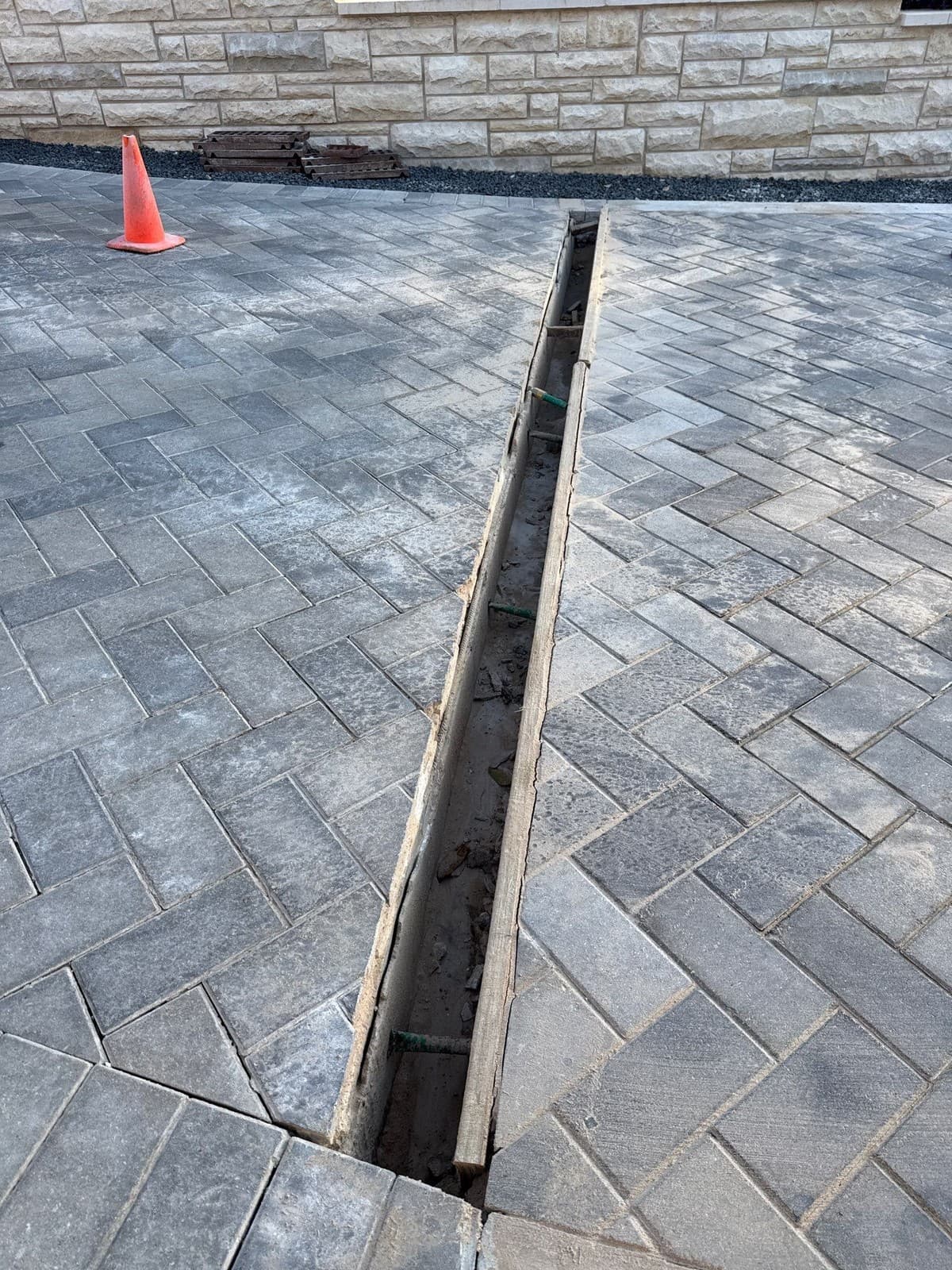
Standard residential patio: 6 inches of compacted crushed limestone. That is the baseline. But Central Texas clay soils compress differently than sandy soils in other regions. If you are in an area with expansive clay — and most of Central Texas qualifies — consider 8 inches as your standard, especially for patios over 400 SF.
Here is the math for base material:
- SF × depth (inches) ÷ 12 = cubic feet of base needed
- Cubic feet × 1.35 (compaction factor) = cubic feet to order loose
- Divide by 27 for cubic yards, then convert to tons (limestone is roughly 1.4 tons/CY)
Example: A 400 SF patio at 8-inch base depth needs 400 × 8 ÷ 12 = 267 cubic feet loose, times 1.35 = 360 CF, divided by 27 = 13.3 cubic yards = about 18.5 tons. Call it 19 tons on your material order. That is a specific number you can price — not a guess.
"If you can not name the tonnage before you bid, you are not estimating — you are hoping."
Labor Rate: What Your Crew Actually Costs Per Hour
Most contractors bill labor at $65–$90 per man-hour all-in, depending on market and crew experience. That number must include payroll taxes, workers comp, benefits (even if minimal), and a share of vehicle costs. If you are paying a crew member $22/hour in wages, your fully-burdened cost is closer to $33–$38/hour. Know your real number.
For a 400 SF paver patio with a 3-man crew: expect 14–18 man-hours for base prep, 10–14 hours for paver installation (running bond, standard access), and 4–6 hours for cleanup, edge detail, and polymeric sand. That is 28–38 man-hours total. At $80/man-hour all-in, you are looking at $2,240–$3,040 in labor cost alone.
Production rates matter here. A skilled two-man paver team can lay 250–350 SF/day in a running bond pattern. That number drops to 180–250 SF/day for herringbone. Build your labor estimate from production rates, not from guessing how many days a job will take.
Markup: What Percentage to Charge
Targeting 40–55% gross margin on paver jobs is reasonable for a well-run operation. That means if your total cost to deliver the job is $8,500, your invoice should be $14,100–$18,900 depending on market competitiveness and your overhead load.
Do not confuse markup with margin. A 50% markup on cost gives you a 33% gross margin. To hit 40% gross margin, your markup needs to be 67%. This distinction costs contractors money every year.
Stop estimating from memory
Build paver estimates in minutes, not hours.
Ledge has assembly-based estimating built in — enter your square footage and the formula handles base, sand, pavers, and labor. No more spreadsheet math or forgotten line items.
Book a Demo →Frequently Asked Questions
What is the average cost per square foot for a paver patio?
Installed cost runs $18–$28/SF for most residential paver patios in Central Texas. Standard concrete pavers in a running bond pattern come in at the lower end. Travertine-look pavers in a complex pattern with poor site access push toward the top. The range is wide because material selection and site conditions swing costs significantly — always build your estimate from your actual supplier pricing, not published averages.
How much base material does a paver patio need?
Standard residential installs call for 6 inches of compacted crushed limestone base, plus 1 inch of bedding sand. In expansive clay soil, use 8 inches of base. Multiply your square footage by your base depth in feet, then add 35% for compaction factor. That gives you the loose cubic feet to order. Divide by 27 for cubic yards, then by 0.74 to convert to tons for limestone.
How do I account for paver waste and cuts?
Add 10% waste for straight running bond patterns. Bump to 15% for 45-degree diagonal cuts, and 20% for patterns around curves, pools, or irregular shapes. These percentages cover cuts at borders and damaged pieces. Under-ordering to save money on material often costs more in labor when the crew sits waiting for a second delivery.
How many square feet of pavers can a two-man crew install per day?
A skilled two-man crew lays 250–350 SF/day in running bond on a prepared base. Herringbone or diagonal patterns drop that to 180–250 SF/day because of additional cuts. Complex patterns with lots of soldier courses around curves can fall below 150 SF/day. Always build your labor estimate from production rates tied to the specific pattern — not from how many days you think a job will take.
Should I include sealer in my paver patio estimate?
Price it as an optional line item, not a buried cost. Offer wet-look sealer and natural-finish sealer as two options with clear pricing per square foot. Clients who want it will add it. Clients who do not still see you have thought through the full job. Never absorb sealer cost into your base labor rate — it is a real expense that erodes margin every time.
Edgar Galindo
Co-founder, Ledge
Edgar built Ledge while running a landscape design-build company in Central Texas. He has priced hundreds of paver jobs — and learned most of these lessons the expensive way.