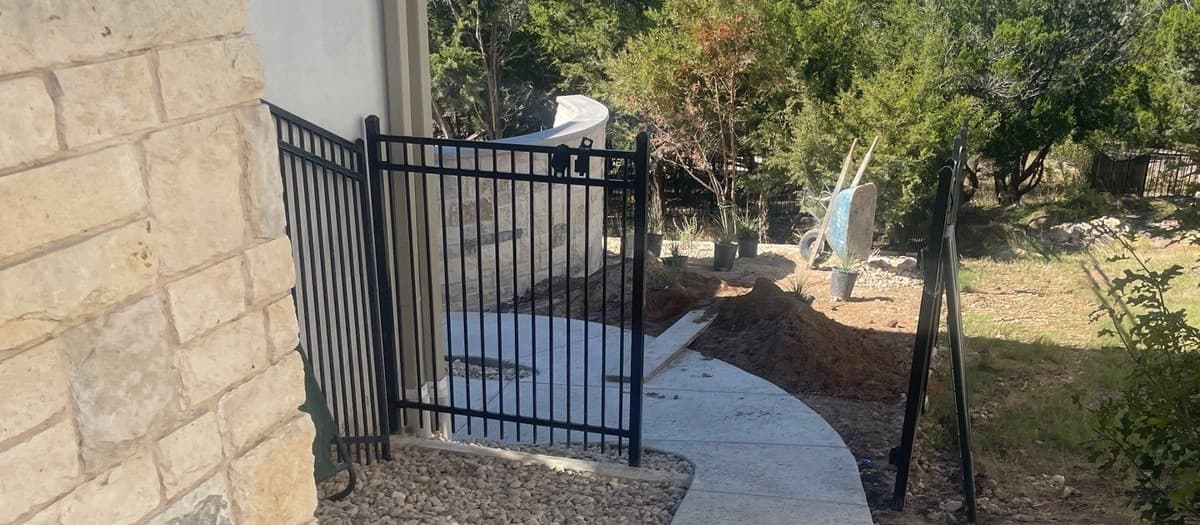
A sagging gate is almost always a post problem or a hinge problem. Here's how to set gate posts correctly and choose hardware that holds up under daily use.
Gates are one of the most complained-about items in residential fencing. The fence looks great. The gate sags, drags, or won't latch. The client isn't mad about the fence — they're annoyed every time they walk through the gate.
Gate installation failures almost always start with the post. Undersized posts, shallow footings, or soft concrete that didn't cure properly before the gate was hung. Get the post right first. The hardware selection is important, but hardware can't compensate for a post that moves.
Gate Post Sizing: Why 3.5" x 3.5" Is the Standard
Gate posts carry dynamic load — every swing of the gate applies torque to the hinge post and impact load to the latch post. Line fence posts don't see this. Gate posts need to be significantly heavier.
For single-swing pedestrian gates (3–4 feet wide, up to 6 feet tall): 3.5" x 3.5" square tube at 11 gauge minimum. This is the standard for residential steel gate posts. Anything smaller will flex noticeably under a heavy gate's swing load.
For double-drive gates (8–16 feet total opening, vehicle access): 4" x 4" or larger square tube, or use a 4" round pipe post. These posts carry much more cantilever load — the gate panel hangs off them like a lever arm. Don't undersize them.
For wood fencing with wood gates: 6x6 pressure treated posts for gate posts, minimum. 4x4 wood is not adequate for gate load.
Footing Depth for Gate Posts
Gate post footings must be deeper than line fence post footings. The rule: footing depth equals 40% of total post length, minimum. For a 3.5" x 3.5" post with 6 feet above grade, that's a minimum 36-inch footing — but 42–48 inches is better in Central Texas clay.
Hole diameter: 10–12 inches minimum for a 3.5" gate post. Use a minimum of two 80-lb bags of concrete per gate post — more if the soil is soft or sandy. In clay soil that expands seasonally, a properly sized footing prevents the post from rocking as the clay moves.
Cure time is non-negotiable. Set gate posts, let the concrete cure for 48–72 hours before hanging any gate. Hanging a gate on fresh concrete — even fast-setting concrete — adds load before the footing has developed full strength. The post may look plumb when you leave but will shift under load within weeks.
Hinge Selection and Placement
For steel gates: weld-on butt hinges or heavy-duty strap hinges rated for the gate weight. Always verify the hinge rating — a 4-foot by 6-foot steel gate can weigh 80–120 lbs. Use hinges rated for at least 150% of actual gate weight.
- Weld-on butt hinges: Strongest connection, cleanest look. Weld directly to the gate frame and post. Use 3/8" or 1/2" steel hinge bodies for gates over 50 lbs. Space hinges at top, bottom, and middle for gates taller than 5 feet.
- Adjustable weld-on hinges: Allow 3-axis adjustment after installation. More expensive but worth it for heavy gates or installations where exact plumb is hard to guarantee. Ability to adjust without cutting and re-welding saves significant field time.
- Bolt-on hinges: Use only for temporary installations or lightweight decorative gates. Bolt connections in steel tube walls will loosen over time from gate vibration.
Hinge placement: top hinge 6–8" from top of gate frame. Bottom hinge 6–8" from bottom of gate frame. Middle hinge (if needed) centered. This distribution minimizes torque at each hinge point.
"We switched to adjustable hinges on all steel gates over 60 lbs. A 15-minute post-installation adjustment is easier than a callback six months later when the gate is dragging the concrete."
Anti-Sag Cables and Bracing for Wide Gates
Any gate wider than 4 feet needs an anti-sag brace. Gravity acts on the free (latch) end of the gate, pulling it down and away from the post. Without bracing, even a well-built gate will sag measurably within a year.
Anti-sag cable: a turnbuckle and cable system running from the top hinge corner diagonally to the bottom latch corner, passing through the gate frame. Tighten the turnbuckle to take up sag. This system works on both wood and steel gates.
For steel gates, a diagonal tension tube (steel bar welded from top hinge corner to bottom latch corner) provides a cleaner, more rigid anti-sag solution than a cable. It's part of the gate fabrication — not a retrofit — and eliminates the need for a separate cable and turnbuckle.
Latch Hardware and Self-Closing Options
Standard residential gate latches: double-bar cane bolt with a key-lockable handle. Mount on the inside face of the gate, out of reach for small children on pool fences (required by code in Texas for pool gates).
Self-closing hinges (spring-loaded) are required for pool gates per the International Swimming Pool and Spa Code, adopted in most Texas municipalities. If the fence encloses a pool, any gate in the fence must self-close and self-latch, with the latch positioned to prevent child access. Verify local requirements — Austin, San Antonio, and Houston all have adopted these standards with local amendments.
Estimate gate and fencing jobs faster with Ledge
Gate hardware, post concrete, panel materials — line it all out in one clean proposal clients can approve on the spot.
Frequently Asked Questions
Why does my gate swing open or closed on its own?
The hinge post is not plumb. A post that leans even 1/4" out of plumb creates a consistent gravitational pull that causes the gate to drift open or closed. Check the post plumb in two directions (toward the fence line and perpendicular to it) and shim or brace accordingly. If the post is set in concrete that's already cured, you may need to cut the post free and reset.
How do I adjust a steel gate that's sagging?
If you used adjustable hinges: use the adjustment bolts to raise the latch corner. Loosen the set screws, rotate the adjustment nut to lift the free corner, re-tighten. If you used non-adjustable welded hinges, the fix is an anti-sag cable and turnbuckle, or in severe cases, cutting and re-welding the hinges at a corrected angle.
What gap should I leave between the gate and the ground?
2" minimum clearance from the bottom of the gate to finished grade for standard residential gates. Pool gates require no more than 4" clearance at the bottom to prevent child access. If the grade changes across the gate opening, the clearance measurement is taken at the highest point of grade along the gate path.
Can I hang a gate from a fence panel post instead of a dedicated gate post?
No. Fence panel posts are sized for static panel load, not dynamic gate load. Using a line post as a gate post will cause the post to lean over time. Always set dedicated gate posts with appropriate sizing and footing depth. The cost difference between a 2" and 3.5" post is minimal compared to a callback to reset a leaning gate post.
How long between setting gate posts and hanging the gate?
48 hours minimum for standard concrete mix, 24 hours for fast-setting concrete (Quikrete Fast-Set) in temperatures above 50°F. In cold weather (below 40°F), standard concrete needs 72+ hours and should be protected from freezing. The extra day of wait prevents half the gate callbacks we see.
Edgar Galindo
Co-founder, Ledge
Edgar built Ledge while running a landscape construction company in Central Texas. He writes about installation techniques, estimating, and building a profitable field operation.