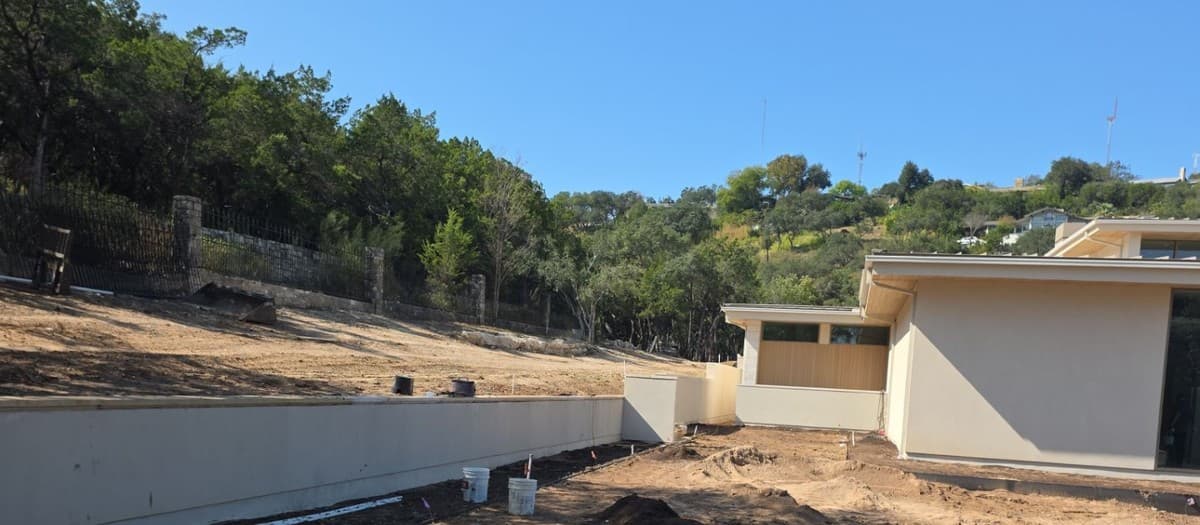
Walls over 4 feet are a different animal. The soil pressure they resist is not linear — it grows with height. Get an engineer, understand the reinforcement options, and build it to last.
A 3-foot retaining wall holds back roughly 450 pounds of soil pressure per linear foot. A 6-foot wall holding the same soil type doesn't hold back 900 pounds — it holds back significantly more, because soil pressure increases with depth at a non-linear rate. This is why walls over 4 feet require engineering input, not just extra blocks.
The 4-Foot Rule and Why It Exists
Most Texas municipalities require an engineer's stamp for retaining walls with exposed face heights over 4 feet. Some jurisdictions set this at 3 feet. The threshold exists because above that height, soil pressure becomes high enough that standard residential installation methods are no longer reliably safe without engineering input.
Before bidding any wall over 3 feet, pull a permit or confirm local code. An unpermitted wall that fails can create significant liability — especially if it is adjacent to a structure, a pool, or property that belongs to a neighbor. The engineering fee is small relative to the total project cost and protects both you and the client.
What Engineers Look For
A geotechnical or structural engineer reviewing a tall retaining wall will evaluate three failure modes: overturning (the wall tipping forward at the base), sliding (the wall shifting horizontally along its base), and bearing failure (the foundation soil compressing under the wall weight).
For segmental block walls, engineers typically specify one or more reinforcement systems — geogrid, deadman anchors, or both — plus drainage requirements, base dimensions, and block type. The block manufacturer's engineering guides (Allan Block, Belgard, Versa-Lok all publish these) give you a starting framework, but a licensed engineer must stamp the drawings for permit purposes.
Engineers will also assess surcharge loads — what sits behind the wall at the top. A driveway behind a wall creates vehicle load surcharge. A pool creates water pressure surcharge. A structure close to the top of the wall adds structural surcharge. Each of these increases the design loads and may change the reinforcement requirement.
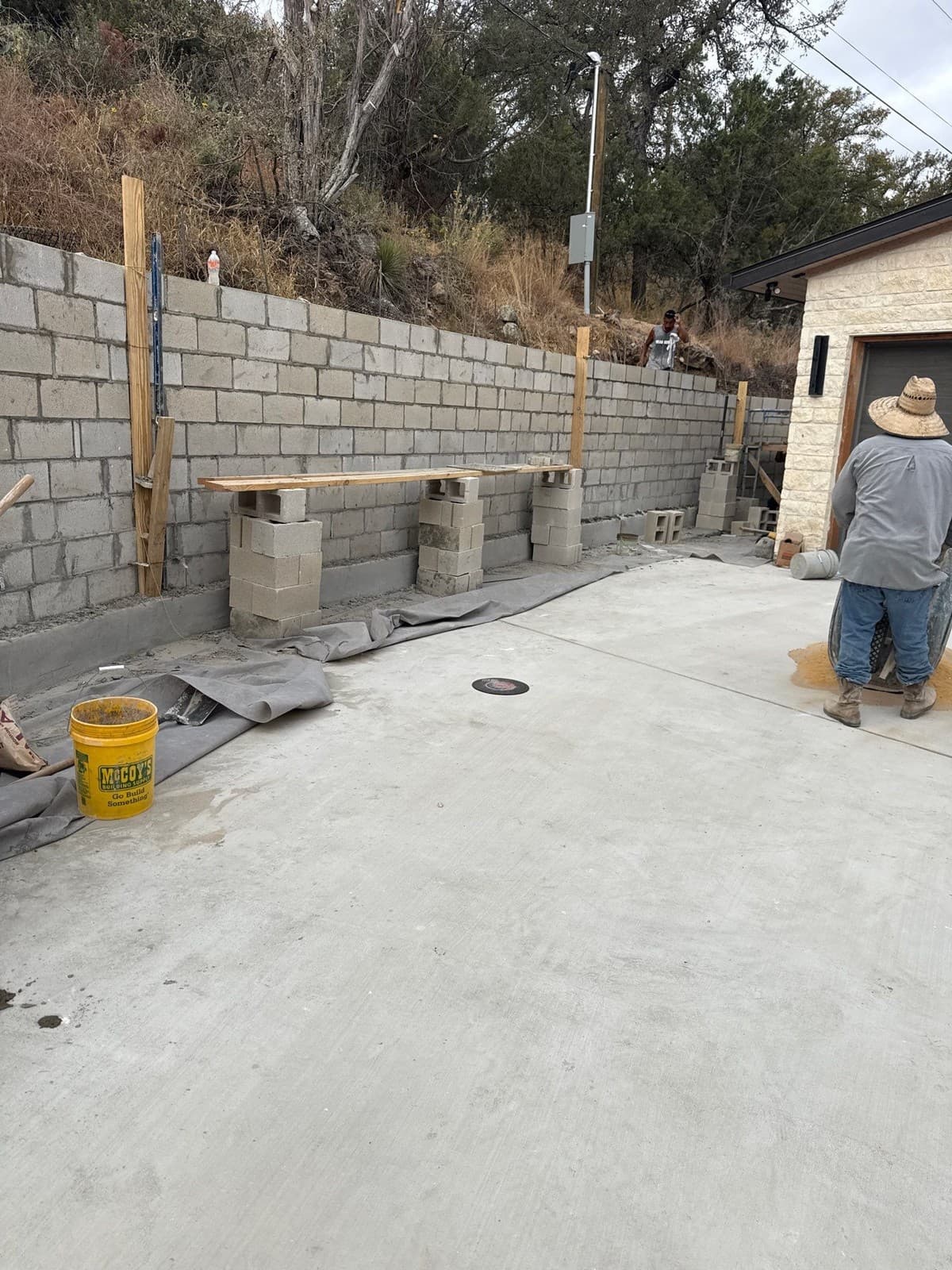
Geogrid: How It Works and When It Is Specified
Geogrid is a polymer mesh embedded horizontally into the soil mass behind the wall. It works by creating a reinforced soil zone — the grid grabs the soil particles and prevents the soil from sliding forward toward the wall face. The wall becomes part of a composite system rather than a standalone structure resisting all the load itself.
Geogrid layers are typically installed every 2–3 feet of wall height, starting within the first 24 inches from the base. Each layer extends back into the reinforced zone — minimum 4 feet, often 6–8 feet depending on wall height and soil conditions. The grid must be placed on a level, compacted surface and anchored at the face by the block course above it.
Tensar, Mirafi, and Huesker all make geogrid products used in residential retaining walls. The block manufacturer's engineering guide will specify a compatible geogrid product and the embedment length by wall height. Do not substitute a lighter grid than specified — grid tensile strength is the design variable.
"Geogrid doesn't make the wall stronger — it makes the soil mass behind the wall stronger. You're not just building a wall, you're building a reinforced earth system."
Deadmen Anchors: The Timber Wall Approach
Deadman anchors are used primarily in timber and railroad tie wall construction rather than segmental block. A deadman is a timber piece (or block unit in some systems) installed perpendicular to the wall face, running back into the soil mass. It acts as an anchor, tying the wall face back to the soil so the wall cannot tip forward.
For timber walls, deadmen are typically installed every 4–6 feet horizontally and every 2 courses vertically. They should extend at least 4 feet back from the wall face. The connection between the face timber and the deadman is critical — use heavy-duty galvanized spikes or threaded rod, not standard nails.
Modern segmental block systems have largely replaced timber walls in landscape construction because of the superior long-term performance and the availability of geogrid reinforcement options. Timber walls rot over 15–20 years. Block walls, properly built, last indefinitely.
Tiered Walls: An Alternative to Single-Tall Walls
When site conditions allow, building two or three shorter tiered walls is often preferable to a single tall wall — both from a structural standpoint and a permit standpoint. A single 8-foot wall requires engineering and significant reinforcement. Two 4-foot walls separated by a terrace of adequate width can each be permit-exempt in many jurisdictions.
The key to tiered wall design is horizontal setback between tiers. A general rule: the setback between the top of the lower wall and the face of the upper wall should be at least equal to the height of the lower wall. So a 3-foot lower wall needs at least 3 feet of flat terrace before the upper wall starts. Without adequate setback, the upper wall's soil load acts directly on the lower wall and the combined system requires engineering treatment.
Build complex hardscape estimates without the headache
Ledge handles multi-tier walls, geogrid quantities, and drainage materials in one estimate. Send a professional proposal before you leave the site visit.
Frequently Asked Questions
What does a structural engineer cost for a retaining wall review?
Expect $500–$2,000 for a residential retaining wall engineering review and stamped drawings, depending on wall complexity and local market rates. Pass this cost to the client as a line item. Clients who understand why it is required (code compliance, liability protection, resale value) rarely push back on it.
How many layers of geogrid does a 6-foot wall need?
Typically 2–3 layers for a 6-foot wall, placed at specific heights determined by the engineering analysis. A common configuration is layers at 2 feet and 4 feet from the base, sometimes with a third layer near the top. The block manufacturer's engineering guide provides starting points, but the engineer will calculate final spacing based on soil conditions and surcharge loads.
Can I build a tall wall without geogrid if I use heavier blocks?
No. Block weight is not a substitute for reinforcement. The limiting factor on tall walls is soil pressure acting against the wall face and the potential for the wall to overturn or slide. Heavier blocks do add some resistance to sliding, but the geometry of the problem still requires reinforcement beyond a certain height. Let the engineer specify the solution.
What soil types are hardest for tall wall design?
Expansive clay is the most challenging. Clay generates significantly higher lateral earth pressure than sandy soils because of its expansion-contraction cycle and its tendency to retain water. Sites with saturated clay behind a wall create both lateral earth pressure and hydrostatic pressure simultaneously. On clay sites, engineers often specify more geogrid layers, wider drainage aggregate zones, and more robust drainage pipe systems.
Edgar Galindo
Co-founder, Ledge
Edgar built Ledge while running a landscape construction company in Central Texas. He writes about installation techniques, estimating, and building a profitable field operation.