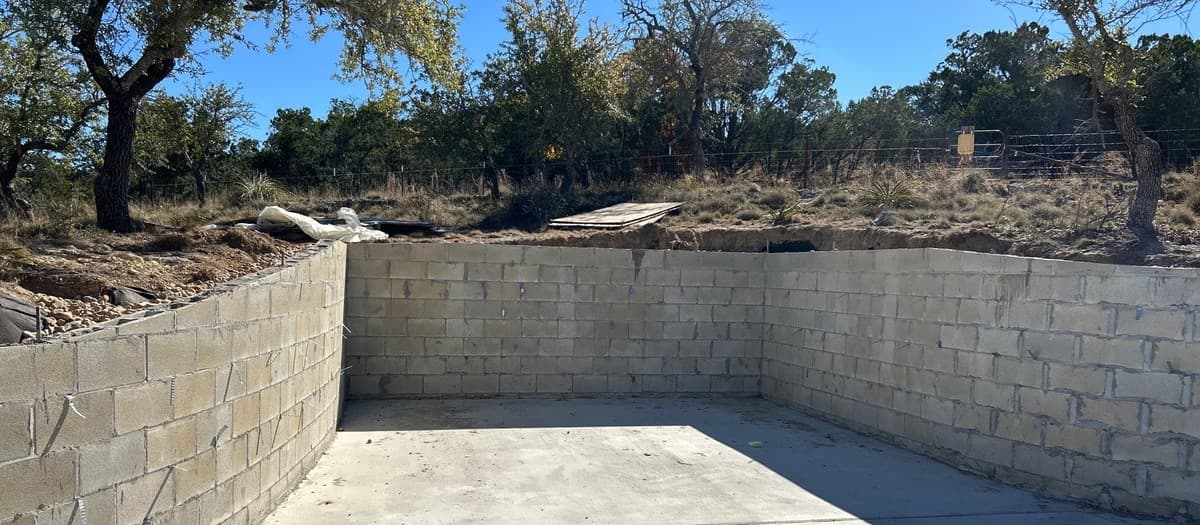
A retaining wall that moves in year two was built wrong in year zero. The base trench, drainage layer, and batter angle are not optional — they are what keeps tons of soil in place for decades.
Most failed retaining walls were not under-built in terms of block quantity. They were under-built in terms of drainage. Water trapped behind a wall generates hydrostatic pressure — and hydrostatic pressure is what pushes walls over. Every step in this process is designed to get water out from behind the wall before it builds pressure.
Before You Start: Height Limits and Permits
This guide covers walls up to 4 feet of exposed face height — the limit at which most municipalities require an engineer's stamp. Over 4 feet, you need a structural engineer involved. That is not a recommendation; it is code in most Texas jurisdictions. Check with your local building department before you start any wall over 3 feet.
The 4-foot rule measures the exposed face of the wall, not including the buried course. A wall with 4 feet of visible face and 8 inches of buried base course stands at 4 feet 8 inches total — still within most permit-exempt limits. Confirm your local rules before assuming.
Step 1: Excavation and Base Trench
Excavate the base trench to a depth of at least 6 inches below finished grade at the front of the wall, plus an additional inch for every foot of wall height. For a 3-foot wall, excavate to at least 9 inches below grade. The buried first course is what gives the wall its footing resistance against forward movement.
Trench width should be at least as wide as your block, plus 12 inches behind for drainage aggregate. For a standard 12-inch-deep block like Belgard's Celtik Wall or Allan Block, your trench needs to be at least 24 inches wide. More room behind for drainage is always better.
In clay soil, excavate a bit wider than you think you need. Clay can heave in wet conditions and exert lateral pressure on your drainage aggregate. Giving yourself more aggregate depth behind the wall gives that aggregate more room to do its job.
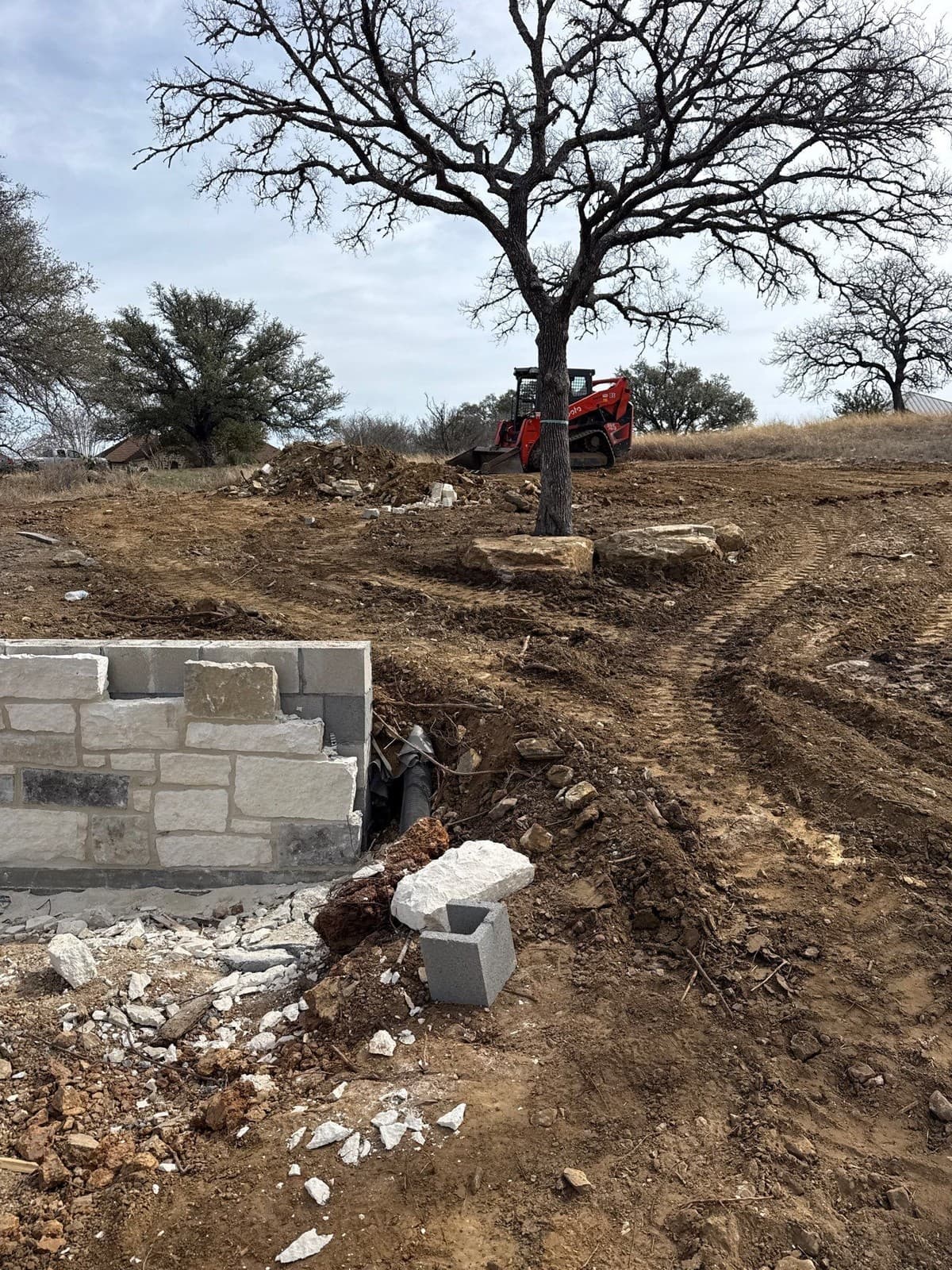
Step 2: Base Course — Leveling and Compaction
Place 6 inches of compacted 3/4-inch crushed aggregate in the base trench. This is your leveling pad. Do not use sand here — sand in a trench becomes a mud bath the first time it rains. Crushed aggregate stays stable and provides drainage under the first course.
Set the first block course on the compacted aggregate, checking level both along the wall and front-to-back. This first course must be perfectly level — every course above it will follow. Take your time here. A slight lean or twist in the base course becomes obvious and hard to correct by the fourth course up.
Bury the first course to at least 1 inch below finished grade in front of the wall. On sloping terrain, you may need to step the base course down the slope. Step in full-block increments — do not try to split the difference with partial burial.
Step 3: Batter and Setback
Batter is the slight backward lean of the wall face — each course sets back slightly from the one below. Most segmental retaining wall blocks (Belgard, Unilock, Anchor Block) have a built-in setback engineered into the block face. Allan Block, for instance, has approximately a 12-degree batter built into the block geometry. You do not calculate batter manually — you follow the block manufacturer's spec.
The setback shifts the wall's center of gravity back toward the soil mass, which helps resist overturning. A wall built perfectly vertical has no this advantage and is structurally weaker. Never fight the block's built-in setback by trying to push courses forward for a more vertical look — that removes a key design feature.
"The drainage behind the wall is the job. The block is just the face that holds the drainage aggregate in place."
Step 4: Drainage Layer Installation
Backfill behind the wall with a minimum 12-inch layer of clean 3/4-inch crushed aggregate — not soil, not pea gravel, and not concrete sand. The drainage aggregate must extend from the base trench up to within 12 inches of the top of the wall. The top 12 inches can be compacted native fill or topsoil once your final course is set.
Install a perforated drain pipe (4-inch NDS or ADS corrugated pipe works fine) at the base of the wall, inside the drainage aggregate. Wrap the pipe in filter sock to prevent fines from migrating in and clogging it over time. Drain the pipe to daylight at each end of the wall — never dead-end it. Water flowing into the drain needs somewhere to go.
Separate the drainage aggregate from the native soil with non-woven geotextile fabric on the soil-facing side. This prevents fine particles from migrating into the aggregate and clogging the drainage column over time. Without it, even good drainage rock turns into a saturated mass within a few years in clay soil.
Step 5: Coursing Up and Cap Installation
Build courses up in the block's running bond pattern, staggering joints from course to course. Backfill and compact behind the wall every two courses — do not wait until the wall is fully built. Uneven backfill pressure on a tall, unbraced wall can push it out of alignment or cause the front face to blow out.
Compact the backfill in 6-inch lifts using a plate compactor, but stay at least 3 feet away from the wall face when compacting. Too close and you risk pushing the wall forward. Hand-tamp the last 18–24 inches near the wall face.
Cap blocks are typically glued to the top course with landscape block adhesive (Loctite PL 500 or similar). Use a zig-zag bead of adhesive and set the cap with a consistent 1/8-inch overhang on the front face. Wipe any adhesive squeeze-out immediately — it does not clean up well after it cures.
Estimate retaining wall jobs without the spreadsheet
Ledge calculates block count, base aggregate, drainage pipe, and labor for retaining wall estimates. Get to a proposal in minutes, not hours.
Frequently Asked Questions
What block brands work best for residential retaining walls?
Belgard, Anchor Block (parent of Allan Block), and Unilock all make quality segmental retaining wall products. In Central Texas, Belgard has strong regional distribution. Allan Block has an excellent engineering guide available for free on their website that covers wall design up to 6 feet. All three manufacturers publish installation guides specific to each product.
Do I need a drain pipe for walls under 2 feet?
Short walls with good natural drainage on either end can sometimes skip the pipe, but the drainage aggregate is still required. If there is any doubt about how water moves behind the wall, install the pipe. The cost of 4-inch perforated pipe is trivial compared to the cost of rebuilding a wall that failed due to hydrostatic pressure.
Can I build a retaining wall on clay soil?
Yes, but drainage is even more critical. Clay holds water, which means hydrostatic pressure builds faster behind walls on clay sites. Use the full 12-inch drainage aggregate column, include the perforated pipe, and separate all aggregate from native clay with non-woven geotextile fabric. Drainage is what keeps clay-backed walls standing long term.
How far from the wall can I compact the backfill?
Stay at least 3 feet away from the wall face with a plate compactor or jumping jack. Closer than that, the vibration and lateral force from compaction can push the wall forward or cause blocks to shift out of alignment. Use a hand tamper or roller within 3 feet of the wall face.
Edgar Galindo
Co-founder, Ledge
Edgar built Ledge while running a landscape construction company in Central Texas. He writes about installation techniques, estimating, and building a profitable field operation.