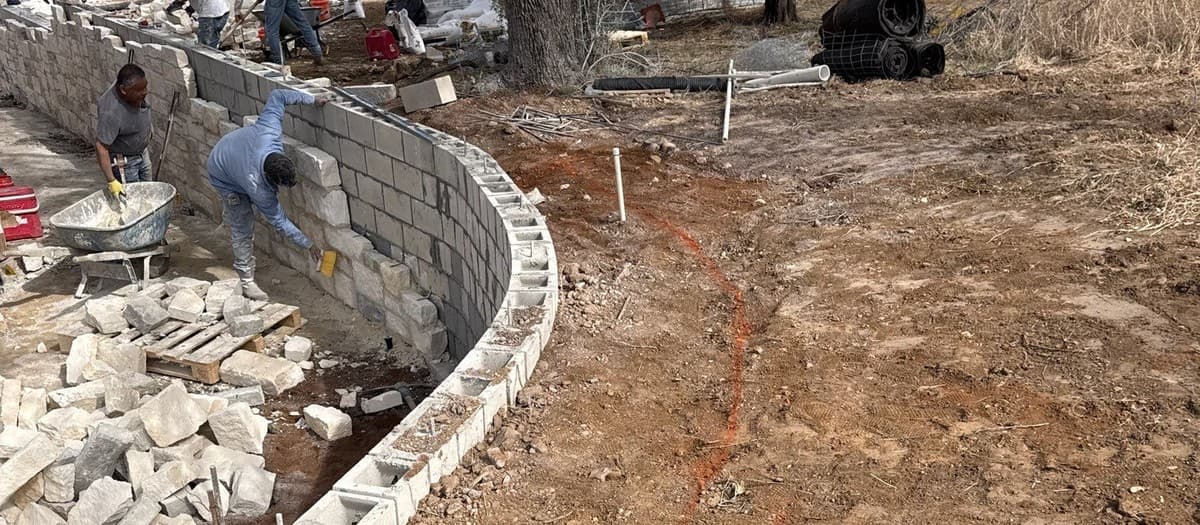
Natural stone walls look like they belong on the land. Concrete block walls are faster to build and easier to engineer. Neither is universally better — the right choice depends on height, budget, and site.
Clients often come in with a picture from Instagram showing a beautiful dry-stack limestone wall and ask you to build it. That is a conversation worth having before the estimate, because the wall in the picture may have taken three times as long to build as a comparable concrete block wall — and that time difference shows up in the price. Knowing when each material makes sense is part of delivering good work at prices that win jobs.
Natural Stone: The Case For
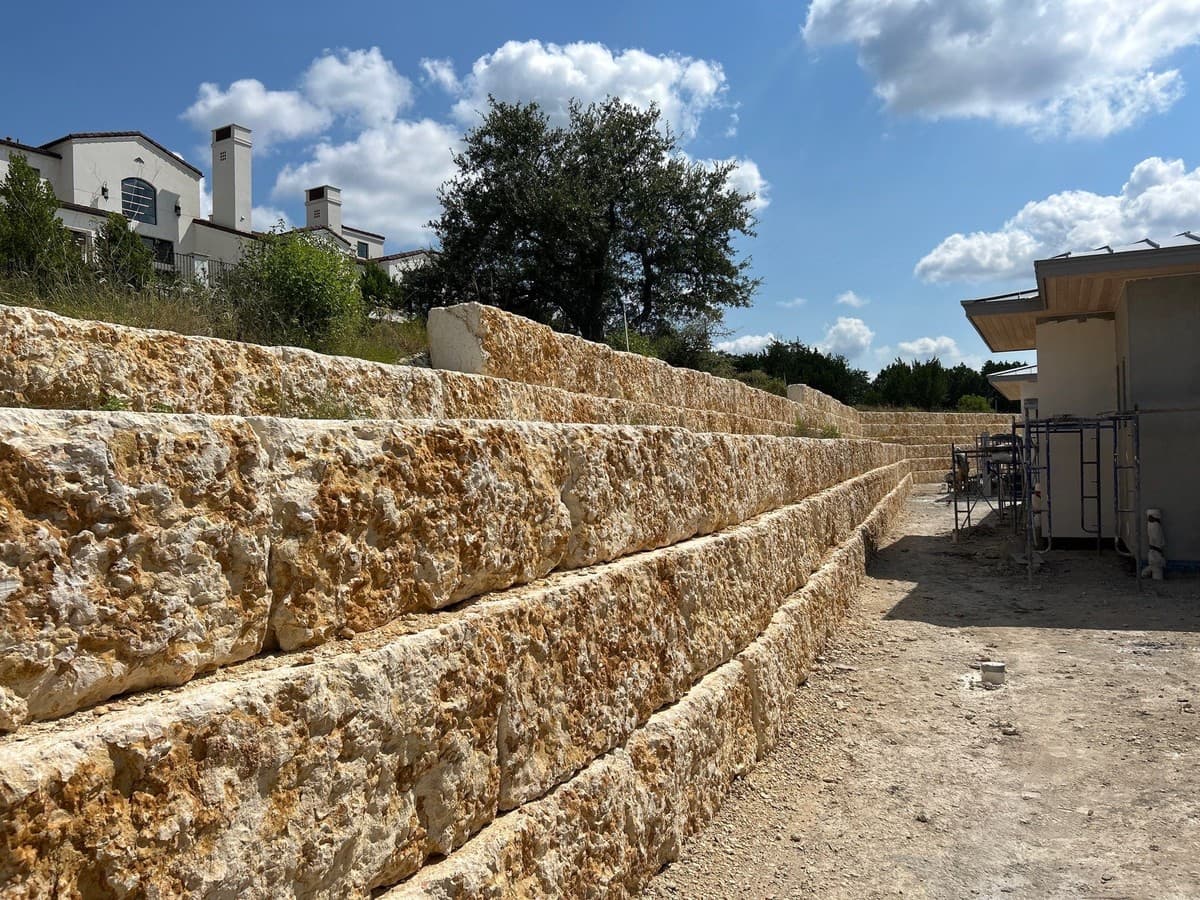
Natural stone walls — dry-laid limestone, Lueders stone, Austin stone, Oklahoma flagstone — have an organic quality that no concrete product fully replicates. The color variation, the texture, the way a well-built dry-stack wall looks like it grew out of the hillside: these qualities are genuine and valued by clients who care about aesthetics.
In Central Texas, locally quarried limestone is culturally appropriate and blends naturally with the Hill Country aesthetic. Clients in Westlake, Dripping Springs, and Wimberley often specifically request stone walls, and the material fits the land. It is also genuinely durable — well-built dry-stack limestone walls have stood in Texas for over 100 years.
For walls under 2 feet, dry-stack natural stone is a competitive option and does not require engineered drainage systems in the same way that taller walls do. The open joints in a dry-stack wall drain naturally. This makes short decorative walls a good application for stone.
Natural Stone: The Case Against
Natural stone is labor-intensive. Every stone is irregular. Selecting, fitting, and placing stone — especially for a dry-laid wall with good face presentation — takes significantly more skill and time than setting manufactured block. On a 100-linear-foot wall, the labor difference between dry-stack stone and concrete block can be 30–50%.
Material cost is also unpredictable. Stone is priced by the ton, and yield varies by stone type and wall thickness. Quarry prices fluctuate, delivery costs add up, and waste (breakage, rejection of pieces that don't fit) can run 15–25%. Estimating stone walls requires field experience — you cannot calculate them from a spec sheet the way you can a manufactured block system.
For walls over 3 feet, engineered natural stone systems exist but are less common in residential work. Most tall natural stone walls are actually concrete block walls with a stone veneer face — which gives the aesthetic of stone with the engineered performance of block. This is worth understanding when a client wants a tall stone wall but the engineering requirement is unavoidable.
Concrete Block: The Case For
Manufactured segmental retaining wall block (Belgard's Celtik Wall, Versa-Lok, Allan Block) is engineered from the start. The block dimensions are exact and consistent. The setback is built into the geometry. The engineering guides specify geogrid spacing, drainage requirements, and maximum wall heights. You build to the spec sheet and the system performs as tested.
Speed of installation is the other major advantage. Experienced crews can set concrete block walls significantly faster than dry-stack stone. The consistency of the units means less time fitting and selecting. On high-volume or time-sensitive projects, block is the practical choice.
Modern block textures have improved considerably. Belgard's tumbled and split-face products, Techo-Bloc's aged textures, and Unilock's natural-look lines all produce walls that are visually competitive with stone, especially when combined with natural stone caps or planting pockets. The gap in aesthetics has narrowed.
"A concrete block wall with a Lueders cap and some planted pockets often satisfies the client who came in asking for a stone wall — at a price they can actually afford."
When to Specify Each Material
Use natural stone when: the wall is under 2–3 feet, the client has a high budget and strong aesthetic preference for natural material, the site has abundant local stone that reduces material cost, or the design requires a curved or flowing wall where the organic shapes of stone are an advantage rather than a problem.
Use concrete block when: the wall exceeds 2 feet, engineering requirements apply, the project timeline is tight, the design calls for precise geometry, or the budget requires cost efficiency without sacrificing structural performance.
Consider a hybrid approach — concrete block structure with stone veneer or stone cap — when the client wants the aesthetic of stone on a wall that exceeds dry-stack height limits. This is the most practical solution for many upscale residential projects.
Price stone and block retaining walls accurately
Ledge keeps your material unit costs and labor rates so every retaining wall estimate is consistent and profitable. No more guessing on tonnage calculations.
Frequently Asked Questions
How much more expensive is a natural stone wall than block?
On a per-square-foot-of-wall-face basis, natural stone walls typically run 30–60% more than comparable concrete block walls when you account for labor, material, and waste. The exact premium depends on stone type, local availability, and crew skill. Locally quarried limestone in Central Texas narrows the gap compared to imported stone.
Does a dry-stack stone wall need drainage?
Short dry-stack walls (under 2 feet) drain through their open joints naturally and typically do not need engineered drainage systems behind them. Taller dry-stack walls (2–4 feet) should still have drainage aggregate behind them. Once you get to walls where engineering is required, drainage is mandatory regardless of wall material.
What stone types are best in Central Texas?
Austin limestone and Lueders limestone are both locally quarried, readily available, and perform well in the Texas heat. Oklahoma flagstone is commonly used for caps and accent pieces. Lueders is denser and more uniform than Austin stone, making it easier to work with for wall construction. Austin stone has more color variation and is more distinctively Texas Hill Country in appearance.
Can I mix stone and block in the same wall?
Yes. Block structure with stone veneer is common and works well. The block provides the structural system and geogrid attachment points; the stone face provides the aesthetic. The block must be sized to accommodate the veneer thickness so the finished face is at the correct location relative to the finished grade.
Edgar Galindo
Co-founder, Ledge
Edgar built Ledge while running a landscape construction company in Central Texas. He writes about installation techniques, estimating, and building a profitable field operation.