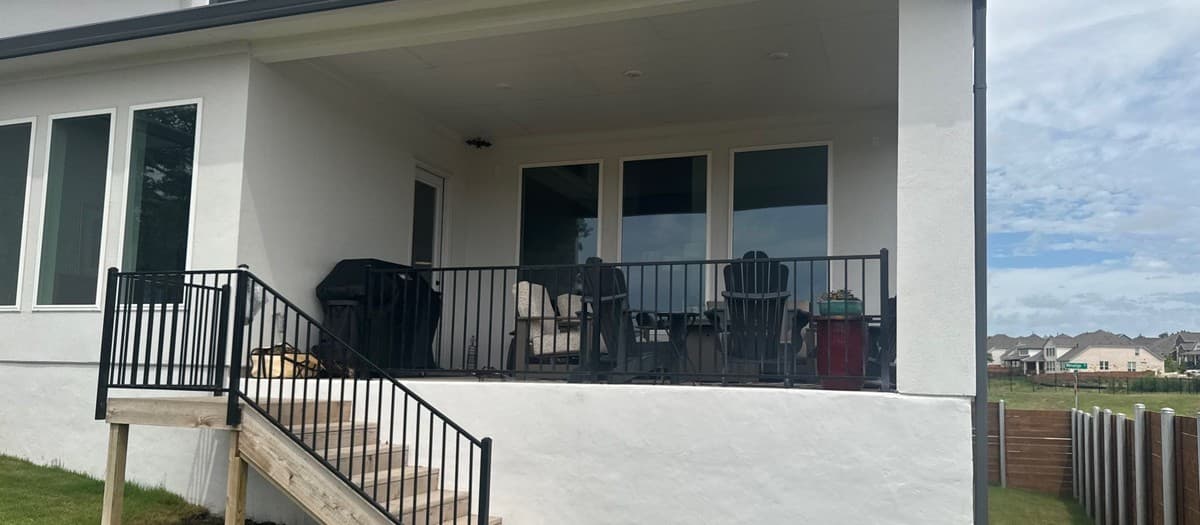
Deck failures — squeaks, bounce, rot, collapsed railings — almost all trace back to framing errors made on day one. Here's the sequence that produces a solid, code-compliant deck.
Deck work requires precision that most landscape crews aren't used to. The tolerance you have on a grading job doesn't exist on a framing job — a ledger that's half an inch low throws the entire deck height off, and an undersized beam that bounces under load is a liability problem, not just an annoyance. Build it right structurally and the decking and finish work go fast.
Footings: Depth, Diameter, and Concrete Spec
Footings are the foundation of the whole deck. In Central Texas, frost depth is not a significant design driver — the primary concern is bearing capacity in expansive clay soil. Use 12-inch diameter sonotubes for most residential deck posts. For decks carrying significant point loads — a heavy pergola, a spa, or a large built-in grill — use 16–18 inch diameter footings.
Footing depth: 24 inches below grade minimum in Austin-area clay. Some jurisdictions require 18 inches; check local code. The bottom of the footing should be in undisturbed soil, not fill. If you're building on a slope where cut and fill occurred, go deeper until you hit native soil.
Use 3,500 PSI concrete minimum for footings. Mix your own (a bag mix is fine for small projects) or order ready-mix for larger decks. Set a Simpson Titan HD or equivalent standoff post base in the wet concrete centered on the footing. This elevates the post bottom off the footing surface to prevent moisture wicking into the end grain — the primary source of post rot at grade.
Footing layout: use batter boards set outside the deck footprint and string lines to establish the footings in a square layout. Check square with the 3-4-5 method (or 6-8-10 for larger decks). A deck that's not square cannot be corrected at the decking stage — you'll have parallelogram-shaped boards at the edges that look wrong forever.
Ledger Attachment: The Most Important Connection on the Deck
The ledger connects the deck to the house and carries half the deck's load. Ledger failures — pulling away from the house under load — cause more deck collapses than any other structural failure. This connection has to be done correctly and is what permits are mostly checking.
Attach the ledger to the house rim joist or structural framing — not to siding, stucco, sheathing, or brick veneer alone. Remove siding in the ledger area, install flashing, then bolt through the sheathing into the rim joist. Use 1/2-inch galvanized lag screws or through-bolts at the spacing required by code (typically 16 inches on-center in two staggered rows, or per the span tables in IRC 2021).
Ledger height: the top of the ledger should sit at a height that puts the finished decking surface 1–2 inches below the interior floor threshold. This prevents water intrusion into the house. Never set the deck surface flush with the interior floor without a proper threshold and waterproofing detail.
Beams, Posts, and Joist Sizing
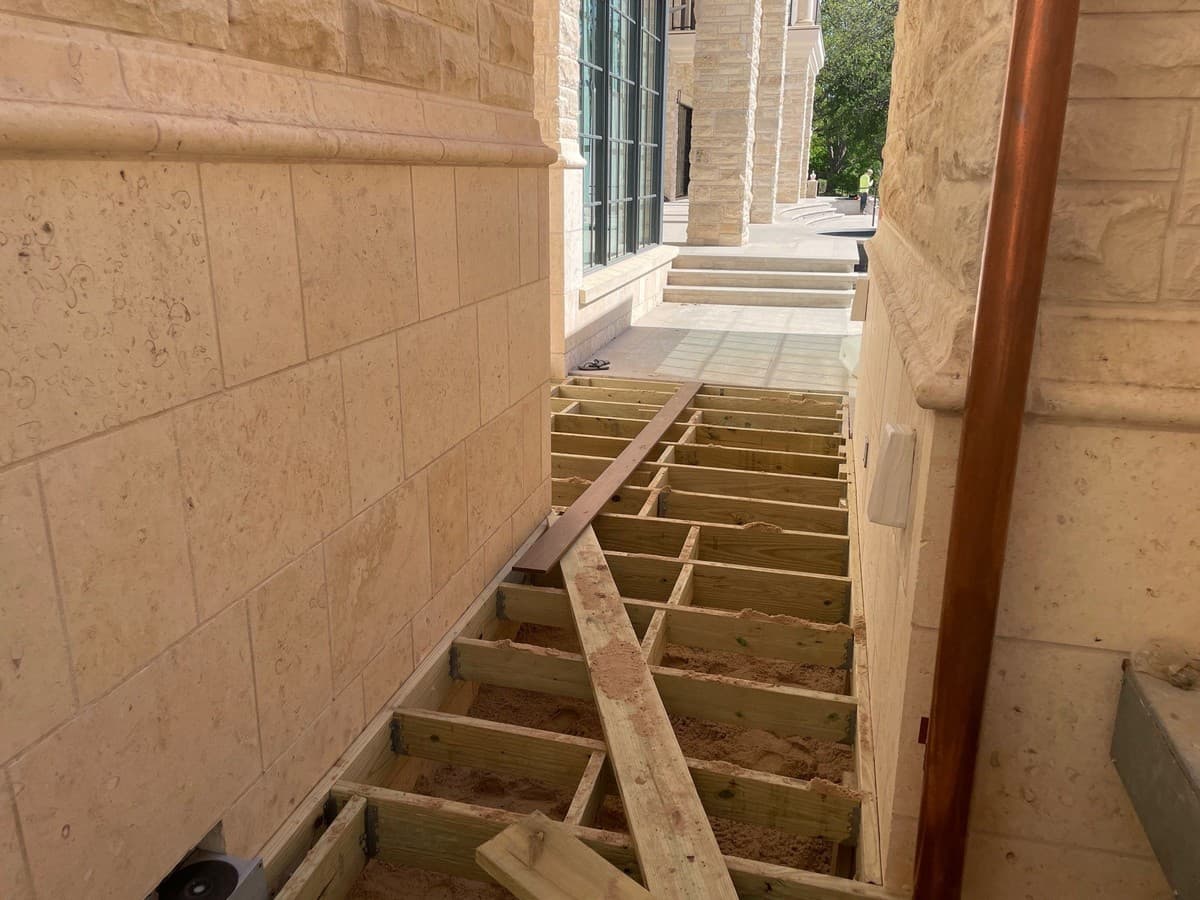
Size beams and posts from the span tables in the IRC or from an engineer's calculation for anything over a simple configuration. For a typical residential deck with 12-foot joist spans:
- Joists at 16" OC: 2x10 PT for spans up to 14 feet. 2x8 PT for spans up to 11 feet. Use doubled joists at stair openings and for heavy point loads.
- Beam under joists: For a 12-foot joist span at 8-foot post spacing, use a tripled 2x10 or a 4x10 PT beam minimum. Check span tables for your exact configuration.
- Posts: 4x4 PT for decks less than 8 feet tall, 6x6 PT for decks 8 feet and above or for any deck supporting a pergola or overhead structure.
All lumber should be pressure-treated .40 PCF for ground contact components (posts, beams near grade). Use stainless steel or hot-dip galvanized fasteners throughout — standard zinc-plated fasteners corrode at the contact point with PT lumber within 3–5 years and cause structural failure.
Install joist hangers (Simpson LUS or equivalent) at every joist-to-ledger connection and at joist-to-beam connections where joists don't rest on top of the beam. Use all specified nails — joist hanger failures almost always trace back to installers using too few nails or the wrong size.
"Every fastener matters on a deck. A joist hanger with half the nails it needs holds until the day it doesn't. That's not a callback — that's a lawsuit."
Decking Installation: Layout, Gap, and Fasteners
Start the decking layout from the house and work out. The first board goes against the ledger (or at a consistent reveal from the house wall). Snap a chalk line and keep the first course straight — everything subsequent follows it.
Spacing between PT decking boards: 1/8 inch for wet lumber (PT is often wet when delivered), or 1/4 inch for dry lumber or composite decking. This gap allows water to drain and prevents boards from cupping when they expand. Use a 16d nail as a consistent spacer.
Fastener options:
- Face screws (structural screws): Fastest installation. Use 3-inch #10 stainless or coated deck screws. Two screws per board at each joist crossing. Pre-drill near board ends to prevent splitting. The visible screw pattern is not ideal for premium installs but is standard practice.
- Hidden fasteners (Ipe Clip, Camo, Tiger Claw): No visible hardware on the decking surface. More labor-intensive — roughly 30–40% more installation time — but results in a clean surface and prevents face checking (surface cracks that open at screw holes over time). Standard on composite and hardwood decking.
Mark the joist locations on the rim joist before decking so you can chalk a string line across each joist and keep screws in a straight line. Off-line screws look sloppy and clients notice.
Railing: Code Requirements and Post Attachment
Decks 30 inches or more above grade require a guardrail. IRC code requirements for residential railings:
- Minimum height: 36 inches for decks less than 6 feet above grade; 42 inches for decks 6 feet and above
- Maximum baluster spacing: 4 inches (a 4-inch sphere cannot pass through)
- Top rail must support 200 lbs of lateral force without movement
- Post spacing: typically 6 feet maximum for structural posts
Post attachment is where most railing failures happen. Never attach railing posts only to the decking surface — they need to connect through the decking to the rim joist or framing below. Use Simpson ABA or equivalent post-to-rim hardware, or through-bolt posts with 1/2-inch galvanized bolts through the rim joist. A railing post attached only to the decking boards with lag screws will fail under a 200-lb lateral load test.
For composite railing systems (Trex Transcend, TimberTech), follow the manufacturer's installation guide exactly — they're engineered systems with specific post mounting requirements, and warranty is void if not installed per spec. These systems look significantly better than wood railings and price accordingly.
Frequently Asked Questions
How deep should deck footings be in Central Texas?
24 inches below grade minimum, in undisturbed native soil. Some jurisdictions require 18 inches. Use 12-inch diameter sonotubes for standard residential decks. Set adjustable post bases in the wet concrete to keep post bottoms elevated off the footing surface.
How do you attach a deck ledger to the house?
Remove siding in the ledger area, install proper flashing, then lag bolt or through-bolt through sheathing into the rim joist at 16 inches on-center in two staggered rows. Never attach to siding, sheathing, or stucco alone — the ledger must connect to structural framing.
What fasteners should I use on a pressure-treated deck?
Stainless steel or hot-dip galvanized throughout — decking screws, joist hanger nails, and structural fasteners. PT lumber has copper compounds that corrode standard zinc-plated fasteners within 3–5 years. Stainless or HDG lasts the life of the structure.
What are the railing height requirements for a residential deck?
36 inches minimum for decks less than 6 feet above grade. 42 inches for decks 6 feet and above. Maximum baluster spacing is 4 inches. Railing posts must be attached to structural framing — not just decking boards — and must resist 200 lbs of lateral force.
What size joists do I need for a 12-foot deck span?
2x10 PT at 16 inches on-center handles spans up to 14 feet comfortably. 2x8 PT handles up to 11 feet. Check IRC span tables for your specific wood species, lumber grade, and load requirements. When in doubt, size up — the material cost difference is small and the structural margin matters.
Price Deck Projects With Confidence
Ledge lets you build deck estimates with framing, decking, railing, and finishing as separate line items — so your proposals reflect real costs and you protect your margin on every project.
Edgar Galindo
Co-founder, Ledge
Edgar built Ledge while running a landscape construction company in Central Texas. He writes about installation techniques, estimating, and building a profitable field operation.