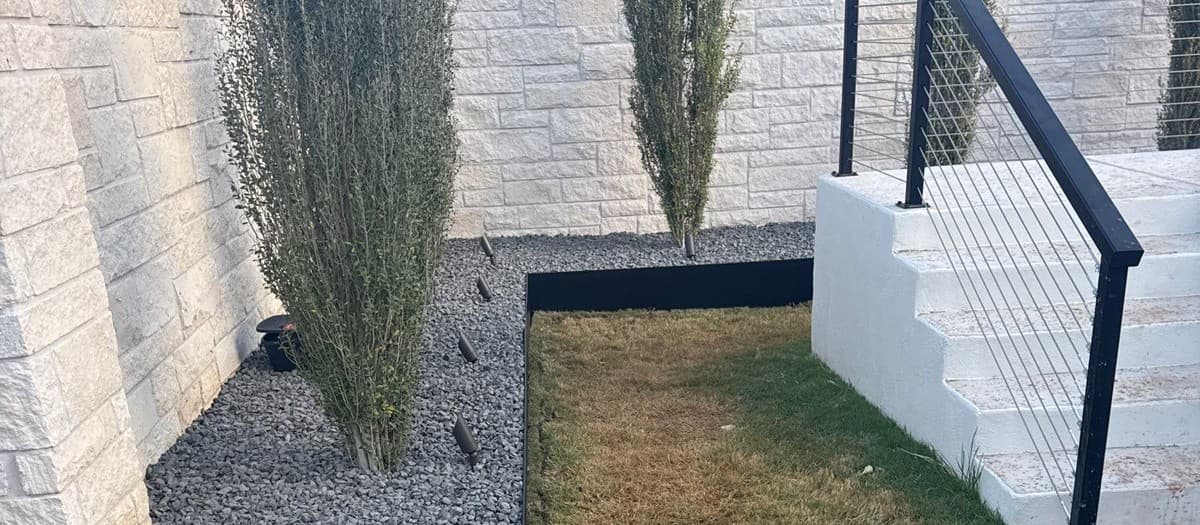
Steel edging that heaves out of the ground in the first season or kinks on curves is almost always a staking or burial problem. Here's how to install it so it stays put.
Steel edging is one of those details that's cheap to do right and expensive to redo. A bed edge that looks sharp the day of install and then starts waving around like a garden hose after the first freeze-thaw cycle is not an aesthetic failure — it's an installation failure. Get the depth, the stake spacing, and the connections right the first time.
Steel Edging Gauge and Profile Selection
Professional steel landscape edging comes in two primary gauges for residential use: 3/16-inch (14 gauge) and 1/8-inch (16 gauge). Use 3/16-inch for all exterior bed perimeters, tree rings, and anywhere edges will be visible. The 1/8-inch stock is appropriate for interior separation of bed areas where it won't be heavily viewed or traffic-stressed.
Standard height for residential edging is 4 inches above grade, requiring 6-inch stock so you have 4 inches exposed and 2 inches below grade — or more commonly 4-inch stock buried with only 1 inch above grade for a near-invisible separation line. The choice depends on the aesthetic. A bed that's built up 4 inches above turf grade needs taller edging to contain the soil.
Brands worth using: Permaloc, EasyFlex, and ColourRail. Avoid thin-gauge aluminum sold at home improvement stores — it kinks on curves and degrades faster. Cor-Ten (weathering steel) is a premium option that develops a controlled rust patina and looks excellent in modern residential design.
Burial Depth and Stake Spacing
The industry standard for 3/16-inch steel edging is 4–6 inches below grade. This depth prevents heaving from freeze-thaw in cold climates and prevents the edging from being lifted out by aggressive mowing along the edge. In Central Texas, where freezing is rare, 3–4 inches minimum is acceptable. For areas with occasional hard freezes, go 5–6 inches.
Stake spacing determines how well the edging holds its shape. Use stakes every 24 inches along straight runs. On curves, reduce to every 12 inches. On tight curves (radius under 18 inches), stake every 8 inches. Insufficient staking on curves is the most common reason edging migrates and loses its line over time.
Drive stakes through the stake holes on the bottom lip of the edging at a slight angle — 10–15° tilted away from the bed side. This locks the edging from lifting. Stakes driven straight down can be pulled loose by freeze-thaw action or accidental prying from the mower.
Bending Curves: Technique and Minimum Radius
Steel edging bends by hand for gentle curves. Lay the stock flat on the ground and gradually work the curve with your hands, walking along the piece and bending incrementally. For sharper curves, place the edging against a round form — a tree trunk, a large PVC pipe section, or a curve guide — and press it around the form.
The minimum practical radius for 3/16-inch steel without kinking is approximately 18 inches. Tighter than that and you'll get kink points even with careful bending. For very tight curves — tree ring circles, small accent beds — consider thinner aluminum bender board or switch to pre-formed flexible aluminum edging that's designed for radii down to 6 inches.
Use a bed edger or a half-moon edging spade to cut the slot for installation. The slot should be just wide enough for the edging to slide in without excessive force. If you're fighting to get it in, the slot is too tight and you'll distort the edging. Too wide and it won't be secure before staking.
"Steel edging is a 20-year install if you do it right the first time. The extra 10 minutes to stake properly saves you a callback on every job."
Inside Corners, Outside Corners, and Connections
Inside corners (concave) are easier — the edging bends toward you as you install it. Cut a small notch (1–2 inches) in the bottom lip at the corner to allow the edging to fold without buckling.
Outside corners (convex) require a relief cut on the top lip. Cut a V-notch in the top edge at the corner point — about 1 inch deep and 1 inch wide. This allows the edging to fold outward cleanly. Without the V-notch, you get a kink that looks like a crinkle in the finished edge.
Connect sections with the manufacturer's couplers or with overlapping the pieces 3–4 inches and driving a stake through both. Never leave a butt joint without a mechanical connection — it will open up as the ground moves. On quality installs, connect with a stake through the overlap plus a dab of construction adhesive on the overlap before staking.
Finishing: Height Above Grade and Mulch Relationship
The top of the edging should be flush with or slightly above turf grade — typically 1/2 to 1 inch above turf to create a crisp line visible from the lawn side. This height also allows a mower wheel to ride along the top of the edging without scalping the lawn.
After mulching, the bed surface should be at or slightly below the top of the edging. If you mulch 3 inches deep and the edging is only 1/2 inch above turf grade, mulch will spill over the edge constantly. Either use taller edging, reduce mulch depth at the perimeter, or accept that the mulch will need to be raked back periodically.
Frequently Asked Questions
How deep should steel landscape edging be buried?
4–6 inches below grade is the professional standard for 3/16-inch steel. In Central Texas where hard freezes are infrequent, 3–4 inches minimum is acceptable. Deeper burial prevents heaving and edging migration over time.
How far apart should edging stakes be spaced?
Every 24 inches on straight runs. Every 12 inches on curves. Every 8 inches on tight curves with radius under 18 inches. Reduce spacing whenever the edging will experience higher stress from mowing or soil movement.
What gauge steel edging should I use?
3/16-inch (14 gauge) for all exterior and visible bed edges. It holds curves better, resists bending under mower contact, and lasts decades. Brands: Permaloc, EasyFlex, ColourRail. Skip thin aluminum from home improvement stores.
How do you make inside and outside corners with steel edging?
Inside corners: cut a notch in the bottom lip to allow folding. Outside corners: cut a V-notch in the top edge 1 inch deep and 1 inch wide at the corner point to allow the edging to fold outward cleanly without kinking.
Build Edging Into Every Bed Estimate
Ledge lets you add edging as a linear foot line item with your material cost and labor rate. Quote it right the first time and protect your margin on every bed install.
Edgar Galindo
Co-founder, Ledge
Edgar built Ledge while running a landscape construction company in Central Texas. He writes about installation techniques, estimating, and building a profitable field operation.