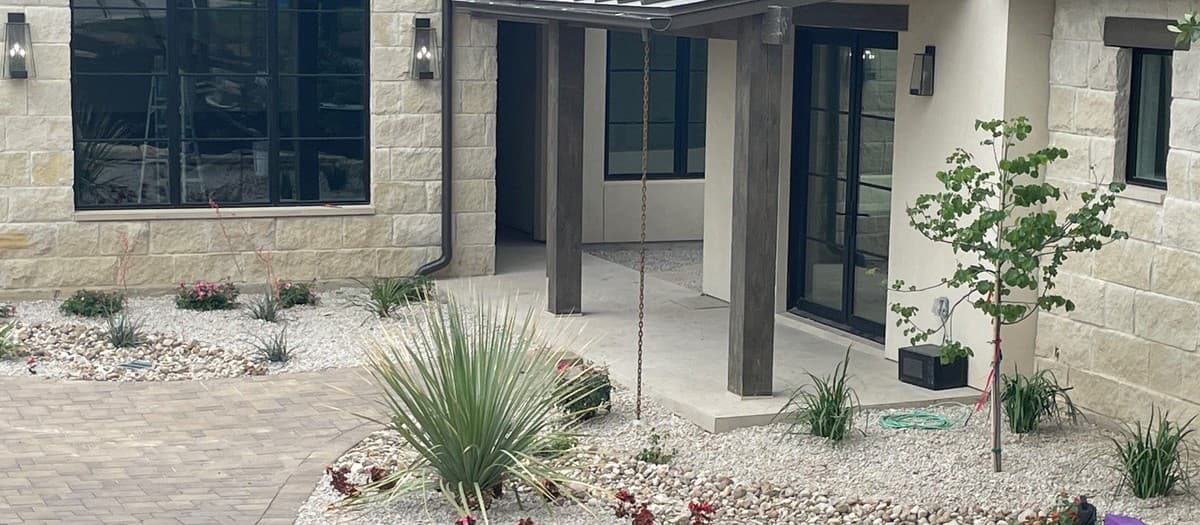
A dry creek bed that looks like a drainage ditch is a design failure. A dry creek bed that moves water invisibly and looks like it belongs is a $4,000 upsell. Here's how to build the second one.
Drainage problems are the entry point for this conversation. The client has a low spot, a soggy corner, or water that runs across the lawn every time it rains. You can solve the drainage and make it look like a feature rather than a utility fix. When the design is right, the creek looks like it's always been there.
Planning the Route: Slope and Outlet
Before you design the aesthetics, solve the hydrology. Identify where the water is coming from (the high point) and where it needs to go (the outlet). The outlet must daylight — it has to reach a point where water can exit the property: a storm drain, a swale, a low point at the property line, or a rain garden.
Minimum slope for a dry creek bed that drains effectively is 2% — that's 1/4 inch per linear foot. This is enough to move water at a walking pace without so much velocity that rock washes out. On steeper grades (over 5%), you need larger rock or check dams at intervals to slow the water and prevent erosion.
Design the route with gentle curves — not switchbacks, not straight lines. Natural creek beds follow the path of least resistance through a landscape. They bend around grade changes, swing wide on slopes, and narrow as they approach outlets. Use a garden hose on the ground to mock up the route before you dig. Walk it with the client so they can visualize it.
Excavation: Width, Depth, and Cross-Section Profile
Excavate a trapezoidal cross-section — wider at the top, narrower at the bottom. A standard residential creek bed is 18–36 inches wide at the top and 8–12 inches wide at the channel bottom, with 6–10 inches of depth. The sloped sides (roughly 2:1 run-to-rise) are what make it look natural versus a drainage ditch.
The channel itself (the center trench) should be 6–8 inches deep minimum. This is where the water flows during a rain event. The berms on either side taper up to grade level. Allow the excavated soil to be used as berms alongside the creek, which naturally elevates the sides and makes the creek look like it's cutting through terrain rather than sitting flat on it.
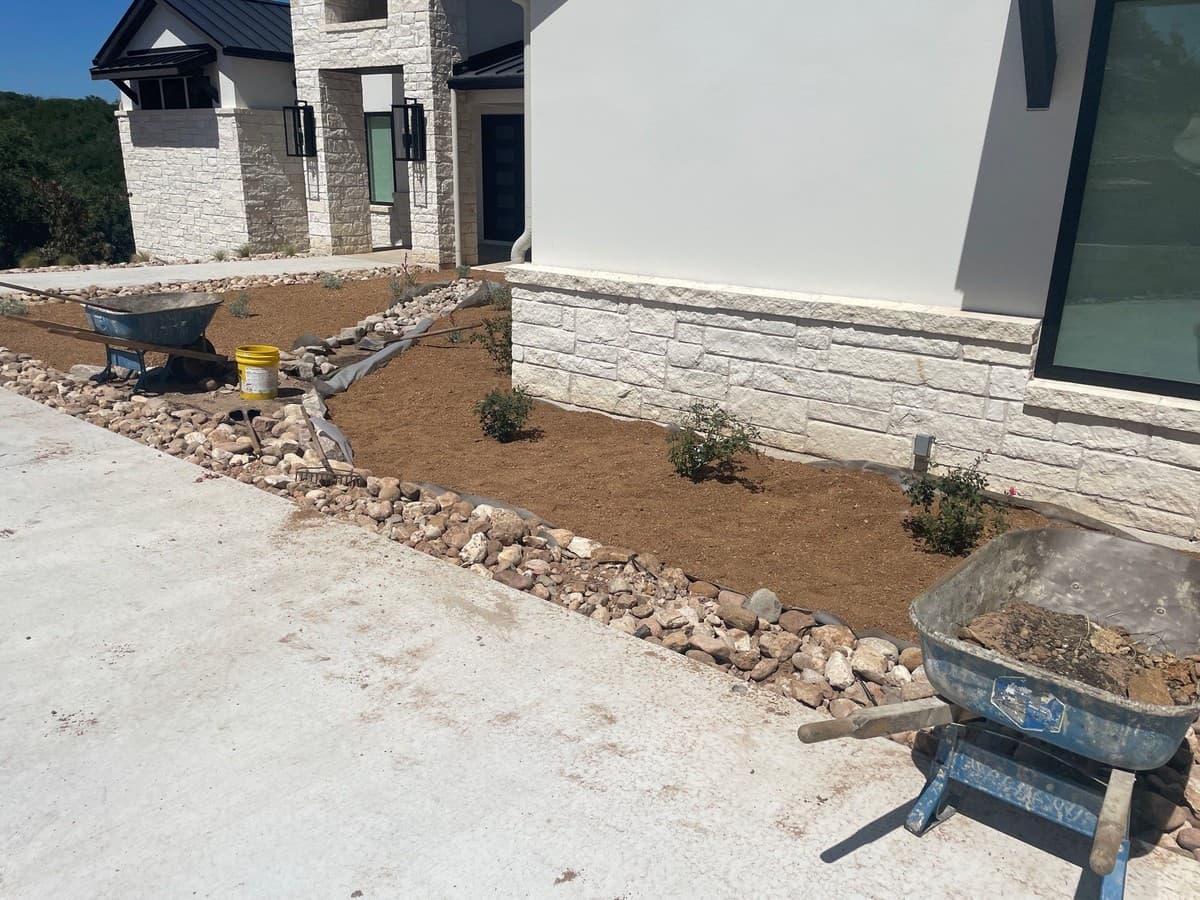
Geotextile Fabric: Specs and Installation
Line the entire excavated channel with geotextile fabric before placing rock. The fabric prevents the rock from migrating into the soil over time while allowing water to pass through. Use a woven geotextile rated for drainage applications — Mirafi 140N or equivalent. The weight should be 4+ oz/yd² for durability. Lightweight non-woven landscape fabric degrades faster and tears around rock edges.
Lay the fabric in overlapping strips across the channel, with at least 12 inches of overlap where strips meet. Pin the fabric to the excavated walls with landscape staples every 18 inches. Fold the edges up and over the berm edges — the rock placed on top will hold them in place. Don't cut the fabric flush with the trench edge; you need the overhang to contain the rock fill.
"A dry creek bed is a drainage solution sold as a landscape feature. Price it like the functional installation it is, and sell it on the curb appeal. Both are true."
Rock Selection and Sizing
Use angular washed river rock rather than round river rock in the channel. Round rock rolls during high-flow events and redistributes itself randomly. Angular rock locks together and stays put.
Sizing strategy for a natural look:
- Channel bottom: 1.5-inch washed river rock or 2-inch flagstone fragments. The main flow zone.
- Mid-channel sides: 3–5 inch cobble, placed individually to create variation and texture.
- Berm edge and transition zone: 6–12 inch boulders placed at irregular intervals. These are the pieces the eye goes to — they define the character of the creek.
- Feature boulders: 18–36 inch boulders at curves, at the outlet, and at any grade change. Place at least two-thirds of the boulder below finished surface — it should look settled, not placed.
Rock depth in the channel should be 4–6 inches minimum. Thin rock on the bottom washes out during the first heavy rain and exposes the fabric. Thicker is better — it looks more substantial and stays in place.
Plant Integration and Check Dams
Plants are what separate a creek bed that looks like a drainage ditch from one that looks like a feature. Plant native grasses, sedges, and low shrubs on the berms alongside the creek. Texas sedge (Carex texensis), inland sea oats (Chasmanthium latifolium), and Gulf Coast muhly (Muhlenbergia capillaris) all work well in Central Texas and tolerate the occasional wet-then-dry conditions next to a drainage feature.
On grades steeper than 5%, install rock check dams at 10–15 foot intervals. A check dam is a cross-channel row of larger boulders (12–18 inches) that slows the water velocity, allows sediment to settle, and prevents channel erosion. The water rises behind each dam during flow events, then spills over and continues downstream at reduced velocity.
Frequently Asked Questions
What slope does a dry creek bed need to drain properly?
Minimum 2% — that's 1/4 inch of fall per linear foot. This is enough to move water without washing rock out of the channel. On grades over 5%, install check dams every 10–15 feet to slow velocity and prevent erosion.
What size rock should I use in a dry creek bed?
Layer sizes for visual interest: 1.5-inch washed rock in the channel bottom, 3–5 inch cobble on the sides, 6–12 inch boulders at the edges, and 18–36 inch feature boulders at curves and grade changes. Mix sizes to look natural.
Do I need geotextile fabric under a dry creek bed?
Yes. Woven geotextile rated for drainage (Mirafi 140N, 4+ oz/yd²) prevents rock from migrating into the soil over time while allowing water to pass through. Use overlapping strips with 12-inch overlap and pin with landscape staples.
How wide and deep should a dry creek bed be?
For a standard residential yard: 18–36 inches wide at the top, 8–12 inches wide at the channel bottom, and 6–10 inches deep. The trapezoidal cross-section with sloped sides is what makes it look natural rather than like a utility trench.
Estimate Creek Bed Projects by the Lineal Foot
Ledge lets you break down drainage feature estimates into rock tonnage, fabric square footage, labor, and equipment — so you know your numbers before the first shovel goes in.
Edgar Galindo
Co-founder, Ledge
Edgar built Ledge while running a landscape construction company in Central Texas. He writes about installation techniques, estimating, and building a profitable field operation.