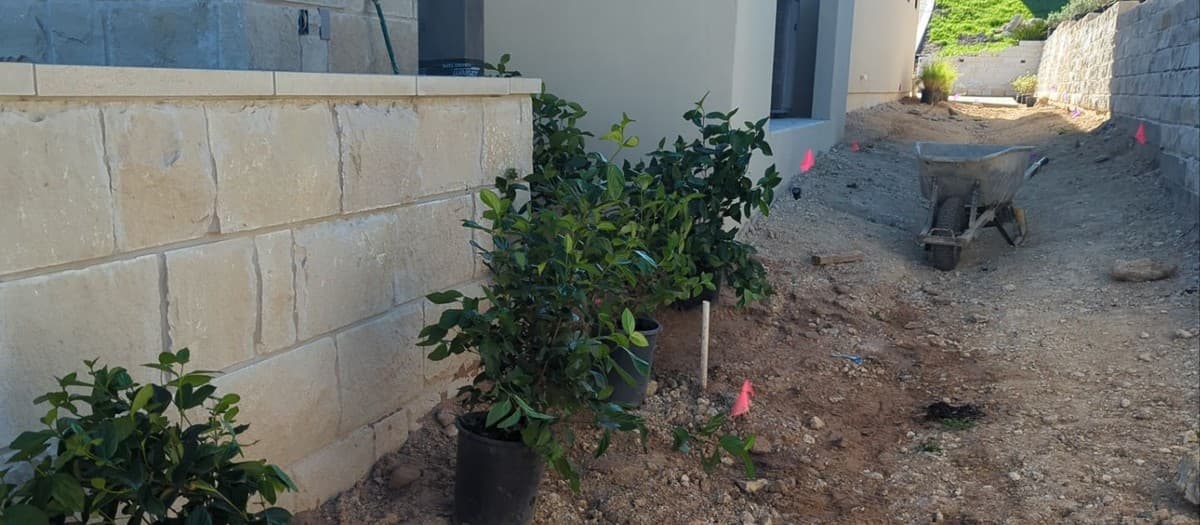
Clients want plants that look good and don't die. In Central Texas, that means native and adaptive species. Here's the list we actually install, with spacing and care notes for each.
The most common planting failure in Central Texas isn't drought. It's the wrong plant in the wrong place. Contractors who install tropical or coastal-adapted plants because they look good in the nursery end up with clients calling when the plants fry in August or freeze in February. The fix is using plants that are adapted to exactly this climate.
Native and Texas-adaptive plants are plants that have already solved the Central Texas climate problem. They've survived here for thousands of years. Below is the list we actually specify on landscape bed installations — not a comprehensive botanical guide, but the plants that work reliably in the ground in Austin, San Antonio, and the Hill Country.
Shrubs and Hedges
Texas Sage (Leucophyllum frutescens)
Size: 4–8 ft tall, 4–6 ft wide. Sun: Full sun. Water: Minimal once established — actually blooms more intensely after drought stress.
The most reliable screening shrub in Central Texas. Silver-gray foliage year-round, purple blooms triggered by humidity. Requires excellent drainage — will not survive wet feet. Space 4–5 ft apart for a mature hedge. 'Compacta' variety stays under 5 ft; standard varieties can hit 8 ft. Don't over-prune — let it grow to natural form.
Flame Acanthus (Anisacanthus quadrifidus var. wrightii)
Size: 3–5 ft tall, 3–4 ft wide. Sun: Full to partial sun. Water: Drought tolerant once established.
Hummingbird magnet. Tubular orange-red flowers summer through fall, when almost nothing else is blooming. Dies back to the ground in a hard freeze — comes back strong in spring. Don't mistake the winter die-back for plant death. Space 3 ft apart. Works as a mass planting or filler between larger shrubs.
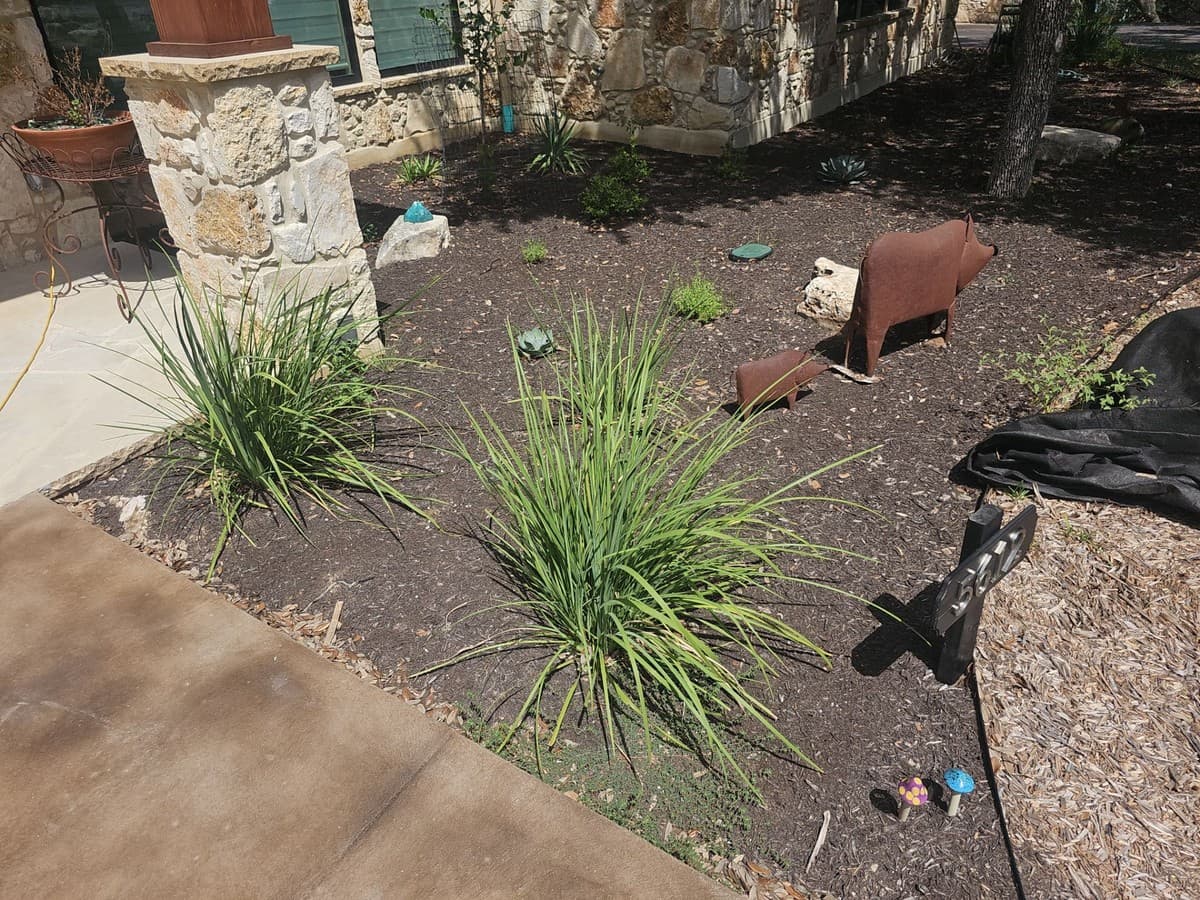
Perennials and Ground Covers
Salvia greggii (Autumn Sage)
Size: 2–3 ft tall, 2–3 ft wide. Sun: Full to partial sun. Water: Drought tolerant; light supplemental irrigation in extreme drought extends bloom season.
Available in red, pink, coral, and white. Blooms spring through fall with breaks in peak summer heat. One of the most versatile native perennials for mixed beds — pairs well with Texas Sage and ornamental grasses. Cut back by 1/3 after each bloom flush to encourage re-blooming. Full sun produces the best flowering; shade reduces bloom density.
Cedar Sage (Salvia roemeriana)
Size: 1–2 ft tall, 1–2 ft wide. Sun: Shade to partial shade. Water: Low to moderate.
One of the few native options that performs well in shade. Bright red tubular flowers in spring and fall. Works under live oaks where irrigation is limited and root competition is heavy. Spreads by self-seeding — plant it where naturalization is acceptable or deadhead regularly to control spread.
Blackfoot Daisy (Melampodium leucanthum)
Size: 1 ft tall, 1–2 ft wide. Sun: Full sun. Water: Very low once established.
White daisy-form flowers essentially year-round in Central Texas. Extremely drought tolerant — prefers neglect over irrigation. Perfect for rock gardens, dry slopes, or any spot where irrigation doesn't reach. Plant in well-drained soil; wet clay kills it quickly.
Succulents and Structural Plants
Agave (multiple species)
Size: varies by species — 1 ft (Agave parryi) to 6 ft (Agave americana). Sun: Full sun. Water: Almost none once established.
The most architectural plant in the Central Texas palette. Agave parryi (Parry's agave) stays compact at 2–3 ft and handles Hill Country freezes to 0°F. Agave ovatifolia (Whale's Tongue) is the current favorite for modern landscapes — blue-gray leaves, cold-hardy, architectural form. Space based on mature width and remember: the plant dies after flowering and produces offsets (pups) that need to be managed.
Texas Yucca (Yucca rupicola, Yucca pallida)
Size: 2–3 ft rosette. Sun: Full sun. Water: Minimal.
Native yucca species (not the tropical-looking Yucca elephantipes sold in pots) are cold-hardy, drought-proof, and contribute strong vertical form when in flower. Twisted-leaf yucca (Y. rupicola) handles clay soil better than most yuccas. White flower stalks in late spring.
"We stopped installing plants that need weekly watering in year two and started asking: 'If this client forgets to water for a month in August, does this plant come back?' If the answer is no, we find a better option."
Ornamental Grasses
Native grasses add movement, texture, and seasonal interest with almost zero maintenance. Buffalo grass (Bouteloua dactyloides) is the classic Texas native — short, fine-textured, goes dormant in winter. Works as a lawn substitute in areas where traditional turf would struggle.
For ornamental bed use: Gulf Muhly (Muhlenbergia capillaris) is the showstopper, producing clouds of pink-purple plumes in fall. Plant in mass for maximum impact — a single specimen disappears in a mixed bed. Lindheimer's Muhly (Muhlenbergia lindheimeri) stays green longer and handles part shade. Both are drought tolerant once established and require no supplemental irrigation after the first season.
Installation and Establishment Tips
Plant in fall (October–November) whenever possible. Fall establishment is easier on plants — roots grow through mild winter temperatures, and by summer the plant has had 6 months to anchor before facing its first extreme heat period.
Water new plantings every 2–3 days for the first 4–6 weeks, then weekly through the first summer. After the first full growing season, most natives need no supplemental irrigation except during extended drought (3+ weeks without rain in summer).
Mulch matters. A 3-inch layer of decomposed granite or hardwood mulch over the root zone significantly reduces soil temperature and moisture loss. In a Central Texas summer, mulch can be the difference between a plant that establishes and one that doesn't.
Build plant installation proposals in Ledge
List plants with quantities, spacing, and maintenance notes. Clients understand what they're getting, and you close faster.
Frequently Asked Questions
How do I prevent Texas Sage from getting leggy?
Don't shear it into a ball. Shearing Texas Sage forces it to produce dense outer foliage on a bare interior, leading to dieback. Instead, use hand pruners to selectively remove long stems at branch junctions once per year in late winter. This maintains natural form and prevents the leggy, bare-interior look that hard shearing creates.
What plants work in the shade of a large live oak?
Live oaks create dry shade — very little rainfall reaches the soil under a mature live oak canopy, and root competition is intense. Cedar Sage, inland sea oats (Chasmanthium latifolium), turk's cap (Malvaviscus arboreus), and heartleaf skullcap (Scutellaria ovata) are the most reliable choices in this challenging condition. Avoid plants that need supplemental irrigation — the root zone is too competitive for drip to be effective.
How cold can Agave ovatifolia handle?
Agave ovatifolia is cold-hardy to approximately 0°F (-18°C). It handled the February 2021 freeze in Austin with minimal damage — better than almost any other succulent or agave species. It's the recommended choice over Agave americana (cold-hardy to only about 15°F) for Central Texas installations.
What's the best mulch for native plant beds?
Decomposed granite for succulents, agave, and dry-adapted plants — it mimics the rocky, well-drained soil they evolved in and doesn't hold moisture against plant crowns. Hardwood mulch (shredded cedar or hardwood blend) for salvias, grasses, and most native shrubs — it decomposes slowly, adds organic matter, and suppresses weeds effectively. Don't use fresh wood chips — they tie up soil nitrogen as they break down.
Where do I source native plants in Central Texas?
Barton Springs Nursery, Native American Seed, Tillery Street Plant Company, and Red Barn Nursery (New Braunfels) are strong local sources. Call ahead on large orders — native plant availability is seasonal and stock can be limited on popular species like Whale's Tongue agave and Gulf Muhly during peak season.
Edgar Galindo
Co-founder, Ledge
Edgar built Ledge while running a landscape construction company in Central Texas. He writes about installation techniques, estimating, and building a profitable field operation.