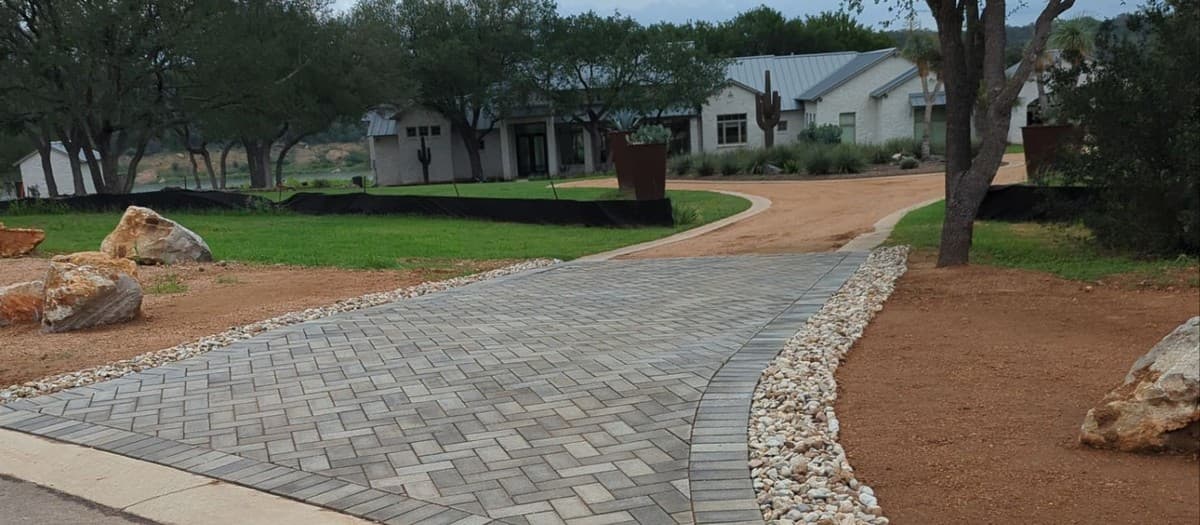
The landscape that survives a Central Texas summer isn't lucky. It's designed for it. Here's the complete approach: soil, plants, irrigation, and hardscape that work together.
Central Texas is one of the hardest landscapes in the country to maintain. You get freeze events that can drop to single digits, summer droughts that run 90 days without meaningful rain, heat that cracks paving and cooks shallow-rooted plants, and clay soil that expands and contracts with every rain cycle. Landscapes that look great at install can look terrible 18 months later.
The ones that survive aren't particularly expensive. They're thoughtfully designed. Every element is chosen for how it performs under stress, not just how it looks on day one.
Start With the Soil: What Central Texas Actually Has
Most of Central Texas sits on expansive clay soil — specifically the blackland prairie clay (Houston Black) in the eastern Hill Country approach and rocky clay over limestone in the Hill Country itself. Both create drainage challenges.
Blackland clay expands significantly when wet and contracts when dry. A 2-inch seasonal movement in the soil surface is not unusual. This movement is what cracks patio pavers, heaves retaining walls, and kills plants that can't handle root disruption. Addressing drainage and soil structure before planting is the foundational move.
For planting beds: amend the top 8–12" of soil with 4–6" of quality compost, tilled in. This doesn't fix the drainage below, but it creates a better root environment in the top layer where most plant roots spend their first two seasons. Don't add sand to clay — it creates a concrete-like mix. Compost is the correct amendment.
Drainage: The Issue Under Every Problem
Poor drainage kills more plants in Central Texas than drought does. Plants sitting in clay that holds water for 3–4 days after a rain develop root rot even in summer. Caliche layers 12–24" below grade can create a perched water table that drowns deep roots while the surface looks dry.
On any landscape project, grade the beds away from the house and toward drainage points before planting. Slope of 1% (1" per 8 feet) is minimum — more in heavy clay areas. If the existing grade ponds water after rain, address it before installing plants or hardscape.
French drains work for chronic low spots. A 4" perforated pipe in a gravel trench routed to daylight or a dry creek bed handles most residential drainage problems. The dry creek bed option doubles as a design feature — a rock-lined channel that carries water during storms and looks intentional the rest of the time.
Plant Selection: The Foundation of a Low-Maintenance Landscape
A landscape that clients can maintain without calling you every summer is the best advertisement for your work. That starts with plant selection. In Central Texas, the shortlist of plants that consistently survive extreme heat and drought without intensive irrigation:
- Texas Sage (Leucophyllum): Drought-tolerant to an extreme degree. Blooms after rains. Full sun, excellent drainage.
- Agave (ovatifolia, parryi, lophantha): Structural anchor for dry beds. Cold-hardy species handle freeze events without protection.
- Salvia greggii and Salvia farinacea: Reliable bloomers through summer. Deadhead to extend season. Hummingbird and pollinator traffic is a selling point clients notice.
- Flame Acanthus: Summer-bloomer, dies back in freeze, returns in spring. Fills mid-height gap in a layered planting design.
- Cenizo, Turk's Cap, Blackfoot Daisy: The reliable fillers that perform when nothing else will.
- Native ornamental grasses (Gulf Muhly, Lindheimer's Muhly): Fall interest, low water, adds movement and texture.
The plants to avoid or limit: non-native tropical plants (bougainvillea, croton, impatiens), high-water perennials installed without supplemental drip, and any plant that can't handle a 48-hour below-freezing event once every 3–5 years.
Irrigation Design: Water Where It Counts
A well-designed drip system is the best investment in plant survival. Spray heads waste water to evaporation in Central Texas heat and can encourage fungal issues in turf. Drip delivers water directly to the root zone, where it matters.
Separate irrigation zones by plant water needs: native/drought-tolerant plants on a zone running 1–2 times per week maximum; lawn on its own zone at appropriate intervals; any high-water plants isolated so they don't force overwatering of the rest.
A smart controller (Rain Bird, Rachio, Hunter) that adjusts watering based on evapotranspiration data pays for itself in reduced water bills within the first summer. Include it as a standard spec on any project with an irrigation system — the conversation is easy: "This controller monitors local weather and skips watering when it rains. Your water bill goes down and your plants don't get overwatered."
"The landscape that looks great in October is the one where we spent time on soil and drainage in February. You can't fix a bad foundation with better plants."
Hardscape Integration: How Paving Affects Plant Health
Hardscape adds heat. A large concrete or dark-colored paver patio radiates stored heat at night, raising soil temperature in adjacent beds. In summer, a south-facing bed next to a concrete patio can see soil temperatures 15–20°F higher than beds away from hardscape.
Design buffer beds between hardscape and main plant areas where possible. Use decomposed granite or permeable hardscape to reduce heat island effect. Light-colored concrete and limestone naturally reflect more heat than dark pavers — worth noting when clients ask about patio color selection.
Shade trees are the single most impactful element in a Central Texas landscape. A well-placed live oak or Texas red oak shades the house, reduces HVAC load, and creates microclimates where plants that would otherwise struggle can thrive. If the site allows for trees, prioritize them even if it means reducing other budget items.
Mulch, Timing, and the Long Game
A 3-inch mulch layer over all planting beds is not optional in Central Texas. It reduces soil temperature by up to 10°F, retains moisture, suppresses weeds, and adds organic matter as it breaks down. Cedar mulch is the local standard — readily available, slow to decompose, and natural in the Texas landscape context.
Timing plant installation matters as much as species selection. Fall (October–November) is the best planting window for almost everything. Plants installed in fall establish root systems through the mild winter and are ready to face summer. Spring is second best. Summer installation adds irrigation dependency and stress — charge accordingly if clients insist on summer plantings, and document the additional care requirements.
The landscape that survives Central Texas isn't built in one season. Explain the establishment timeline to clients: year one, the plants are establishing — they may look smaller or bloom less than expected. Year two, root systems are set and the plants perform. Year three, clients call you to add more. That three-year arc is the standard for native plantings here, and clients who understand it are happier clients.
Build better landscape proposals with Ledge
Estimate plants, drainage, irrigation, and hardscape in one clean proposal. Clients see the full picture. You close faster.
Frequently Asked Questions
What's the biggest mistake contractors make on Central Texas landscape installs?
Installing plants without addressing drainage first. The second biggest is using plants adapted to coastal or tropical climates that look good at the nursery but can't handle a February freeze or an August drought. Both mistakes look fine at install and fail 12–18 months later — after the warranty has expired and after the client has referred someone else (or not).
How do I spec a landscape for minimal irrigation after establishment?
Use only native or Texas-adaptive plants rated for low water use. Install drip irrigation for the first 2 years of establishment, then design the system so those zones can be turned off in year three. Include this in the client conversation: "After two full growing seasons, these plants will need supplemental watering only during extended drought — 3+ weeks without rain." Most clients appreciate the long-term cost reduction.
How do I handle client expectations about plants looking small at install?
Be explicit in the proposal. Include a note like: "Native plants are installed at 1-gallon to 5-gallon size and will appear smaller than their mature size for the first 1–2 growing seasons. This is intentional — smaller containers establish better root systems than larger ones and outperform larger transplants within 3 years." Show before/after photos from previous installs if you have them.
Does Central Texas really get freeze damage every year?
Light freezes (25–32°F) happen most winters in Austin and San Antonio. Hard freezes (below 20°F) happen every 3–5 years on average, though the 2021 event proved they can be significantly colder. Design for -5°F and you'll be prepared for worst-case. Plants listed as cold-hardy to 15°F are a gamble in Central Texas — they'll survive most years but get hit in bad ones.
How much should I charge for a full landscape design-build in Central Texas?
Full landscape design-build including soil prep, plants, irrigation, mulch, and any edging or hardscape accent work runs $8–25/SF for planting areas in the Austin/San Antonio market. Budget projects with simple native plant palettes and minimal hardscape fall at the lower end. High-design projects with specimen plants, complex grading, and integrated drip systems are at the upper range. Always estimate per project — landscape pricing varies too much for blanket per-SF rules.
What landscape maintenance contract should I offer after install?
A simple first-year establishment package works well: monthly check-in visits to adjust drip, deadhead spent blooms, and address any plant failures under warranty. Price it at $150–300/month depending on scope. It protects your installation investment, keeps you in contact with the client, and is a natural path to additional work when clients want to expand the landscape in year two or three.
Edgar Galindo
Co-founder, Ledge
Edgar built Ledge while running a landscape construction company in Central Texas. He writes about installation techniques, estimating, and building a profitable field operation.