Dry spots and soggy corners come from the same source: zones designed without matching GPM, head spacing, or plant types. Here's how to design zones that actually work.
Irrigation is one of those services that clients won't think about until something goes wrong. They don't notice the system working correctly — they notice dead grass in August and a water bill that doubled. Both failures trace back to bad zone design. Match your zone planning to the available GPM, use proper head spacing, and separate incompatible plant types. That's the whole job.
Start With Service Line GPM
Before you design a single zone, determine the flow available from the water service. Turn on the meter, close all other water uses, and measure GPM at the point of connection. Most residential services deliver 10–15 GPM at 40–60 PSI. Know these two numbers: GPM and static pressure. Design to stay within 75% of available GPM per zone so pressure loss through the pipe doesn't take you below minimum operating pressure for the heads.
Each head type has a specific GPM requirement. A Rain Bird 5000 rotor running a half-circle pattern at 35 PSI uses approximately 1.0 GPM. A full-circle runs 2.0 GPM. Hunter PGP rotors are similar. Fixed spray heads (Rain Bird 1800 series, Hunter Pro-Spray) use less — a 4-foot fixed spray at 30 PSI uses 0.19 GPM, a 12-foot spray uses around 0.62 GPM. Add up the GPM for every head you're putting on a zone and verify it stays under your 75% threshold.
The 50% Overlap Rule for Head Spacing
The single most important rule in spray head layout: head-to-head coverage. Every head should throw water to the radius of the adjacent head. This creates 100% overlap and eliminates dry strips between heads. For a Rain Bird 5000 set to a 15-foot radius, heads should be spaced no more than 15 feet apart.
Most new contractors violate this by spacing heads too far apart to save on head count. The result is a dry strip between every pair of heads. In Texas summer heat, those strips show within 2 weeks. You save $40 in heads and spend $200 on a service call.
For rectangular turf areas, use a square spacing pattern with full-circle heads at the corners and partial-arc heads on edges. Triangular spacing covers slightly better for odd-shaped areas but is harder to calculate and install accurately. Default to square spacing and add correction heads at the perimeter to cover edge areas.
Zone Separation: Match Plant Type and Precipitation Rate
Never mix turf and planting beds on the same zone. Turf zones run rotor heads at lower precipitation rates (0.4–0.6 inches per hour) for longer durations. Bed zones run drip or micro-spray at different rates for different durations. Mixing them forces a compromise where either the turf drowns or the beds stay dry.
Additional separation rules:
- Sun vs. shade zones: Shaded turf areas need 50–70% less water than full sun. Separate them or install smart controller zones that allow individual scheduling adjustments.
- Slopes vs. flat areas: Sloped zones need cycle-and-soak programming to prevent runoff. Keep steep areas on their own zone so you can program multiple short cycles instead of one long one.
- Different head types: Never mix rotor heads and fixed spray heads on the same zone. Their precipitation rates are too different — one will over-water while the other under-waters.
"A well-designed irrigation system should be boring. It runs, everything grows, the client never calls. That only happens when the zones are right from the start."
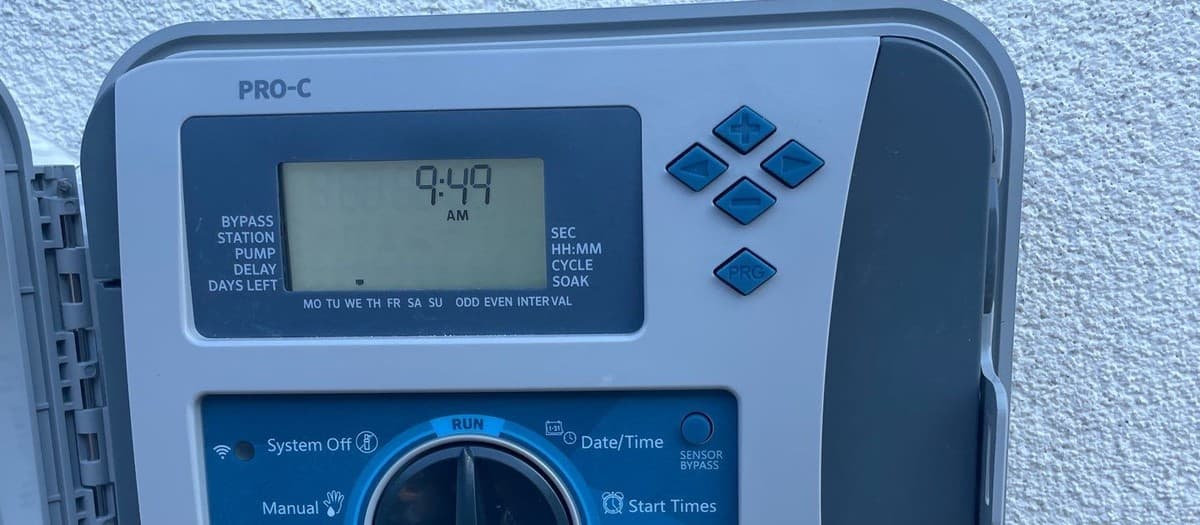
Controller Setup and Run Time Calculation
Calculate run time from target application depth, not from guessing. For established Bermuda turf, target 1 inch per week total. If your rotors apply 0.5 inches per hour (check the spec or measure with catch cups), you need 2 hours of run time per week — typically split across 2–3 days for 40–60 minutes each.
Install a smart controller that connects to local weather data. Rachio, Rain Bird ESP-TM2, and Hunter Hydrawise are the go-to contractor choices. Smart controllers adjust run times based on evapotranspiration data and skip watering after rainfall. Clients who get smart controllers see 30–50% water reduction on average — that's a selling point you should put in every proposal.
Program cycle-and-soak on any zone with slopes: 10 minutes on, 30 minutes off, 10 minutes on, 30 minutes off, repeat until target run time is met. This lets water infiltrate between cycles and eliminates runoff on grades.
Pipe Sizing and Zone Layout on Paper First
Main lateral lines running from the valve to the first head should be 3/4-inch PVC (Schedule 40) for zones up to 10 GPM. Sub-lateral lines branching off to individual heads can step down to 1/2-inch for short runs. Long runs — 100 feet or more — should stay at 3/4 inch even to the last head to control pressure loss.
Sketch the zone layout on a site plan before you ever call the dig line. Mark head locations, pipe routes, valve locations, and the controller location. This drawing becomes the as-built document you leave with the client — and the thing that saves you a callback when someone else digs up the yard three years from now.
Frequently Asked Questions
What is the 50% overlap rule in irrigation?
Every sprinkler head should throw water that reaches the adjacent head — head-to-head coverage. This creates full overlap with no dry gaps between heads. It's the most important spacing principle in irrigation design.
How many GPM does a typical residential irrigation zone use?
Typically 5–10 GPM per zone depending on head type and count. Rotor zones (Rain Bird 5000, Hunter PGP) run 1–2 GPM per head. Fixed spray zones run 0.2–0.7 GPM per head. Always stay under 75% of your service line's available GPM.
Can I put turf and beds on the same irrigation zone?
No. Turf and beds have different water requirements, different head types, and different precipitation rates. Mixing them forces a compromise that either over-waters one or under-waters the other. Always separate by plant type and exposure.
What smart controller brands should I install?
Rachio 3, Rain Bird ESP-TM2, and Hunter Hydrawise are the contractor standards. All connect to weather data and adjust automatically. Smart controllers reduce water use 30–50% on average — worth specifying in every proposal.
What is cycle-and-soak irrigation programming?
Running a zone in multiple short cycles with rest periods in between, rather than one long run. Used on slopes and heavy clay soils to allow infiltration between cycles and prevent surface runoff. Typically 10 minutes on, 30 minutes off, repeated until target run time is met.
Estimate Irrigation Jobs Without Spreadsheets
Ledge lets you build zone-by-zone estimates with head counts, pipe runs, and controller specs all in one proposal. Clients see exactly what they're getting.
Edgar Galindo
Co-founder, Ledge
Edgar built Ledge while running a landscape construction company in Central Texas. He writes about installation techniques, estimating, and building a profitable field operation.