Most landscape lighting fails at the design stage, not the installation stage. Here's how to place fixtures, route wire, and avoid the mistakes that make a job look cheap.
The difference between landscape lighting that looks designed and landscape lighting that looks like a kit from the hardware store is almost never about the fixtures. It's about where you aim them, how many you use, and whether the wire work is hidden before the job is done. Clients notice the glowing blob in the path light that lights up nothing and the tree uplight positioned so it shines directly into the living room window. Those details cost you referrals.
Design First: Layering and Fixture Count
Good outdoor lighting uses three layers: ambient (path lights, step lights — safety and general navigation), accent (uplights, downlights — features and focal points), and task (deck lights, under-cabinet — functional zones). A system with only one layer looks flat or harsh. Most residential installs that look bad are all path lights or all uplights.
For a typical 2,000 square foot residential job, a starting point is 8–12 path/step lights, 6–10 uplights on trees and architectural features, and 4–6 deck or patio accent fixtures. Scale up for larger properties. Don't try to cover a large yard with too few fixtures at high wattage — the result is harsh pools of light with dark voids between them. More fixtures at lower wattage looks better than fewer at higher wattage.
Uplight Placement: Angles and Distance
For trees, place the uplight 12–18 inches from the trunk for a mature tree with a full canopy. Closer to the trunk on smaller trees (6–10 inches). Angle the fixture at 45° toward the canopy. Straight up creates a column of harsh light with no texture. Angle too far and you throw light onto the neighbor's property or into windows.
For architectural features — walls, columns, textured surfaces — graze lighting from a low angle (15–30°) exaggerates texture and creates depth. Mount a well light or a directional bullet fixture at grade level and angle it up along the surface. This technique on a stacked stone wall or a board and batten fence looks high-end for minimal fixture cost.
Use Kichler, VOLT Lighting, or FX Luminaire fixtures for residential installs where quality matters. Cheap die-cast zinc fixtures sold at big box stores corrode in 2–3 seasons. Solid brass or marine-grade aluminum fixtures last 15–20 years and hold their finish.
Path Light Spacing and Height
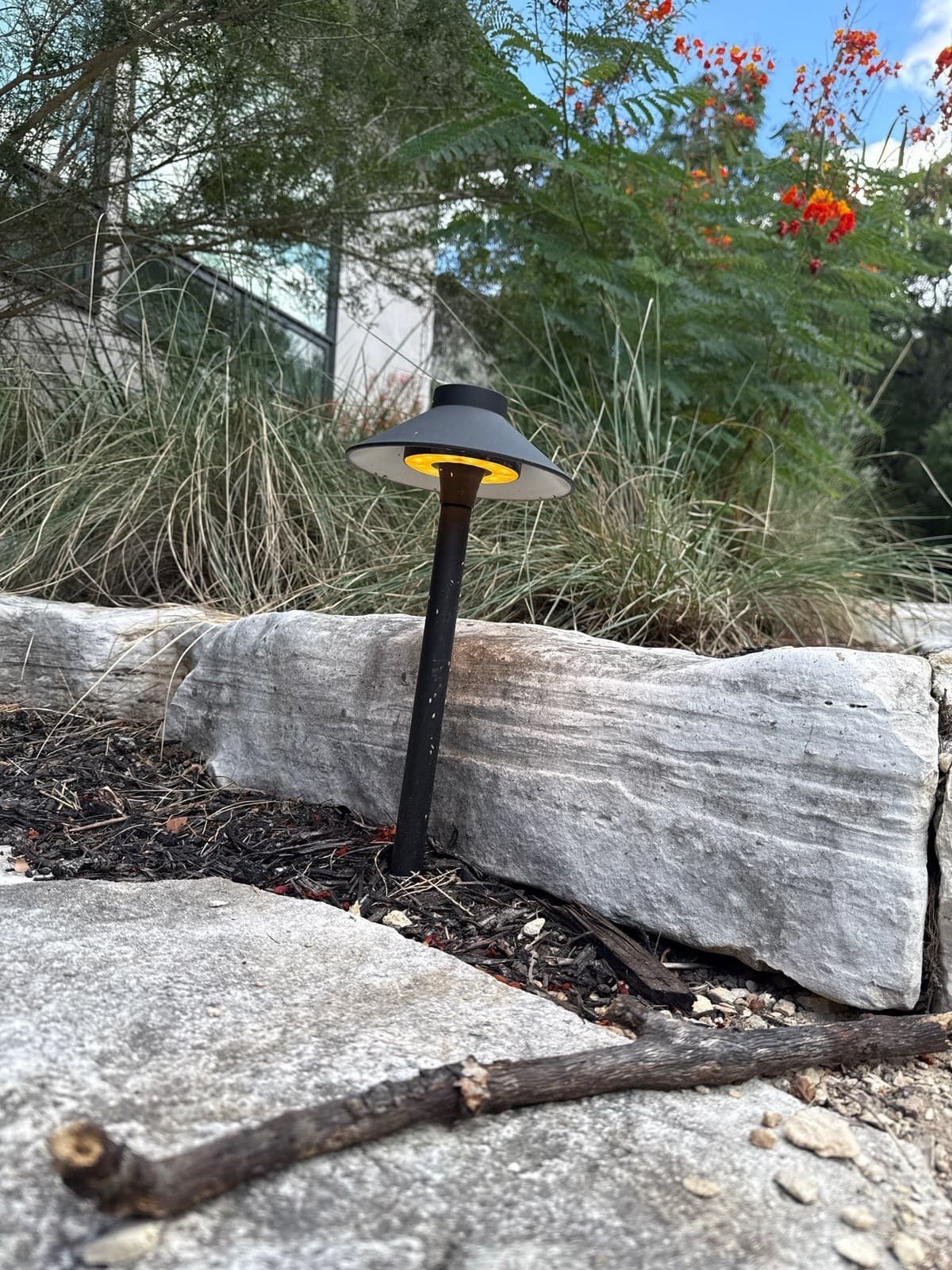
Space path lights 8–10 feet apart. The goal is overlapping pools of light, not individual spotlights on the path. Too close (4–5 feet) creates a runway effect that looks like an airport. Too far apart leaves dark gaps between fixtures that feel unsafe.
Stagger path lights on alternating sides of the path rather than running them in a straight line on one side. Alternating placement creates visual rhythm and better coverage. For curved paths, adjust spacing so the fixture is always placed at the outside of each curve — this lights the turn where it matters most.
Fixture height matters. A path light that stands 12 inches high in a bed of 24-inch ornamental grasses is invisible and useless. Select fixture height based on what will be growing around it in two seasons, not what's there the day you install it.
"The fixtures are maybe 30% of how the job looks at night. The other 70% is where you aimed them and where you hid the wire."
Wire Burial Depth and Routing
Low-voltage landscape wire (12V) should be buried a minimum of 6 inches deep in turf and bed areas. Under hardscape — walkways, driveways, patios — run the wire through 1/2-inch or 3/4-inch PVC conduit before the surface goes down. Never run wire under pavers without conduit; paver movement will cut the wire within a few seasons.
Use a cable puller or a flat spade to open a narrow trench in turf areas. Cut a straight slot, push the wire in, and close the slot by pressing the soil back together with your foot. The turf heals over in 1–2 weeks. Mark all wire locations on a diagram for the client before you leave — future irrigation repairs and landscape changes will cut wire if the routes aren't documented.
Route wire along the perimeter of the property where possible rather than cutting diagonals across open lawn. Longer runs but far fewer future conflicts with mowing, edging, and renovation work.
Color Temperature and Beam Angle Selection
For residential landscape lighting, 2700K–3000K is the standard. 2700K is warm — it reads like incandescent, flatters wood and stone, and feels residential. 3000K is neutral warm — slightly crisper, good for modern architecture and commercial properties. Never use 4000K or 5000K for outdoor residential; it reads cold and clinical and clients will hate it.
Beam angle controls spread. Narrow beams (15°–25°) for tall trees and accent features — you want directed light, not spread. Wide beams (40°–60°) for path lights and broad architectural washes. Mid-range (30°–40°) for most uplights on medium shrubs and ornamental trees. Using the wrong beam angle — a 60° flood on a narrow column or a 15° spot on a wide garden bed — is the second most common source of bad-looking installs.
Frequently Asked Questions
How deep should landscape lighting wire be buried?
Minimum 6 inches in turf and planting beds. Under hardscape, wire should always run through PVC conduit — minimum 1/2-inch diameter — regardless of depth. Conduit protects against movement and makes future wire replacement possible without digging up the patio.
What color temperature is best for landscape lighting?
2700K–3000K for residential. 2700K is warm and flattering for natural materials like stone and wood. 3000K works for modern or commercial properties. Avoid 4000K and above outdoors — it reads as cold and harsh.
What brands should I use for residential landscape lighting fixtures?
Kichler, VOLT Lighting, and FX Luminaire are reliable contractor-grade options. Solid brass and marine-grade aluminum fixtures last 15–20 years. Skip the big box store die-cast zinc kits — they corrode in 2–3 seasons and clients come back to you for the repair.
How far apart should path lights be spaced?
8–10 feet on alternating sides of the path. This creates overlapping light pools and visual rhythm. Closer than 6 feet reads like a runway. Farther than 12 feet leaves dark gaps that feel unsafe.
How close to the trunk should an uplight be placed on a tree?
12–18 inches from the trunk for mature trees. 6–10 inches for smaller specimens. Angle at 45° toward the canopy. Straight-up placement creates a harsh column with no depth or texture.
Quote Lighting Jobs Before You Leave the Site
Ledge lets you build fixture-by-fixture estimates with your material costs and labor built in. Send a proposal on the spot and close the job the same day you scope it.
Edgar Galindo
Co-founder, Ledge
Edgar built Ledge while running a landscape construction company in Central Texas. He writes about installation techniques, estimating, and building a profitable field operation.