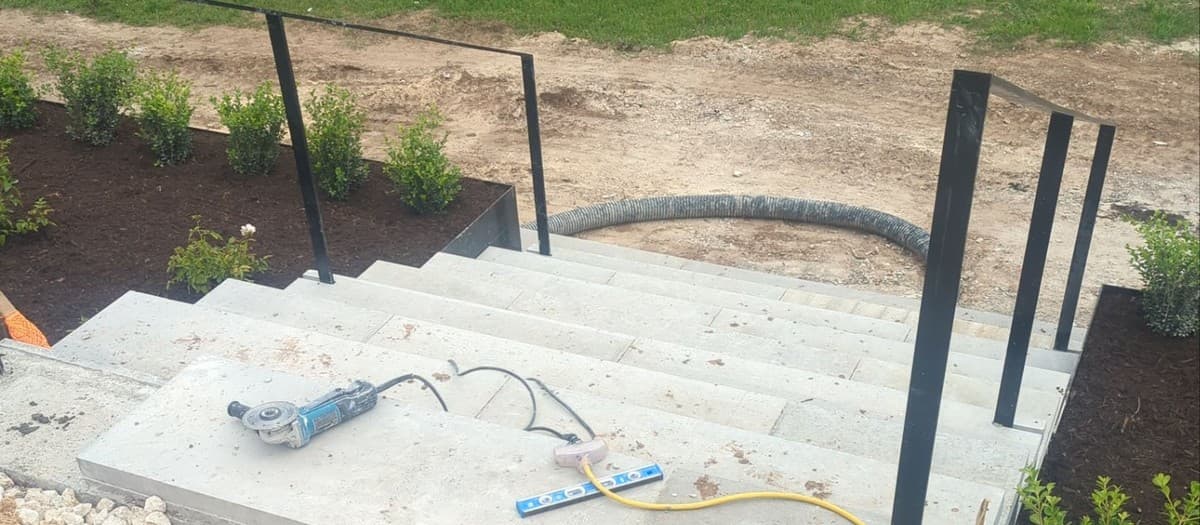
Steel railing estimates fall apart when contractors treat shop fabrication and field fabrication as the same thing. They are not — and pricing them identically will cost you money on every job.
A client adds a steel railing to a stair or retaining wall scope and you pencil in $80–$100 per linear foot without thinking about it. That number might work if a local fab shop builds the whole thing and installs it. It will definitely not work if your crew is cutting and welding tube steel in the field, or if the scope includes custom picket patterns. Where did that number come from?
Railing cost depends on three decisions: who fabricates it, what the detail spec is, and how the posts attach to the structure below. Get any of those wrong and your margin disappears.
Shop Fabrication: Cost Per Linear Foot
Shop-fabricated steel railing means you send drawings to a fab shop, they weld the sections in their facility, apply primer or powder coat, and deliver panels to site. Your crew sets posts, groutes them in or bolts them down, and installs the panels. This is the preferred method for custom residential railings where quality control matters.
- Standard flat-bar picket railing, shop fab, powder coated: $120–$180 per linear foot installed. This covers fab shop cost, finish, delivery, and your crew's installation labor.
- Round tube handrail only (no pickets), shop fab: $65–$95 per LF. Faster to install — typically 4–6 LF per man-hour for a straight run with standard post spacing.
- Custom decorative pattern, shop fab: $200–$380 per LF. Scrollwork, custom picket spacing, or mixed materials (cable infill between steel posts) push cost up fast.
- Your markup on sub cost: 20–30% is standard for a sub you manage on-site. If you are pulling the permit and coordinating inspections, 25% is floor.
Field Fabrication: When Your Crew Does the Welding
Field fabrication means your crew cuts, fits, and welds tube steel or flat bar on-site. It is slower and harder to control quality than shop work, but it is sometimes necessary for curved runs, grade changes mid-span, or repairs to existing structures.
Material cost: 1.5-inch square tube steel runs $3.50–$5.50 per LF at a steel supplier. Flat bar pickets (0.5×1.5 inches) run $1.20–$1.80 per LF. A standard 4-foot-tall railing section with pickets at 4-inch spacing uses roughly 12 LF of picket per LF of run. That is $14–$22/LF in picket material before top rail, bottom rail, or posts.
Labor for field fab: A skilled welder running tube steel railing in the field produces 8–14 LF per day on a straight run with standard detail. That slows to 4–8 LF/day on curved sections or complicated post-to-structure connections. Price labor by the linear foot from your actual production rate — not from a per-day guess.
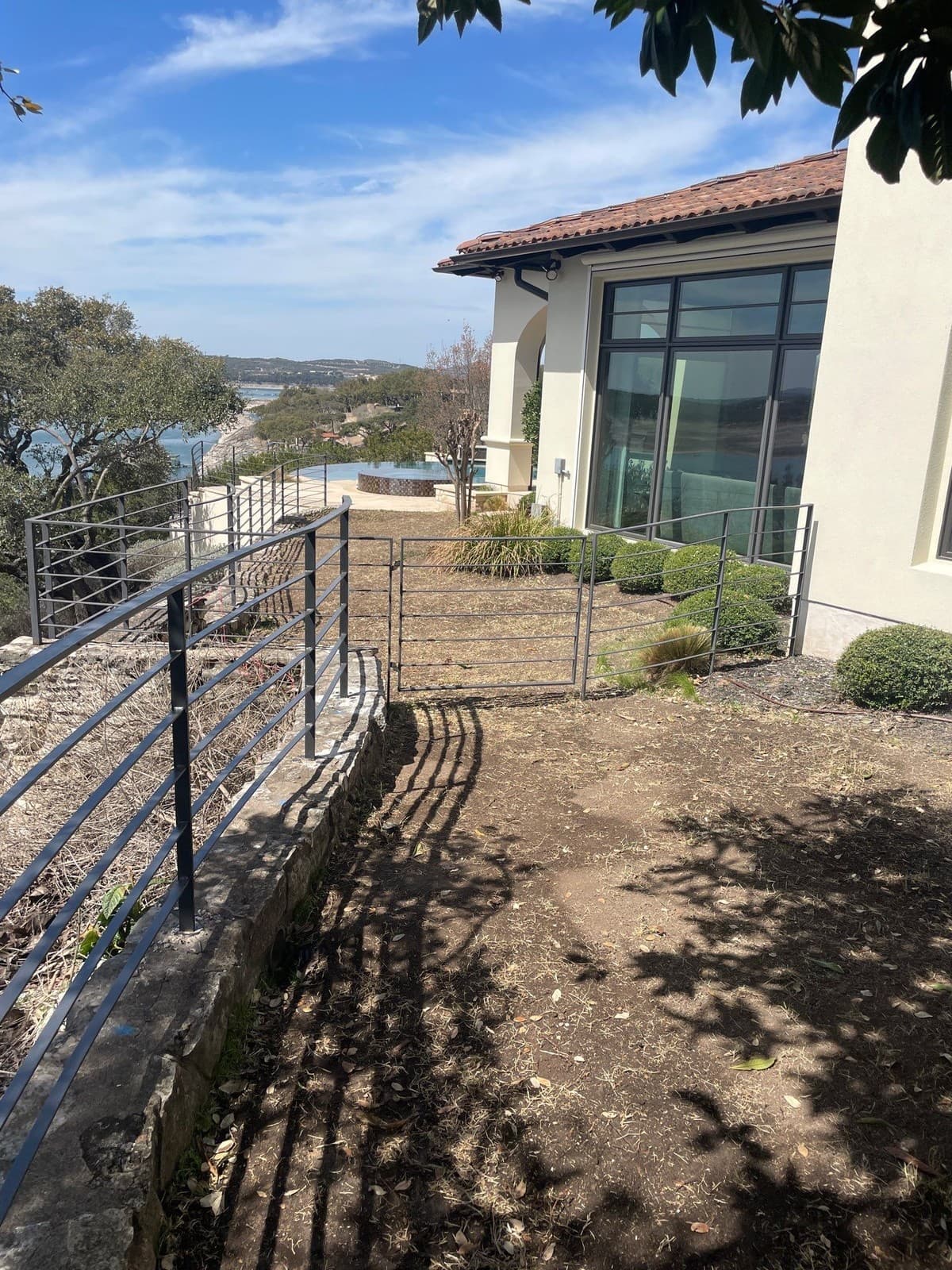
Post Spacing and Attachment: Where Estimates Break Down
Post count determines material cost more than any other variable. Standard post spacing for a residential steel railing is 4 to 6 feet on center. Code typically requires posts at every riser on a stair rail. Are you pricing posts as a flat quantity or calculating them from the linear footage?
Surface-mount posts (base plate, anchor bolts): $85–$130 per post installed, including base plate, hardware, and grout. Add the base plate fabrication cost if your shop is making custom plates — budget $20–$35 per plate for simple square designs.
Core-set posts (drilled into concrete): $110–$160 per post, including core drilling the slab or wall, setting the post in non-shrink grout, and waiting for cure. Core drilling into existing concrete adds 30–45 minutes per post location. If you have 8 posts to set that way, add 4–6 hours of crew time to your labor number.
"The railing is not the expensive part. The post attachment to the structure below it is."
What the Per-Linear-Foot Price Has to Include
When you quote $X per LF for a steel railing, make sure that number accounts for all of these:
- Top rail, bottom rail, pickets, and all connection hardware
- Post material plus post attachment hardware and any anchor plates
- Primer, powder coat, or paint finish — this is not optional on exterior steel
- Delivery from fab shop to site (often forgotten on small runs)
- End caps, return bends at top of stair runs, wall returns if needed
- Touch-up paint for any field cuts or welds made during installation
Stop guessing on estimates
Build accurate estimates in minutes, not hours.
Ledge has assembly-based estimating built in — material takeoffs, labor rates, and markup all in one place.
Book a Demo →Frequently Asked Questions
What is the average cost per linear foot for a steel railing installed?
A shop-fabricated steel railing with flat-bar pickets, powder coat finish, and standard post spacing runs $120–$180/LF installed in most markets. Simpler handrail-only designs come in at $65–$95/LF. Custom decorative work with scrollwork or cable infill can exceed $300/LF. The wide range is driven by fab shop rates, finish type, and post attachment method — never use a single average without knowing the actual spec.
When should I subcontract steel railing vs. doing it in-house?
Subcontract to a fab shop any time the design requires consistent welds, a quality powder coat finish, or sections longer than 8 feet. Field welding works for repairs, short curved sections, or simple handrail-only scopes where precision is less critical. In-house field fab looks cheaper until you account for welding equipment cost, consumables, and the time it takes to produce a clean finish in the field.
How do I handle railing on a curved wall or stair?
Curved runs require either bent tube steel or a series of short straight sections meeting at angle cuts. Bent tube is a shop operation that adds $15–$30/LF to fab cost depending on radius. Short sections with angle cuts are field-installable but require precise measurement at every post. Budget 50% more labor than a straight-run equivalent. Always take field measurements after the structure is complete — not from plans.
Does exterior steel railing require a permit?
In most Texas jurisdictions, guard rails over 30 inches above grade require a permit and must meet IBC or IRC load requirements (200-pound point load at any point on the top rail). Stair rails have additional height and graspability requirements. Permit fees vary by municipality — include them as a direct line item, not overhead.
Edgar Galindo
Co-founder, Ledge
Edgar built Ledge while running a landscape design-build company in Central Texas. He has specified, coordinated, and installed steel railings on dozens of hardscape projects and knows exactly where the cost surprises hide.