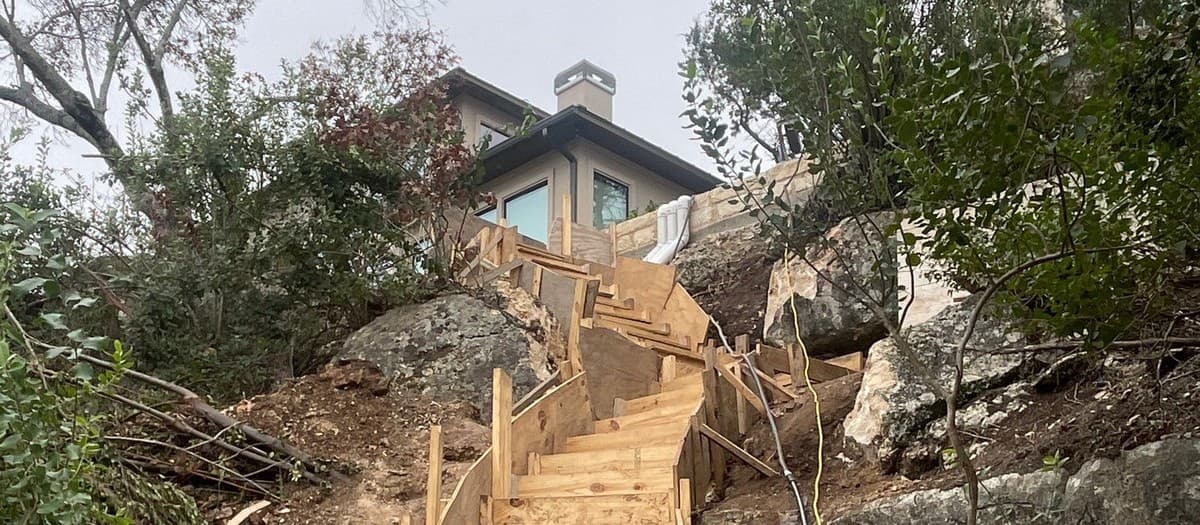
Outdoor stairs look simple on a plan set. The estimate falls apart when you forget concrete footings cost the same regardless of what material goes on top of them.
A client wants a four-riser entry stair from their driveway to the front door. Simple scope, right? Then you realize the grade change needs a concrete footing regardless of material, the landing needs to tie into existing hardscape, and they have already asked about adding a railing. Three decisions just became twelve line items — and if you guessed at the price, you are eating the difference.
Wood, concrete, and steel stairs each have different cost drivers. The material choice changes your labor time, your subcontractor needs, and what permits you may need to pull. Here is what each option actually costs, by the numbers.
Wood Stairs: Cost Per Riser and Per Flight
Pressure-treated lumber stairs are the most common choice for deck access and grade-change steps in residential landscape-build. They are faster to install than concrete and cheaper up front — but they carry higher maintenance expectations and shorter lifespan.
- Material cost per riser: $45–$90 for PT lumber stringers, treads, and fasteners. Add $15–$25/riser for composite treads (Trex or TimberTech) if the client wants low-maintenance.
- Labor per riser: 1.5–2.5 hours per riser for a two-man crew, including layout, stringer cuts, tread attachment, and landing connection. A standard 4-riser flight runs 6–10 man-hours total.
- Footing requirement: Concrete footing at the base regardless. A standard tube footing (12-inch diameter, 24 inches deep) runs $80–$130 in concrete and labor. Do not skip this in your estimate.
- Total installed cost per flight (4 risers, 48-inch width): $900–$1,600 depending on tread material and site complexity.
Concrete Stairs: Cast-in-Place vs. Precast
Concrete stairs cost more upfront and take longer to build, but they are permanent. In most design-build landscape projects, cast-in-place concrete is the right call for main entry stairs where the detail level or railing attachment demands it.
Cast-in-place concrete: $280–$420 per riser installed, including forming, reinforcement, concrete pour, and finish. A 4-riser entry stair at 48-inch width runs $1,200–$1,700 in material and labor before any surface treatment. Add $4–$8/SF if the client wants a brushed finish, exposed aggregate, or stamping.
Precast concrete steps: Cheaper per unit at $120–$250 per step, but you are limited to standard dimensions (typically 48-inch or 60-inch wide, 7-inch rise). They work for straight runs with no curve or landing requirement. They do not work for custom grade changes.
What does concrete add that most contractors forget? Forming lumber. You will use 2×10s or 2×12s to build the forms — that material costs $60–$120 for a 4-step flight and is typically single-use. It belongs in your estimate as a direct job cost, not overhead.
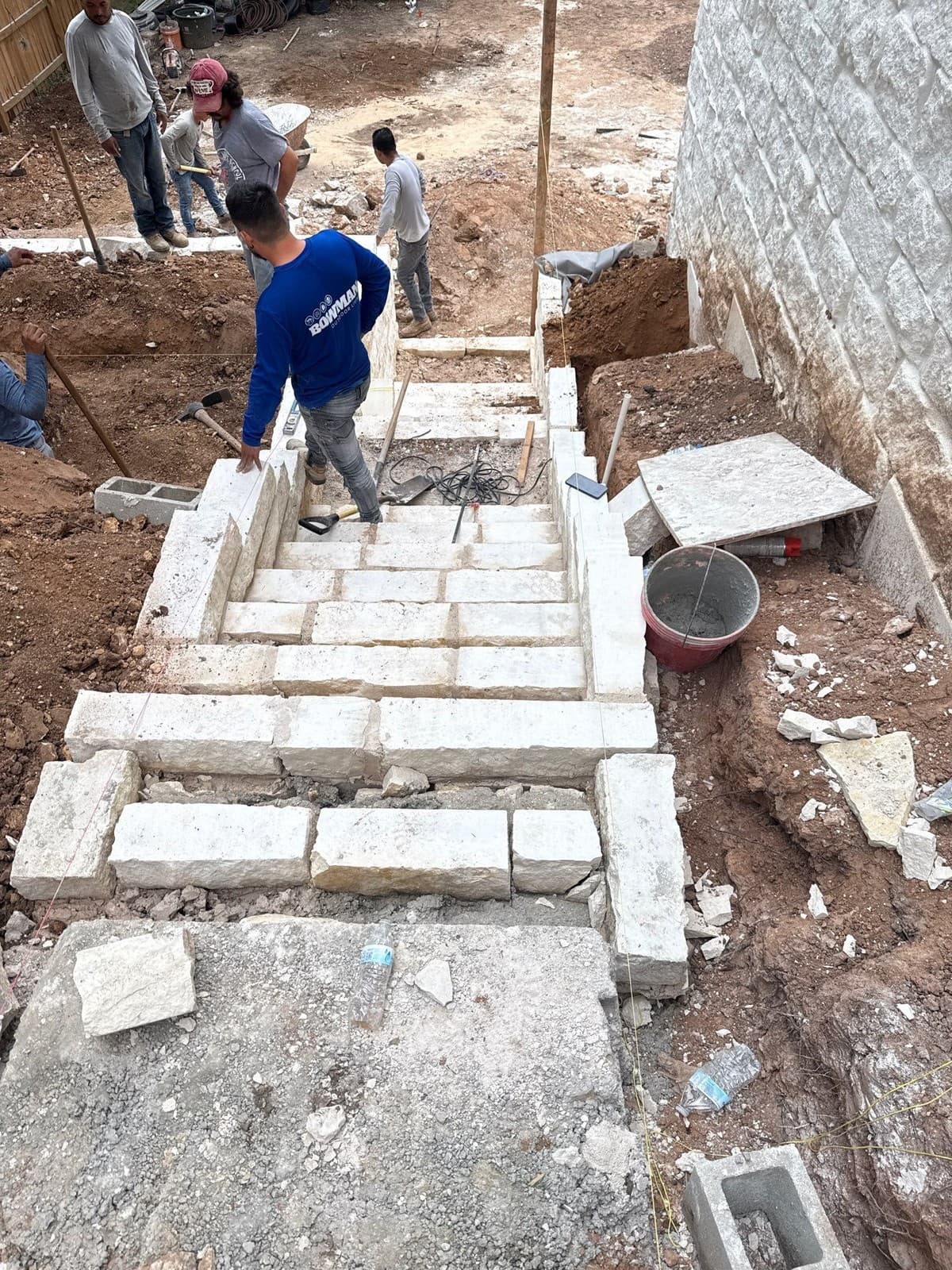
Steel Stairs: Fabricated vs. Prefab Stringers
Steel stairs show up in commercial landscape and high-end residential projects. They are the most expensive option per flight but carry the best load rating and the longest design life. You have two paths: custom shop-fabricated or prefab steel stringers with field-installed treads.
- Prefab steel stringers with wood treads: $180–$320 per stringer pair (covers one 36-inch wide flight). Add tread cost on top — composite treads run $40–$80 each. Total for 4 risers: $900–$1,500 material only.
- Custom shop-fabricated steel stairs: $450–$900 per riser for a fully welded steel structure including powder coat finish, delivered to site. This is a subcontractor cost — you are paying a fab shop, not buying materials from a supplier.
- Field installation labor: 4–8 man-hours for a prefab stringer set. Custom fab stairs arrive ready to bolt — installation is faster, but crane or lift equipment may be required for larger assemblies.
"Every stair estimate has at least two costs hiding under the surface: the footing and the railing attachment detail."
What Every Stair Estimate Is Missing
Regardless of material, contractors consistently leave out the same four line items.
Grade prep and grading. The ground under those stairs has to be cut and compacted before anything is set. That is a separate scope. On a sloped site with 8–12 inches of relief, grading the stair path can add $200–$500 to a small stair job.
Railing post blocking or embedded anchor plates. If a railing comes later, the stair structure has to be built to accept it. Wood requires blocking at post locations. Concrete requires embedded anchor bolts or sleeve anchors cast in place. Steel requires welded base plates. None of this is zero cost.
Landing. Most stair runs need a landing at the top or bottom — sometimes both. A 4×4-foot concrete landing pad adds $280–$400. A paver landing adds more. Price it as a separate line item so the client sees what they are buying.
Permits. In Texas, exterior stairs over 30 inches above grade typically require a permit. Check your jurisdiction. Permit fees are a direct cost, not overhead — they belong in the estimate as a line item.
Stop guessing on estimates
Build accurate estimates in minutes, not hours.
Ledge has assembly-based estimating built in — material takeoffs, labor rates, and markup all in one place.
Book a Demo →Frequently Asked Questions
What is the cheapest material for outdoor stairs?
Pressure-treated wood is the lowest cost per installed riser at $200–$400 all-in for a 4-riser, 48-inch-wide flight. Precast concrete steps come close when you have a straight run with standard dimensions. Custom concrete and steel are significantly more. The caveat: wood stairs have the highest maintenance cost over 10 years, so total cost of ownership shifts the comparison.
How do I estimate outdoor stairs by the riser?
Price material per riser, labor per man-hour tied to production rate, then add footing, landing, and railing prep as fixed costs per flight. For wood, plan on $45–$90 in material per riser plus 1.5–2.5 man-hours labor. For cast concrete, plan $280–$420 per riser installed. For custom steel fab, quote from a sub and mark it up 20–25%.
Do outdoor stairs need a permit?
In most Texas jurisdictions, exterior stairs over 30 inches above grade require a building permit. Some municipalities also require a separate permit for attached railings. Check with the local building department before bidding. Permit fees are a direct project cost — not overhead — and should appear as a line item in your estimate.
How long does it take to build a 4-riser concrete stair?
A 4-riser cast-in-place concrete stair typically takes two days with a two-man crew: day one for grading, forming, and rebar; day two for the pour and finish. Add cure time before the form strip — minimum 24–48 hours depending on temperature. Plan your schedule around concrete lead times and weather, especially in summer heat.
Can I mix materials — for example, steel stringers with wood treads?
Yes, and it is common on mid-range projects. Steel stringers with composite or hardwood treads give a modern look at lower cost than full custom steel fab. Price the stringer pair and tread separately in your estimate. Account for tread attachment hardware — lag screws into steel stringers require pre-drilled pilot holes, which adds 30–45 minutes to a 4-riser installation.
Edgar Galindo
Co-founder, Ledge
Edgar built Ledge while running a landscape design-build company in Central Texas. He has priced hundreds of stair jobs across wood, concrete, and steel — and learned where the money disappears on each one.