Wrong production rates are the fastest way to lose money on hardscape. Here are the real numbers — from actual field crews, not manufacturer estimates.
You bid a paver patio at three days. Your crew takes five. The math on that job falls apart fast — not because your material pricing was wrong, but because your labor estimate was. Production rates are the foundation of every hardscape bid, and most contractors are using numbers that are either outdated, too optimistic, or borrowed from someone else's market.
What follows are real production rates from active field crews. These are conservative numbers — meaning they account for setup, cleanup, material staging, and the inevitable mid-job problem. Build your estimates from these and you will stop losing money on hours.
Paver Installation Production Rates
These are two-man crew rates per day, on a prepared base with good site access:
- Running bond, standard access: 280–350 SF/day
- Herringbone or 45-degree diagonal: 200–260 SF/day
- Complex pattern with multiple soldier courses: 140–180 SF/day
- Tight backyard access (wheelbarrow haul over 50 ft): Deduct 20–30% from any of the above
- Large-format pavers (24x24 or bigger): Deduct 15% — heavier, slower to set level
Base preparation is separate and adds 1.5–2 days for a 400 SF patio: excavation, grading, base compaction in lifts, and bedding sand screeding. Do not bundle this into your paver installation rate.
Retaining Wall Production Rates
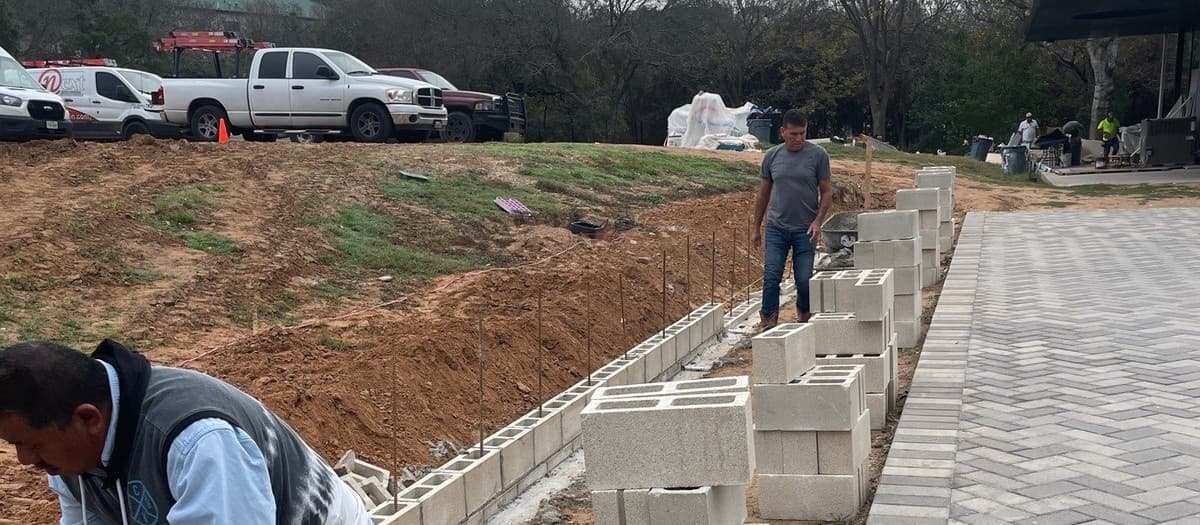
Retaining wall output is measured in square face feet per day, not linear feet. A 2-man crew building a standard concrete block wall (Versa-Lok, Allan Block, or similar):
- Standard block wall under 4 ft: 60–90 SF/day (face feet, including base prep)
- Wall 4–6 ft (geogrid required): 40–65 SF/day — geogrid layers slow the work significantly
- Natural limestone or fieldstone: 20–35 SF/day — fitting stone is slow, no way around it
- Drainage pipe and gravel backfill: Add 0.5–1 full day per 100 linear feet of wall
Concrete Flatwork Production Rates
Concrete is different from pavers — the pour itself is fast, but the prep and finish take time. A 3-man crew (foreman plus two):
- Form setting and base prep: 200–350 SF/day depending on complexity of form work
- Pour day (broom finish): 800–1,500 SF per pour — limited by truck scheduling, not labor
- Stamped concrete: 300–500 SF/day including color and pattern work
- Exposed aggregate: 400–600 SF/day — faster than stamped, slower than broom
Never schedule more concrete in a day than your crew can finish before it sets. In summer heat in Central Texas, you may have 30 minutes less working time than the spec sheet says.
Drainage and Excavation Rates
Drainage work is often where jobs lose time because no one scoped it carefully. Hand excavation for a French drain trench — 12 inches wide by 24 inches deep — runs 40–60 linear feet per man-day in normal soil. Rocky caliche cuts that in half. Machine excavation (mini-ex) does 150–250 LF/day but requires mobilization cost.
Catch basin installation, including excavation, setting the basin, and connecting pipe: 2–4 basins per crew-day depending on depth and pipe runs.
"The crew that tracks production rates wins twice — better bids and a benchmark to improve against."
How to Build Your Own Production Rate Log
These industry benchmarks are a starting point. Your actual rates depend on your crew's experience, your equipment, and your market. Track them on every job:
- Log the task, crew size, hours worked, and units completed for every major operation
- Note site conditions that affected speed (access, soil, weather)
- After 10–15 jobs, you will have your own rates — and they will be more accurate than any guide
This is what separates contractors who grow from contractors who stay stuck. When you know your numbers cold, every estimate is faster and every job is more predictable.
Estimate from real data
Ledge tracks production rates across every job you close.
Assembly-based estimating means your production rates are built into your line items — so every new bid learns from the last one.
Book a Demo →Frequently Asked Questions
How many square feet of pavers can a crew install in a day?
A two-man crew in running bond on a prepared base installs 280–350 SF per day under normal conditions. Herringbone or diagonal patterns drop that to 200–260 SF/day due to additional cuts. Complex patterns with curves or soldier course borders can fall below 180 SF/day. Always separate base prep days from paver installation days in your estimate.
What is the production rate for retaining wall block installation?
A two-man crew building a standard concrete block wall under 4 feet produces 60–90 square face feet per day, including base course preparation. Walls over 4 feet requiring geogrid drop to 40–65 SF/day because geogrid backfill layers add significant time. Natural stone walls run 20–35 SF/day — fitting irregular stone is slow regardless of crew experience.
Why do my production rate estimates keep coming in low?
The most common reason is that contractors estimate installation rates but forget setup, staging, and cleanup time. A crew that lays 300 SF of pavers also spends 1–2 hours per day on material staging, equipment movement, and end-of-day cleanup. Build those non-production hours into your labor budget, not your production rate. They are real costs that show up on every job.
How do site conditions affect hardscape production rates?
Site access is the biggest variable. Tight backyard access requiring wheelbarrow haul over 50 feet reduces output by 20–30% on any task. Rocky soil adds excavation time. Slopes require additional care on base compaction. Summer heat in Central Texas slows concrete work — crews need more breaks and concrete sets faster. Scope every site individually rather than applying average rates to every job.
Edgar Galindo
Co-founder, Ledge
Edgar built Ledge while running a landscape design-build company in Central Texas. He tracked production rates on every job and used that data to build better estimates — and eventually, better software.