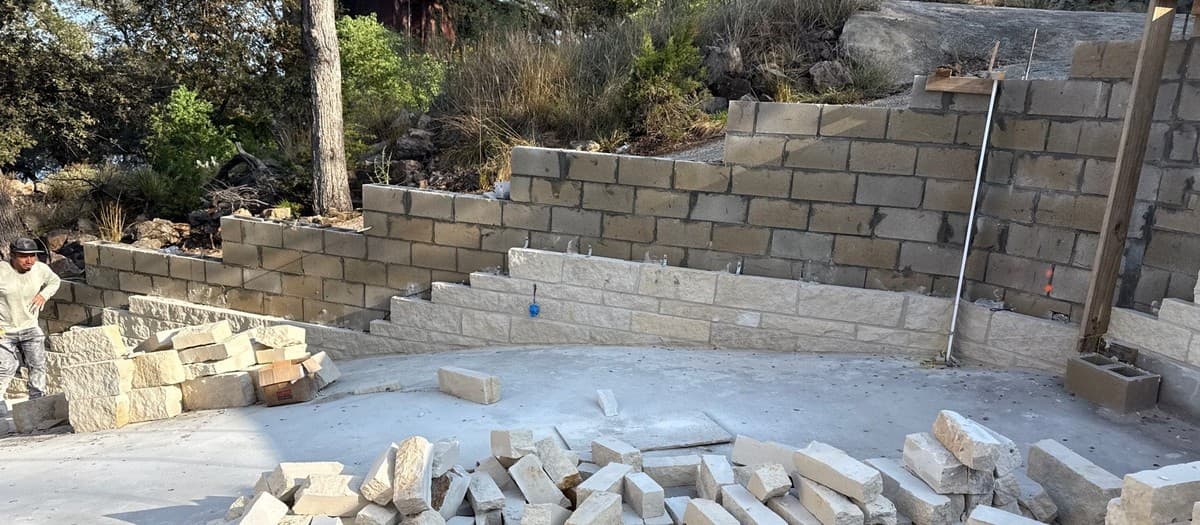
Retaining walls have more moving parts than almost any hardscape job — drainage aggregate, geogrid, deadmen, batter, and permits all hit your cost before you set the first block. Here is how to price every line item.
Retaining wall estimates go wrong in the middle. Most contractors get block count right. They forget the drainage aggregate behind the wall, the filter fabric, the compacted gravel base course, the deadmen or geogrid at taller heights, and the cap block on top. Those omissions add up to $800–$2,500 on a typical 40-linear-foot wall — and they come straight out of your pocket.
This guide breaks down every cost category so your next retaining wall bid reflects what the job actually costs to build.
Block Count: The Starting Point
Every block estimate starts with two measurements: linear feet of wall and exposed wall height in courses. Most retaining wall block runs 7–8 inches tall per course after accounting for the batter (backward lean). A 36-inch exposed wall is roughly 5–6 courses of standard Belgard or Allan Block. Add one buried course below grade — always — for your base course that sits on compacted gravel.
Formula: (Linear feet × courses) + 10% waste = total block count. A 40-LF wall at 5 exposed courses needs 200 blocks minimum — order 220. Cap blocks are a separate SKU and a separate line item. Don't lump them in.
- Standard wall block (Belgard Cambridge, Allan Block Classic): $2.80–$4.20 per block depending on size and region.
- Cap block: $3.50–$6.00 per cap. Price per linear foot separately — one cap per foot of wall at most standard sizes.
- Corner units: Count your inside and outside corners. These are specialty pieces and usually run 20–40% more per unit than standard block.
Drainage: The Most Underpriced Part of the Job
A retaining wall without drainage is a retaining wall on borrowed time. Hydrostatic pressure behind the wall will push it out within a few seasons. Yet drainage costs are the most commonly missing line item on contractor estimates.
Standard drainage assembly behind a block retaining wall: 12 inches of clean crushed granite or washed gravel (not decomposed granite) wrapped in filter fabric. For a 40-LF wall at 36 inches exposed height, you need approximately 4–5 tons of drainage aggregate. At $45–$65 per ton delivered, that is $180–$325 in material before labor. Add a 4-inch perforated pipe at the base — drained to daylight — at $1.20–$1.80 per linear foot.
- Drainage aggregate: $45–$65/ton delivered. Budget 1 ton per 10 LF of wall for a 36-inch wall height.
- Filter fabric: $0.25–$0.45/SF. A 40-LF wall needs roughly 120–160 SF of fabric — not expensive, but it belongs in the estimate.
- 4-inch perforated pipe: $1.20–$1.80/LF plus elbow and outlet fittings. Size this to actual wall length, not an approximation.
- Base course gravel: 6 inches of compacted crushed limestone under the first buried course. Budget 1.5 tons per 20 LF of wall.
Geogrid and Deadmen: Required Above 3 Feet
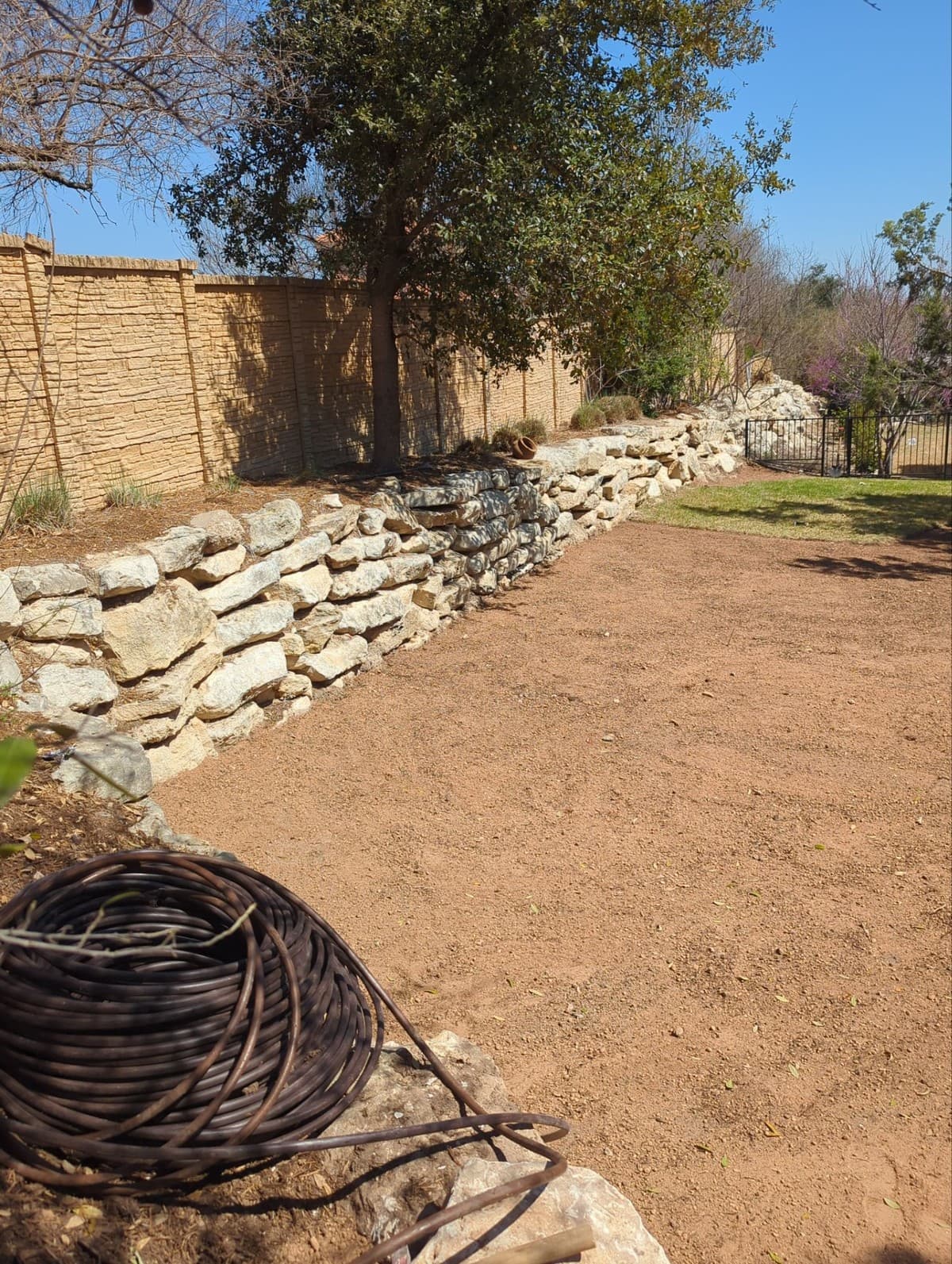
Allan Block and Belgard both publish engineering specifications for when geogrid reinforcement is required. For most soil conditions, that threshold is walls over 3 feet in exposed height — roughly 4–5 courses depending on block size. If you are building a 48-inch wall without geogrid, you are building a liability.
Geogrid runs $0.60–$1.10 per SF of wall face, installed in horizontal layers every 2–3 courses. A 40-LF wall at 4 feet tall with two geogrid layers needs roughly 320 SF of grid material — around $200–$350 in material cost. That is before labor to fold it back into the hill and compact the retained fill over it.
"A wall that fails in year three is a warranty call, a legal risk, and a reputation you do not want."
Labor Rates: What Retaining Wall Installation Actually Takes
Retaining wall labor is heavy. Plan for 2.5–4 man-hours per linear foot for a standard 36-inch wall with drainage — that includes excavation, base prep, block setting, drainage aggregate, filter fabric, and backfill. A 40-LF wall might run 100–160 man-hours total depending on access, soil type, and whether geogrid is required.
Tight access — a backyard with no equipment entry — adds 20–40% to labor because everything moves by hand. Can you get a mini-excavator in? If not, price accordingly. The machine question decides whether a job is profitable.
Fully-burdened labor cost for a retaining wall crew runs $70–$95 per man-hour depending on your market. At 130 man-hours and $80/hour, you are looking at $10,400 in labor cost on a 40-LF job before materials, dump fees, or markup.
Excavation, Haul-Away, and Equipment Costs
Retaining walls move a lot of dirt. Excavating behind the wall for drainage, removing old material, and grading the retained area all generate spoil that has to go somewhere. Price dump fees by tonnage or by the load — not as a percentage of job cost.
- Mini-excavator rental: $350–$550/day for a 1.5–2.5 ton class machine. Know your day count before you write the number.
- Dump fees: $65–$100 per load for clay/mixed soil. A 40-LF wall generates 4–8 loads of spoil depending on how much retained fill you import vs. what was already there.
- Plate compactor: If you rent rather than own, budget $120–$200/day. For walls with geogrid, you need a jumping jack or plate at every lift of fill — hours of compaction time.
Full Estimate Example: 40 LF × 36 Inch Wall
Here is a real-world cost build for a 40 linear foot, 36-inch exposed height retaining wall in Central Texas. All numbers are cost to you — not client pricing.
- Block (220 units @ $3.50): $770
- Cap block (40 caps @ $4.50): $180
- Base course gravel (3 tons @ $55): $165
- Drainage aggregate (5 tons @ $58): $290
- Filter fabric + 4-inch pipe: $180
- Equipment (mini-ex 2 days, plate compactor): $1,050
- Dump fees (5 loads @ $80): $400
- Labor (120 man-hours @ $80): $9,600
- Total cost to deliver: $12,635
- Client price at 45% GM: $22,975
That works out to about $575 per linear foot installed. Contractors consistently underbid this scope at $350–$400 per LF because they miss drainage, equipment, and dump fees. Now you know where the gap lives.
Stop guessing on estimates
Build accurate estimates in minutes, not hours.
Ledge has assembly-based estimating built in — material takeoffs, labor rates, and markup all in one place. No more spreadsheet math.
Book a Demo →Frequently Asked Questions
How much does a retaining wall cost per linear foot installed?
Expect $400–$700 per linear foot for a standard 36-inch concrete block retaining wall with proper drainage, installed in Central Texas. Walls with geogrid reinforcement, poor equipment access, or premium block selections push toward $700–$900/LF. Contractors who quote $250–$300/LF are either skipping drainage or losing money.
Do I always need drainage behind a retaining wall?
Yes. Hydrostatic pressure from water-saturated soil is the primary cause of retaining wall failure. Every block wall needs at least 12 inches of free-draining aggregate behind it wrapped in filter fabric, plus a drainage outlet at the base. Skip it and you are building a warranty liability — or worse, a legal one if the wall fails and damages property.
When is geogrid required for a retaining wall?
Geogrid is typically required for walls over 36 inches of exposed height, though the exact threshold depends on soil type and surcharge (load above the wall). Belgard and Allan Block publish engineering tables for their specific products — use them. If you are building above 4 feet in most residential soil conditions, geogrid every 2–3 courses is not optional.
How many blocks do I need per linear foot?
For Belgard Cambridge or Allan Block Classic (standard 12-inch face units): approximately 1.5 blocks per linear foot per course. A 5-course, 40-LF wall needs 300 blocks before waste factor. Add 10% minimum for cuts, damaged units, and corner adjustments. Count courses based on actual block height including batter — do not assume 8 inches per course without checking the spec sheet.
Should I include a permit cost in my retaining wall estimate?
Most municipalities require a permit for retaining walls over 30 inches of exposed height. Permit costs vary — $150–$600 in most Texas jurisdictions — but that is not the real issue. The real issue is the engineering letter or stamped drawing many jurisdictions require for walls over 4 feet. That engineering report runs $800–$2,500 and belongs in your estimate as a pass-through, not an absorbed cost.
Edgar Galindo
Co-founder, Ledge
Edgar built Ledge while running a landscape design-build company in Central Texas. He has priced hundreds of retaining wall jobs and learned the drainage lesson the expensive way.