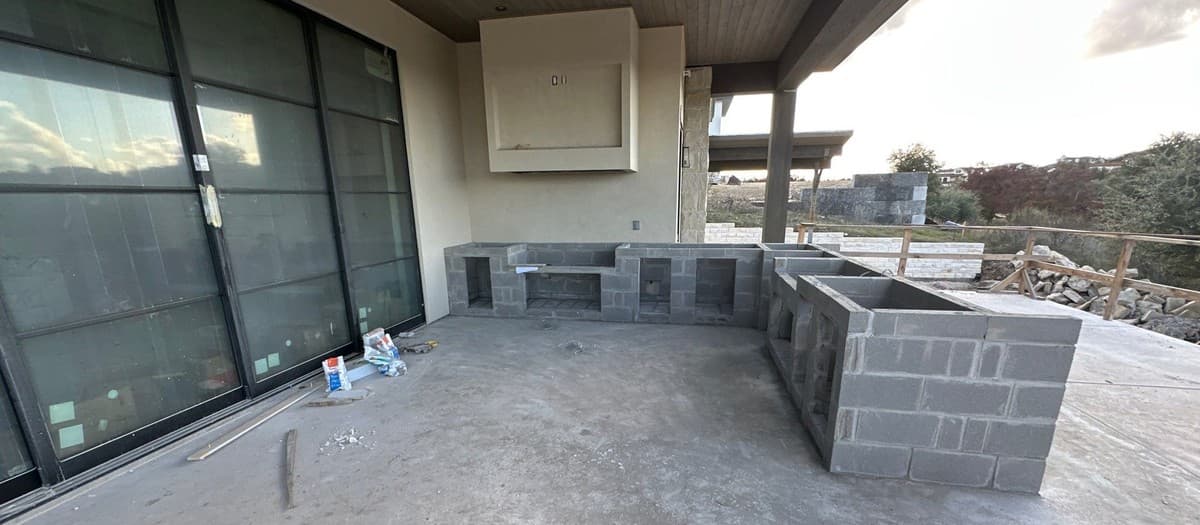
Outdoor kitchens have more moving parts per square foot than almost any landscape job. Structural frame, countertop material, appliances, gas rough-in, electrical, and plumbing — every category needs its own line item, or your estimate will not survive contact with the actual build.
The client shows you a photo from Houzz: stacked stone base, granite countertop, built-in grill, side burner, refrigerator, maybe a pizza oven. They ask what it costs. Before you say a number, you need to know whether gas already runs to the patio, whether a licensed electrician will be required, and whether the appliances are owner-supplied or contractor-supplied. Every one of those answers changes the number significantly.
Category 1: Structural Frame
The frame is what holds the countertop, supports the appliances, and gives the outdoor kitchen its shape. Most landscape contractors use one of three frame systems: concrete block (CMU), steel stud, or prefabricated aluminum frames like Kalamazoo or Cal Flame module systems.
- CMU block frame: $8–$14/SF of counter length for materials. Labor-intensive but durable and a solid base for stone veneer. Standard 8-inch CMU block at $1.80–$2.50 each.
- Steel stud frame with cement board: $6–$10/SF of counter length. Faster to build than CMU, requires cement board sheathing before veneer application. 20-gauge steel studs at $0.80–$1.20/LF.
- Prefab aluminum modules: $400–$900 per module wholesale. Install-ready from the supplier, accepts most standard appliances. Fastest installation but least customizable.
A typical 12-foot L-shaped kitchen runs 12–16 linear feet of counter length. Frame cost alone: $800–$2,000 for materials depending on system chosen.
Category 2: Countertop
Countertop material is often the most visible cost driver in an outdoor kitchen estimate. Clients upgrading from granite to quartzite or natural stone can swing $800–$2,500 on a 16-LF kitchen.
- Concrete countertop (site-cast): $65–$110/SF installed. Labor-heavy but highly customizable. Requires sealing.
- Granite (2 cm slab): $45–$85/SF fabricated and installed. Most common for mid-range outdoor kitchens.
- Porcelain tile countertop: $18–$35/SF for material + $15–$25/SF for installation. Lower cost but more grout maintenance.
- Quartzite or natural stone: $95–$160/SF fabricated and installed. Premium tier — worth offering as an upsell.
Measure countertop square footage accurately. Include the overhang (typically 1.5 inches) and any return or bar extensions. Countertop fabrication shops need your template or exact dimensions — mistakes here cost $500+ in re-fabrication.
Category 3: Finish Material (Veneer)
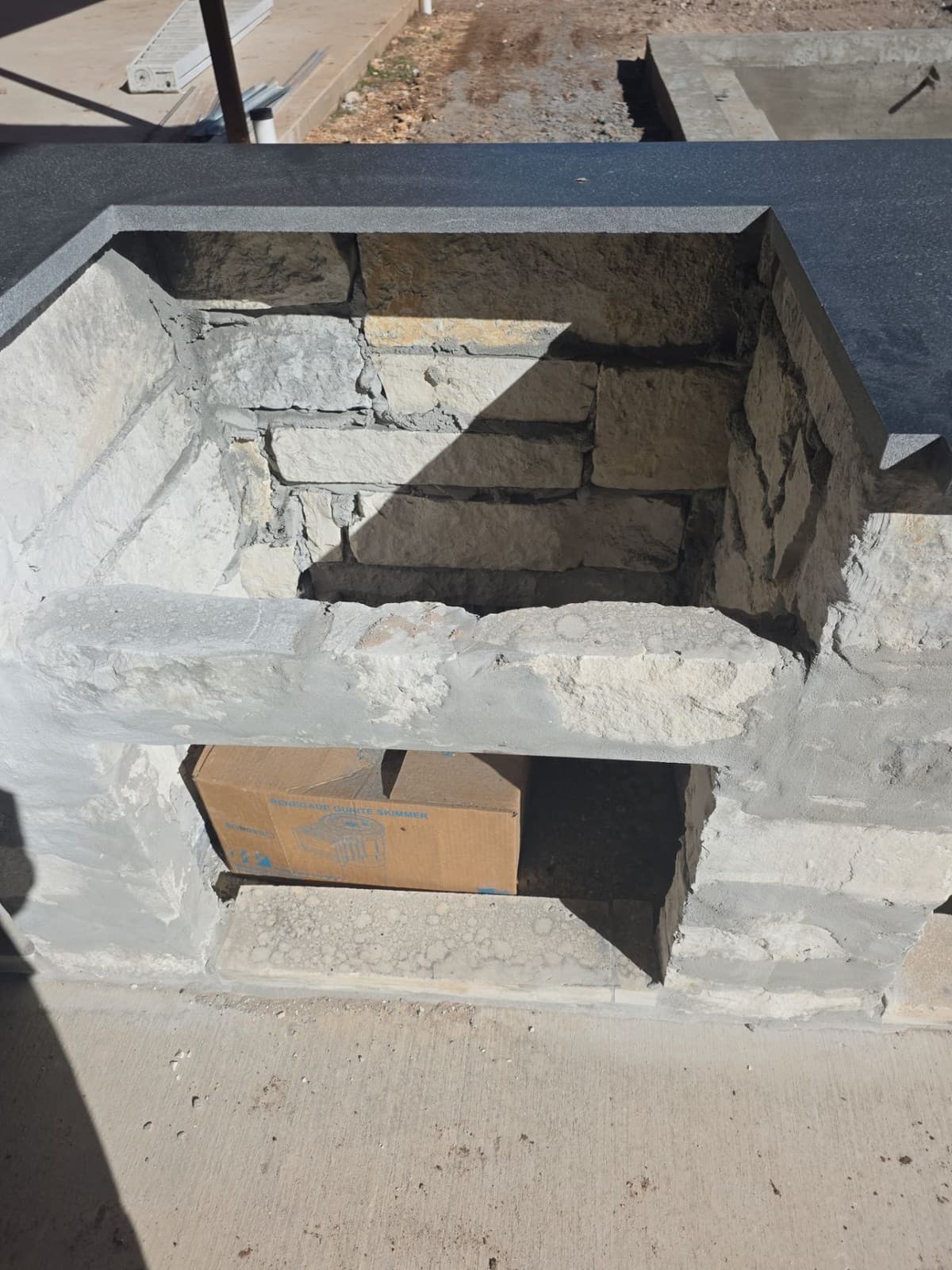
The exterior face of the outdoor kitchen base needs a weather-resistant finish. Stone veneer is the most common choice — cultured stone, natural thin-cut stone, or large-format porcelain tile.
- Cultured stone veneer (Belgard or Eldorado Stone): $8–$15/SF material + $12–$20/SF installation.
- Natural thin-cut stone: $14–$28/SF material + $15–$25/SF installation. Premium look, heavier to work with.
- Large-format porcelain tile: $6–$18/SF material + $12–$18/SF installation. Low maintenance and extremely durable outdoors.
Measure face area carefully — include the front, sides, and any knee wall. Subtract for door openings. For a 12-foot long, 36-inch tall kitchen base with an 18-inch deep return, you are looking at roughly 36–42 SF of veneer face.
Category 4: Appliances
This is where outdoor kitchen budgets split wide open. A basic built-in grill runs $800–$1,800 wholesale. A Twin Eagles or Lynx grill runs $3,500–$8,000. Get client appliance selection confirmed before finalizing the estimate — not after.
- Built-in grill (mid-range): $900–$2,500 wholesale (Lion, Summerset, or Blaze)
- Premium grill (Lynx, Twin Eagles): $3,500–$9,000 wholesale
- Side burner: $300–$800
- Outdoor refrigerator: $500–$1,400 wholesale
- Pizza oven: $1,800–$6,000+ depending on fuel type and manufacturer
Mark up appliances at 15–25%. You sourced them, you are responsible for warranty coordination, and you carried the cost while the client waited for delivery. That margin is earned.
Category 5: Gas, Electrical, and Plumbing
Are you running gas? Electrical? A sink with water supply and drain? Each of these requires licensed subcontractors in most jurisdictions. Price their work as a pass-through with your markup.
- Gas rough-in (licensed plumber or gas fitter): $600–$1,800 depending on run length from existing line and whether a new regulator is needed.
- Electrical rough-in (licensed electrician): $500–$1,400 for GFCI outlets, lighting circuit, and panel extension. 20-amp circuits required for refrigerators.
- Plumbing (sink and drain): $800–$2,200 depending on distance from drain connection and whether a grease trap is required.
"The grill gets the client's attention. The gas line gets your profit margin."
Labor Hours for Outdoor Kitchen Installation
A mid-range 12-foot L-shaped outdoor kitchen with CMU frame, granite countertop, stone veneer, built-in grill, and side burner runs 40–65 man-hours of landscape contractor labor — separate from the licensed sub work. That is 2.5–4 days for a two-man crew. Complex kitchens with pizza ovens, custom cabinetry, or multiple levels easily run 80–120 man-hours.
Stop guessing on estimates
Build accurate estimates in minutes, not hours.
Ledge has assembly-based estimating built in — material takeoffs, labor rates, and markup all in one place. No more spreadsheet math.
Book a Demo →Frequently Asked Questions
How much does a custom outdoor kitchen cost installed?
Entry-level outdoor kitchens (basic frame, tile countertop, mid-range grill) run $8,000–$15,000 installed. Mid-range builds with granite countertop, stone veneer, built-in grill, and side burner run $18,000–$30,000. High-end kitchens with premium appliances, custom cabinetry, pizza oven, and full plumbing often exceed $45,000. The appliance selection alone can move the total by $10,000–$20,000.
Do I need a permit for an outdoor kitchen?
Gas connections and electrical work require licensed contractors and inspections in virtually every jurisdiction. The structural build itself may or may not require a permit depending on whether it is attached to the house and how local code treats permanent outdoor structures. Pull the permit and get the gas and electrical work inspected — it protects you and the client.
What is the best countertop material for an outdoor kitchen?
Granite and porcelain are the two best choices for most outdoor kitchens. Granite handles heat well, resists UV fading, and is relatively affordable from fabrication shops. Porcelain tile is extremely durable, UV-stable, and low maintenance but shows grout over time. Avoid quartz outdoors — it is engineered for interior use and will discolor in direct sunlight. Concrete is excellent but requires regular sealing and professional installation.
Should I supply the appliances or let the client buy them?
Supplying appliances gives you margin and control. You confirm the specs, you receive delivery, you verify dimensions before the frame is built. When clients self-supply, you lose control of the spec — they often order something that does not fit the cutout dimensions you built. Take a clear position: supply appliances with a 15–20% markup, or charge a coordination fee for client-supplied units and disclaim responsibility for fit issues.
Edgar Galindo
Co-founder, Ledge
Edgar built Ledge while running a landscape design-build company in Central Texas. Outdoor kitchens taught him that the most expensive mistakes happen in the estimate, not the build.