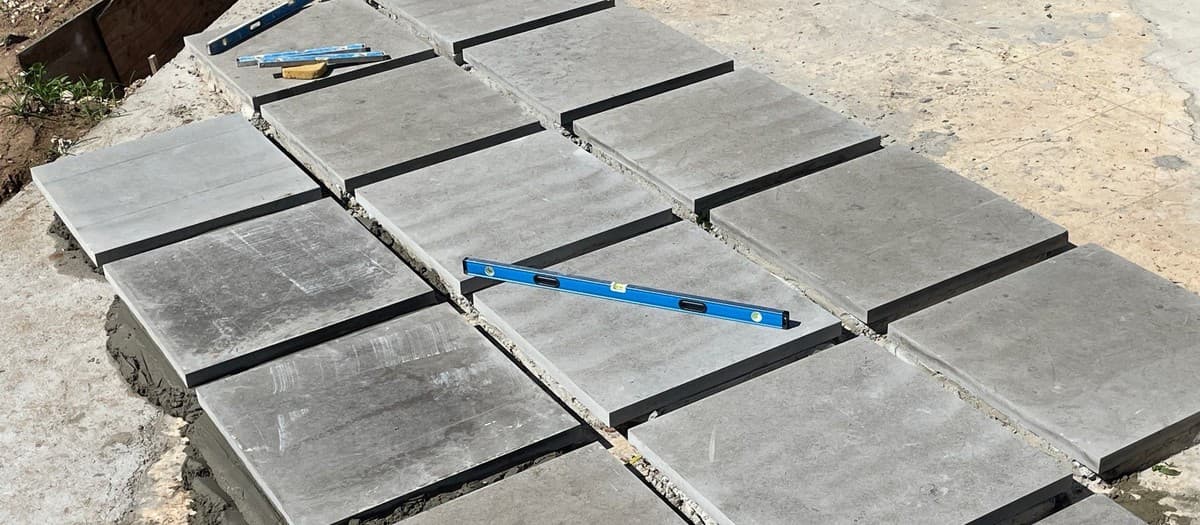
The "6-inch base" rule you learned in training is a starting point, not a rule. Actual depth depends on what is underneath and what is going on top. Here is how to get it right.
Callbacks from shifting pavers almost always trace back to an underdone base. Not a bad paver. Not a bad joint. The base was too shallow for the soil underneath, or too shallow for the load on top, or both. Getting the depth right before you dig is far cheaper than ripping out a finished patio.
The Two Variables That Drive Depth
Base depth is determined by two things: what the pavers will support (pedestrian vs. vehicle load) and how stable the soil is underneath. These are independent variables. You can have terrible soil with light loads, or great soil with heavy loads. Each combination calls for a different approach.
The base itself is just a load-spreading platform. Its job is to distribute weight evenly across the subgrade so the pavers never see a point load that causes one to sink relative to its neighbor. The weaker the subgrade, the thicker the base needs to be to spread that load. The heavier the load, the more base you need for the same subgrade conditions.
Depth by Load Type
For standard pedestrian patios — foot traffic, patio furniture, grills — 6 inches of compacted aggregate base is the minimum on average soil conditions. This is the number most ICPI-certified installation guides cite for standard applications.
For driveways or areas where passenger vehicles will park or drive, 8–10 inches is the standard. If heavy trucks or equipment will regularly use the area, go 12 inches or more. Remember that this is compacted depth. Aggregate compacts roughly 15–20% from loose to compacted state, so you need to place more than you think.
Pool decks are pedestrian load but have drainage requirements that often drive you toward a thinner base with a permeable design, or a base specifically engineered for water flow. Always check local building codes for pool deck specifications — many municipalities have their own requirements.
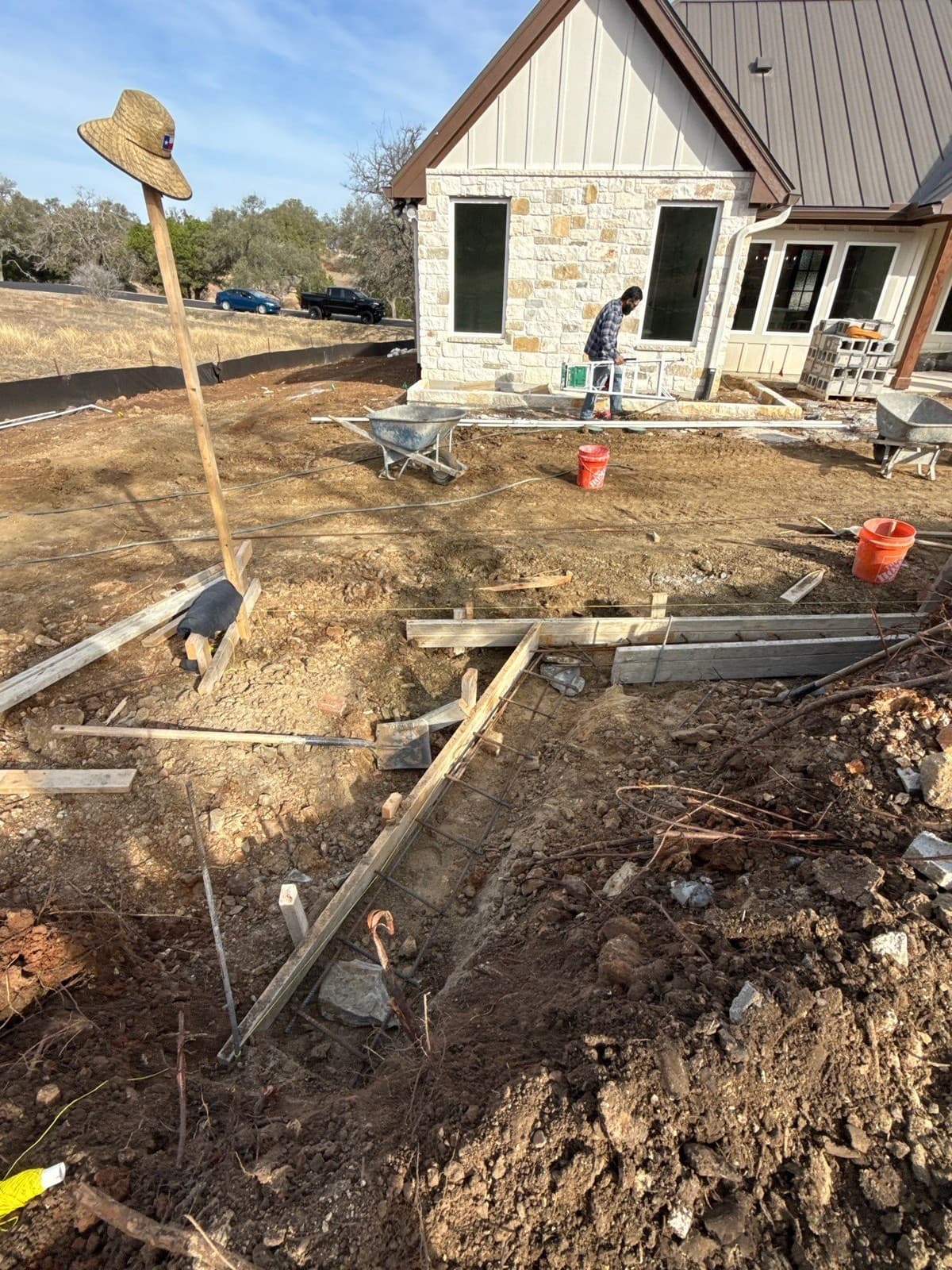
Depth by Soil Type
Sandy loam is the friendliest soil for paver installation. It drains well and compacts predictably. On sandy loam with good bearing capacity, 6 inches is usually adequate for pedestrian applications. Proof-roll the subgrade with a loaded wheelbarrow or skid steer. If it stays firm, you are in good shape.
Clay soil is the most common problem in Central Texas residential work. Clay is expansive — it shrinks in drought and swells when wet. That movement is enough to displace a paver over a season. On heavy clay, increase your base depth to 8–10 inches for pedestrian applications. Some contractors also use a layer of coarse crushed stone before the standard base to break up capillary action and provide additional drainage.
Decomposed granite (DG) is common in Hill Country areas west of Austin. DG compacts well and has decent bearing capacity when properly densified. Treat it similarly to sandy loam but be careful of wet-season softening — DG turns to mush when saturated. Ensure positive drainage away from the patio perimeter.
Caliche is the wild card in Austin and San Antonio area projects. Dense, intact caliche can be used directly as a bearing layer — it is essentially a natural cement layer and is extremely stable. However, fractured or crumbly caliche behaves more like loose gravel. When you hit caliche during excavation, probe it. If it holds a solid bearing under your boot and a steel rod, you can reduce your added base depth. If it breaks apart easily, excavate it and treat it like unstable fill.
"We dug a job in South Austin and hit solid caliche at 4 inches. Cut the base to 4 inches of added aggregate, compacted everything, and that patio has been perfect for three years. Read your soil."
Base Material: What Actually Belongs in There
Crushed angular aggregate is the correct base material. Specifically, 3/4-inch minus crushed limestone, crushed granite, or crusher run. These materials compact into a stable, interlocked mass because the angular particle faces lock against each other under load.
Do not use pea gravel, river rock, or round aggregate as your base. Round stones do not interlock. They roll under load, and your pavers will follow. The cost difference between pea gravel and crusher run is minimal. The performance difference is enormous.
Do not use sand as your base layer. Sand is for the 1-inch bedding layer only. Sand in the base moves, especially when it gets wet. Base material needs to be angular aggregate that compacts to a solid mass.
Quick Reference: Depth by Situation
| Application | Soil | Base Depth |
|---|---|---|
| Pedestrian patio | Sandy loam / DG | 6 in. |
| Pedestrian patio | Clay | 8–10 in. |
| Pedestrian patio | Dense caliche | 4–6 in. |
| Driveway (passenger vehicles) | Sandy loam | 8–10 in. |
| Driveway (passenger vehicles) | Clay | 10–12 in. |
| Heavy vehicle / RV | Any | 12+ in. |
Estimate base material quantities in seconds
Ledge calculates aggregate base tonnage, bedding sand, and paver quantities automatically when you enter your dimensions. Build your estimate without a calculator.
Frequently Asked Questions
Can I use less base if I add a geotextile fabric?
Geotextile fabric prevents fines from migrating up and keeps your base from punching into soft subgrade, but it does not replace base depth. Fabric is not structural. You still need the correct depth of compacted aggregate on top of the fabric.
Does paver thickness affect base depth requirements?
Thicker pavers (3 1/8 inch vs. 2 3/8 inch) distribute load better across a wider contact area, which can reduce stress on the base slightly. But for practical purposes, use the same base depths regardless of paver thickness. The base depth table above applies to both standard 2 3/8-inch and thick 3 1/8-inch pavers.
How do I know if my subgrade is good enough?
Proof-roll with a loaded wheelbarrow, skid steer, or your plate compactor. Any area that deflects noticeably or shows pumping action when driven over is too soft. Dig those areas out and replace with compacted fill. A simple penetrometer test can also give you a rough bearing capacity reading if you want a number.
What happens if I skimp on base depth?
The pavers will settle unevenly over time. This usually shows up in 6–18 months as individual pavers sinking or tilting, joints opening up, or water pooling in low spots. The fix almost always involves lifting pavers, adding base material, recompacting, and resetting — which costs more than getting the depth right the first time.
Is crusher run the same as road base?
They are similar products. Road base and crusher run are both angular crushed aggregate that includes fines. Road base terminology is more common in Texas; crusher run is more common in other regions. Either product works well as a paver base. Confirm with your supplier that the material is angular crushed aggregate, not round gravel.
Edgar Galindo
Co-founder, Ledge
Edgar built Ledge while running a landscape construction company in Central Texas. He writes about installation techniques, estimating, and building a profitable field operation.