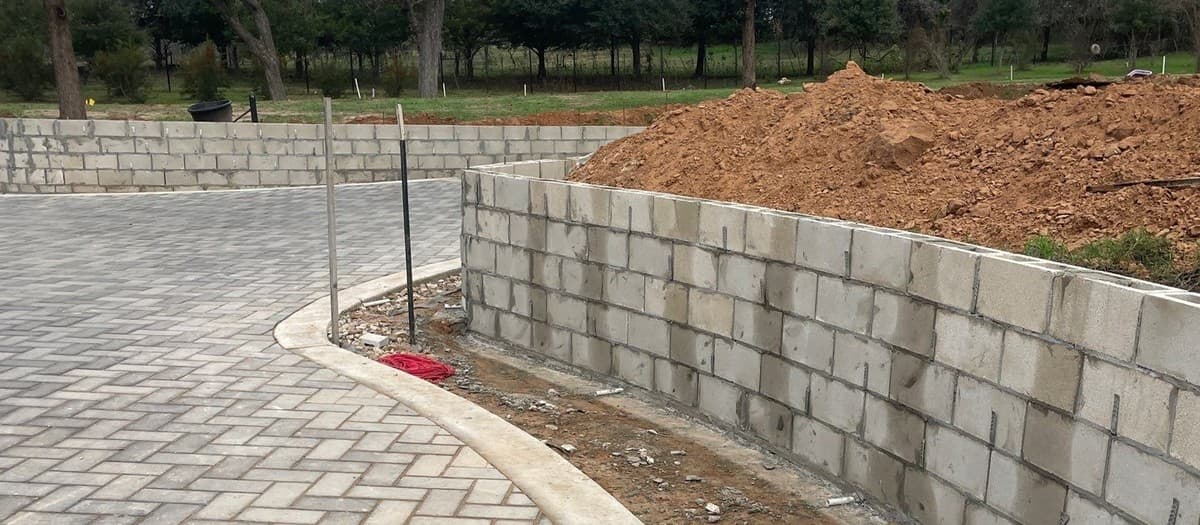
A paver patio that lasts 20 years is built in the base, not at the surface. Here is the full process from excavation to final compaction, the way crews that stand behind their work actually do it.
Most paver callbacks come down to one thing: the base moved. Not a bad paver, not a bad joint — the base shifted, the surface followed, and now a homeowner is calling six months after install because their patio looks like a potato chip. Getting that base right is the entire job. Everything else is just finishing.
Step 1: Layout and Excavation
Start with stakes and string lines to define your perimeter. Mark the finished surface elevation first, then work backward: finished pavers sit on 1 inch of bedding sand, which sits on your compacted base. For pedestrian patios, budget 6–8 inches of compacted aggregate base. For driveways or areas with vehicle loads, go 10–12 inches. Add an inch for the bedding layer, and you have your total excavation depth.
In Central Texas, you will often hit caliche within the first 12 inches. Dense caliche can actually serve as a solid bearing layer, but fractured or crumbly caliche needs to come out. When in doubt, excavate past it and bring in clean crushed limestone base.
Mark your slope direction before you dig. You need a minimum 2% grade (roughly 1/4 inch per foot) away from any structure. On a 20-foot-deep patio against a house, that means your outer edge should sit about 5 inches lower than your house-side edge. Set this in your string lines before the excavator shows up.
Step 2: Sub-Base Prep and Compaction
Once you hit grade, proof-roll the subgrade with your skid steer or plate compactor. Any soft spots — areas that flex or pump — need to be dug out and filled with compacted crushed limestone or road base. Do not skip this step. Soft spots will show up in your finished surface within one freeze-thaw or one heavy Texas thunderstorm.
Install a non-woven geotextile fabric over the prepared subgrade before bringing in your base material. The fabric keeps fines from migrating up into your aggregate and keeps your base from punching down into soft clay over time. Overlap seams by at least 12 inches and fold the edges up against your edging or form boards.
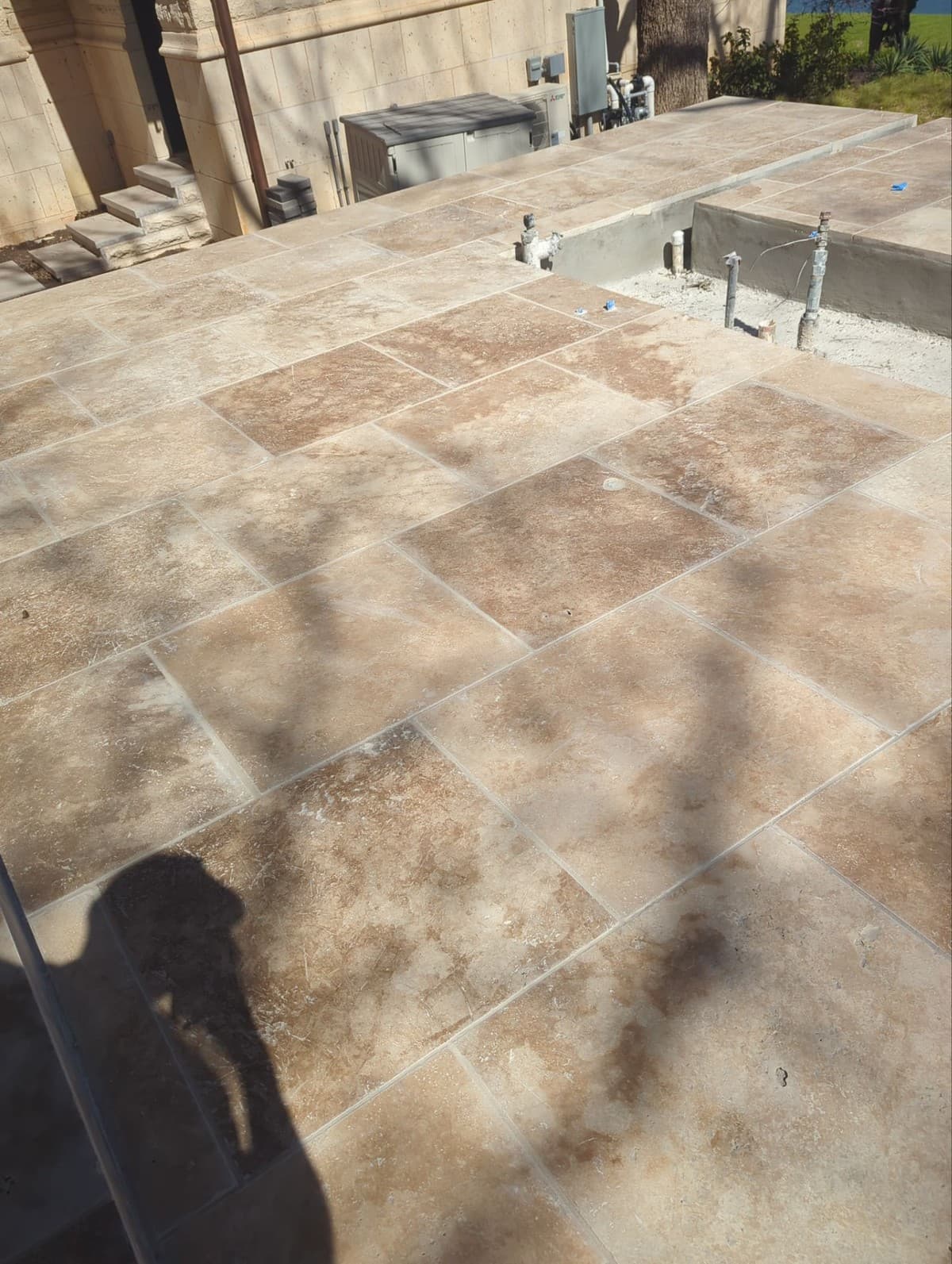
Step 3: Aggregate Base — Lifts and Compaction Targets
Place and compact your base material in lifts no thicker than 4 inches. Trying to compact 8 inches at once is one of the most common mistakes on residential hardscape crews. The plate compactor can only densify so deep — typically 4–6 inches, depending on the machine. Use a 3,000–5,000 lb/f plate compactor, not a jumping jack, for this application.
Crushed angular aggregate is what you want — 3/4-inch minus clean crushed limestone or granite. Angular material locks together under compaction in a way that round river gravel never will. Run the compactor in overlapping passes, both perpendicular and diagonal to your patio axis. Add a light mist of water if the material is dry; it helps compaction. Do not flood it.
Check your screed rails or string lines after each lift. The compaction process will pull everything down slightly. Re-check grades before installing bedding sand.
"The grade you set in the base is the grade you live with in the surface. There is no fixing slope problems after the pavers go down."
Step 4: Bedding Sand and Screed
Bedding sand goes in at exactly 1 inch loose, which compacts to about 3/4 inch under the paver. Use coarse concrete sand — not mason sand, not play sand. Mason sand is too fine and will wash out under the joints over time. Coarse sand provides the right particle size for the pavers to seat into without going anywhere.
Set your screed rails (1-inch diameter conduit works well) directly on the compacted base, positioned to match your slope. Spread sand and screed it off level with the rails. Remove the rails and fill those channels with sand by hand. Do not compact the bedding sand before laying pavers. The whole system is designed for the pavers to be set and then compacted together.
Do not walk on screeded sand. If you must re-enter the area, place kneepads or a board to distribute your weight. Any foot impressions in the sand will show up as low spots in the finished surface.
Step 5: Setting Pavers
Start from a fixed, straight edge — either your house wall or a pre-set soldier course along the patio perimeter. Lay pavers in your chosen pattern, keeping consistent joint spacing. Most Belgard and Techo-Bloc products have built-in spacer nibs cast into the sides, which makes this easier. For products without nibs, use 1/8-inch spacers.
Cut pavers at the edges with a diamond blade saw. A quality ring saw like the IQ Power Tools unit gives you cleaner cuts and a lot less dust than a standard circular saw with a diamond blade. For curved edges, a hand grinder with a diamond blade gives you the most control.
Check your layout with a string line or long straightedge every 4–6 feet. Pavers can drift in pattern. Catching a 1/4-inch drift early is easy; catching it after 200 square feet means re-setting a large section.
Step 6: Edge Restraints, Compaction, and Jointing
Install edge restraints before final compaction. Snap edge (the plastic flexible restraint) is the standard for curved work; aluminum or steel restraint is better for straight runs that need to hold against vehicle loads. Spike at least every 12 inches, closer on curves. The edge restraint holds the field pavers from migrating outward under load.
Run the plate compactor over the entire surface with a rubber pad or neoprene pad installed on the base plate. This seats the pavers into the bedding sand and brings everything to final grade. Make two to three passes in different directions.
Spread polymeric sand (Techniseal HP+, Alliance Gator G2, or similar) across the surface and sweep it into the joints using a push broom. Work it into every joint, then blow off all excess with a leaf blower on low speed before it cures. Any polymeric sand left on the surface will haze the pavers. Run the plate compactor one more time to seat the sand, then mist the surface evenly according to the manufacturer's specs. Do not flood it. Over-watering causes the polymer to cloud and prevents proper curing.
Estimate paver jobs faster with Ledge
Build paver patio estimates with real material quantities, labor hours, and markups — then send a professional proposal in minutes. No spreadsheets required.
Frequently Asked Questions
How long should polymeric sand cure before rain?
Most polymeric sands need 24 hours to cure before being exposed to rain. If rain is coming within 24 hours, postpone jointing. Once wet, uncured polymeric sand can wash out of joints and cloud on the surface. Check the manufacturer's data sheet — some newer formulations cure faster.
Can I install pavers over an existing concrete slab?
Yes, but only if the slab is structurally sound and has adequate drainage slope. You would typically use a dry-set mortar or pedestal system rather than traditional bedding sand on concrete. The slab must not have heaving or cracking issues that will telegraph through your paver surface.
What paver brands are best for residential patios in Texas?
Belgard, Techo-Bloc, and Unilock all produce high-quality concrete pavers that perform well in the Texas heat. For natural stone work, Austin limestone and Lueders limestone are locally sourced and excellent. Belgard has the widest regional distribution in Central Texas, which makes warranty support easier.
How much slope do I need for drainage?
Minimum 2% (1/4 inch per foot) away from any structure. More is better where drainage paths are long. For patios that drain onto grass or into landscaping, this is usually enough. If the patio drains toward a structure or into a closed area, you may need a channel drain or French drain at the low edge to capture water before it causes problems.
Should I seal the pavers when I'm done?
Sealing is optional on concrete pavers but highly recommended for natural stone and for any patio near a pool or outdoor kitchen where grease and organic staining are likely. Wait at least 90 days before applying sealer to new concrete pavers to allow the efflorescence to clear. Use a penetrating sealer appropriate for the paver type.
Edgar Galindo
Co-founder, Ledge
Edgar built Ledge while running a landscape construction company in Central Texas. He writes about installation techniques, estimating, and building a profitable field operation.