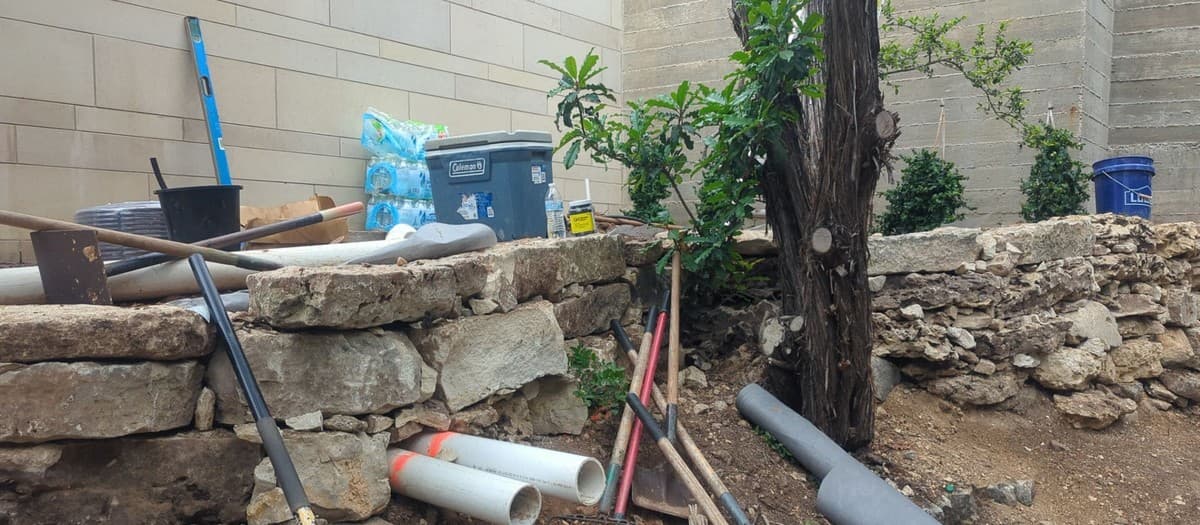
A dry-stack freestanding garden wall is one of the most accessible hardscape projects for a landscape crew — no mortar, no engineer, and a result that looks custom every time.
Freestanding garden walls are different from retaining walls in one fundamental way: they do not hold soil back. They stand on their own and are exposed to the elements on both sides. That changes how you build them — the base needs to account for differential movement, the wall needs to be wide enough to be stable without soil mass behind it, and caps need to be secured to prevent shifting.
Height Limits for Dry-Stack Freestanding Walls
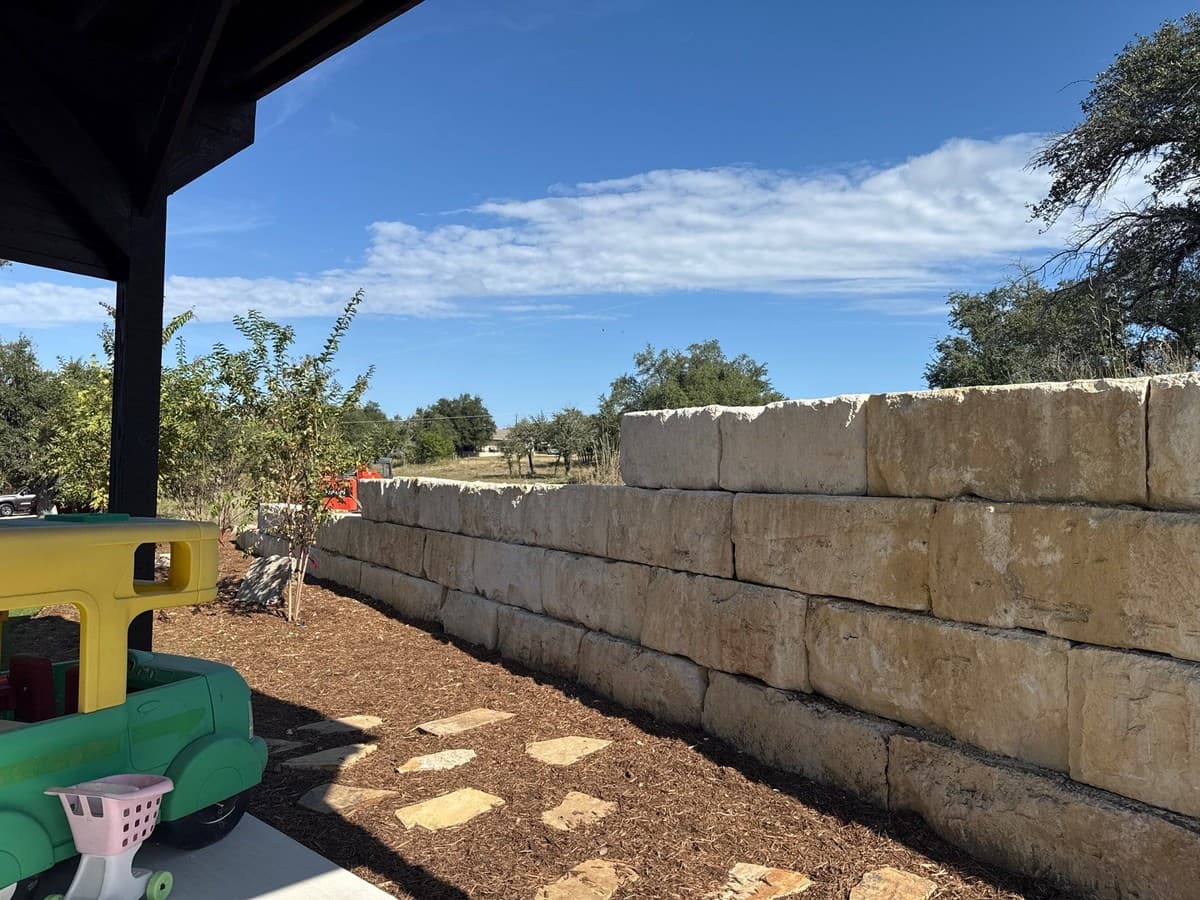
Keep dry-stack freestanding walls under 3 feet of exposed height. Beyond that, a wall with no retained soil mass behind it and no mortar is vulnerable to lateral movement from wind, casual contact, and ground movement. Most garden walls clients ask for are 18–24 inches — which is comfortable for seating, clear for planting bed definition, and very buildable without engineering.
If a client wants a taller freestanding wall — 3–4 feet — consider mortared construction or a block system with glued courses. Dry-stack is appropriate for decorative walls at garden scale; for walls that need to stand up to Texas wind events or regular physical contact, adhesive or mortar-set construction is more appropriate.
Material Options: Block vs. Natural Stone
For concrete block garden walls, look at Belgard's Cambridge Cobble, Techo-Bloc's Raffinato, or Unilock's natural-finish products. These are designed for double-faced applications — both faces look good — which is exactly what a freestanding wall requires. Retaining wall block is often single-faced (a finished face and a rough back); verify before ordering.
For natural stone, Lueders limestone and Oklahoma flagstone both work well for freestanding garden walls in Texas. Lueders is more uniform and easier to work with. Oklahoma flagstone gives a thinner, more layered appearance. Both can be dry-stacked to 24 inches without issue on a proper base.
Base Preparation
Excavate a trench 6 inches deep and at least 4 inches wider than your wall on each side. Fill with 6 inches of compacted 3/4-inch crushed aggregate. This base serves two purposes: it provides a stable, level starting surface and it allows water to drain away from the wall footing so the base does not become a saturated mud layer that shifts seasonally.
Level the compacted aggregate carefully. The first course of a freestanding wall needs to be perfectly level front-to-back and along the wall run. A freestanding wall has no soil mass behind it to correct for minor lean — any tilt you put in at the base will be visible in the finished wall.
Coursing and Joint Stagger
Stagger joints by at least half a unit between courses. This is the structural core of any dry-stack wall — each block bridges the joint below, locking the course together. Never run a continuous vertical joint through more than one course. On natural stone walls, this means choosing and placing stones with deliberate thought, not just grabbing whatever is closest.
For freestanding walls, maintain consistent width throughout the wall height. A common approach is to use full-length blocks for the wall body and half-blocks to start alternate courses, keeping the stagger right while maintaining wall width. For natural stone, use your largest, flattest stones as "bond stones" — stones that span the full wall width — at regular intervals to tie the two faces together.
Keep courses level as you build. Use a level and a string line. It is easy to drift slightly on a natural stone wall where units are irregular. Check every 3–4 courses with a long level to catch any lean before it compounds.
"Garden walls sell themselves — clients see them and picture their yard transformed. But they need to be built as well as they look."
Cap Installation
The cap course is what finishes a freestanding wall and makes it look intentional. For concrete block walls, use the manufacturer's matching cap or a contrasting material like Lueders limestone flat cap. For natural stone walls, select your flattest, most uniform stones for the top course.
On freestanding walls, glue caps down even on dry-stack construction. Use landscape block adhesive (Loctite PL 500 or similar). A dry-stacked cap on a freestanding wall is one windstorm away from being knocked loose. Glued caps stay where you put them. Apply adhesive to the top of the last block course, set the cap, and wipe any excess before it cures.
Price garden walls faster and win more bids
Ledge helps landscape contractors build estimates for any hardscape scope — garden walls, patios, drainage — and send professional proposals the same day as the site visit.
Frequently Asked Questions
Do freestanding garden walls need a concrete footing?
For walls under 2 feet, a compacted aggregate base is typically sufficient. For walls over 2 feet, particularly in clay soil that moves seasonally, a concrete footing improves long-term stability. A 4-inch concrete pad over 6 inches of compacted aggregate is a practical upgrade on sites with expansive soil.
How wide should a freestanding wall be?
A general rule: wall width should be at least one-third of wall height for adequate stability. A 24-inch tall wall should be at least 8 inches wide. Standard concrete block at 12 inches depth easily satisfies this for garden-height walls. For natural stone, aim for at least 10–12 inches of wall thickness on walls over 18 inches tall.
Can I plant directly in or over a freestanding wall?
Yes. Natural stone dry-stack walls are excellent for planting in the joints — sedum, creeping thyme, and native groundcovers all work well. Fill joint pockets with a sandy soil mix before planting. Concrete block walls can have planting pockets at the top if designed with that intent from the start.
How long does it take to build a 20-foot freestanding garden wall?
A two-person crew can typically build 20 linear feet of 18–24 inch freestanding garden wall in a full day, including base prep and cap installation with concrete block. Natural stone takes longer — figure 1.5–2 days for the same linear footage and height. Material delivery and staging time should be planned in addition to installation time.
Edgar Galindo
Co-founder, Ledge
Edgar built Ledge while running a landscape construction company in Central Texas. He writes about installation techniques, estimating, and building a profitable field operation.