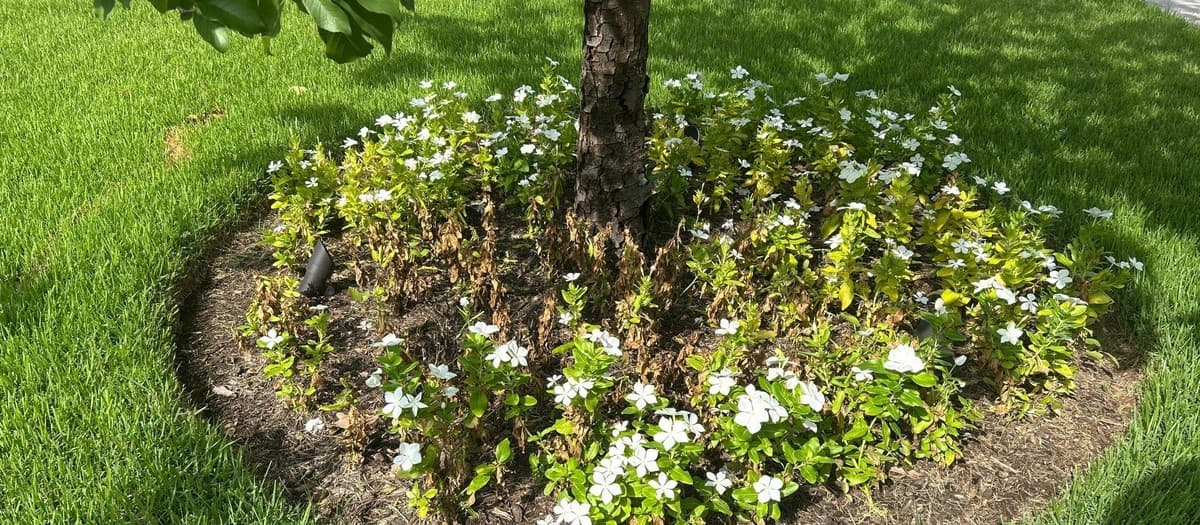
The tree type you spec affects install time, survival rate, and project cost. Knowing when each form works best keeps you profitable and keeps trees alive.
Most landscape contractors default to container trees because that's what the local nursery stocks year-round. But container trees aren't always the right call. For large-caliper installs, certain species, or specific planting windows, B&B and bare root each offer real advantages. Knowing when to use which form is a spec skill that affects your margins, your survival rates, and your reputation.
Balled-and-Burlapped (B&B): The Large-Caliper Standard
B&B trees are field-grown, dug with a portion of the root ball intact, and wrapped in burlap and wire. They're the standard for large-caliper trees — 2-inch caliper and above — because container growing at that size is impractical. A 3-inch caliper live oak in a container would require a 200+ gallon pot. Most large specimens you see from quality nurseries are B&B.
Advantages of B&B:
- Available in large caliper sizes not possible in containers
- Root system is adapted to native field soil conditions
- Immediate visual impact — the client sees a real tree, not a sapling
Disadvantages:
- Heavy — a 2-inch caliper tree ball can weigh 400–600 lbs. Requires equipment to move and plant.
- Root system is significantly reduced during digging. Establishment stress is real — expect some leaf drop even on healthy trees.
- Limited planting window. Best installed when dormant (late fall through early spring in Texas). Summer B&B installs need intensive irrigation management.
- Species-sensitive. Oaks, elms, and pecans transplant well as B&B. Some species transplant poorly — check with the nursery before speccing any tree type as B&B.
Container Trees: The Year-Round Workhorse
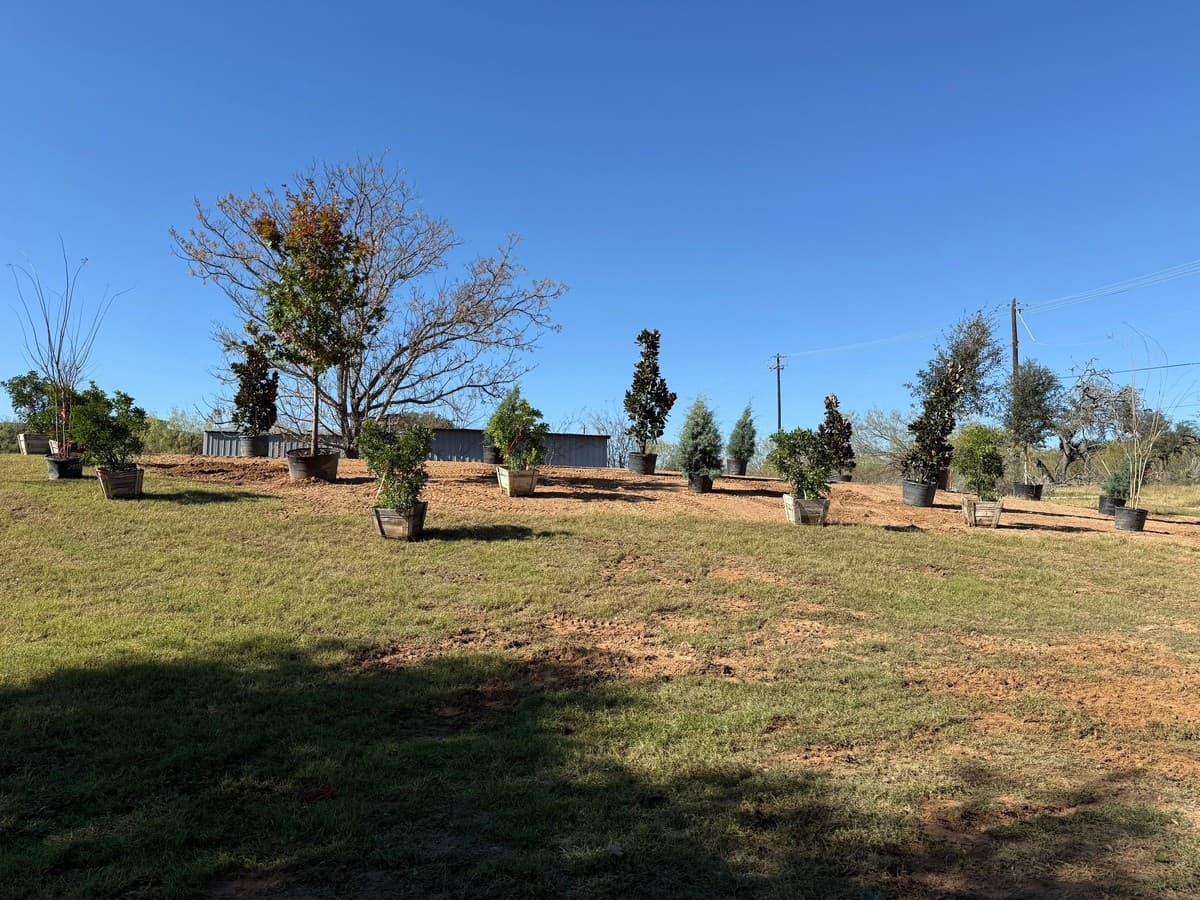
Container trees are grown in plastic pots — 1-gallon through 200-gallon — and can be planted year-round because the root system is fully intact. They're the backbone of most residential landscape installs for small to medium trees (up to roughly 2-inch caliper) and for specimen shrubs.
The main thing to check on any container tree before installing: root bound condition. Pull the tree from the pot and look at the root system. If roots are circling the bottom in tight coils, they need to be cut before planting. Use a serrated knife to make 4 vertical cuts down the root ball, 1 inch deep, spaced at 90° intervals. Without this step, circling roots continue to grow in circles — and eventually girdle the trunk years after installation.
Container advantages:
- Plant any time of year
- Full root system intact — less transplant shock
- Lighter and easier to handle without equipment for smaller sizes
- Available at most nurseries year-round
Disadvantages:
- Limited to smaller caliper sizes at most nurseries
- Root bound risk if the tree has been in the container too long
- Container soil (often peat-heavy) can create a hydrophobic interface with native clay soil — water pools in the container medium and doesn't infiltrate properly into the surrounding soil
"Always pull a container tree from the pot before you spec it. If the roots are tight circles at the bottom, that's the contractor before you's problem — and now potentially yours."
Bare Root Trees: The Dormant-Season Option
Bare root trees are field-grown, dug while dormant, and shipped with no soil around the roots. They're typically available only in winter months — December through February — and must be planted while still dormant. If you miss the window, bare root trees die quickly.
Bare root advantages:
- Significantly cheaper than B&B or container at comparable sizes. A bare root peach or fruit tree that would cost $80 in a 15-gallon container costs $15–$25 bare root.
- Lighter and easier to handle — no soil weight.
- Often available in varieties not stocked by local nurseries. Specialty fruit trees, heirloom varieties, and native species are commonly available bare root through mail-order suppliers like Arbor Day Foundation, Raintree Nursery, or Willis Orchard Company.
- Faster establishment than B&B — bare root trees develop extensive root systems quickly once planted because they can start growing immediately without the constraint of a burlapped root ball.
Bare root disadvantages:
- Narrow planting window — dormant season only
- Roots dry out quickly. Plant within 24–48 hours of receiving. If you must hold them, wrap roots in damp burlap and keep in a shaded, cool location.
- Smaller sizes only — typically up to 1.5-inch caliper
- No immediate visual impact — clients see a stick in the ground, not a tree
Choosing by Project Type
Match the tree form to the project requirements:
- High-end residential with immediate impact requirements: B&B for large specimen trees. Container for smaller accent trees and shrubs.
- Large-scale planting projects with budget constraints: Bare root for fruit trees, native species, and wind breaks where quantity matters more than immediate size.
- Year-round planting: Container only. B&B and bare root have seasonal constraints that don't work for crews that install through summer.
- Slope stabilization and erosion control: Bare root native species planted in winter establish root systems faster than container trees and cost a fraction of B&B.
Frequently Asked Questions
Which tree form has the best survival rate after planting?
Container trees, when planted correctly and not root bound, have the highest survival rates because the full root system is intact. Bare root trees planted in dormancy also establish well. B&B trees have the most transplant stress because of root loss during digging.
Can you plant B&B trees in summer in Texas?
Yes, but it requires intensive irrigation management — watering every 2–3 days during establishment in June through August. Most B&B failures happen on summer installs where the client under-waters. Best window is October through March for B&B trees in Central Texas.
How do you check if a container tree is root bound?
Pull the tree from the pot and look at the bottom of the root ball. Tight circular roots at the bottom indicate root bound condition. Make 4 vertical cuts 1 inch deep at 90° intervals around the root ball before planting to redirect root growth outward.
When should I use bare root trees on a landscape project?
Winter planting projects where budget matters, large-scale native or fruit tree installations, and erosion control plantings. Plant within 24–48 hours of receiving. Only available during dormancy — typically December through February.
Build Plant Estimates That Win Jobs
Ledge lets you build planting estimates with species, container size, and unit cost built into every line item. Proposals go out fast and clients see exactly what they're getting.
Edgar Galindo
Co-founder, Ledge
Edgar built Ledge while running a landscape construction company in Central Texas. He writes about installation techniques, estimating, and building a profitable field operation.