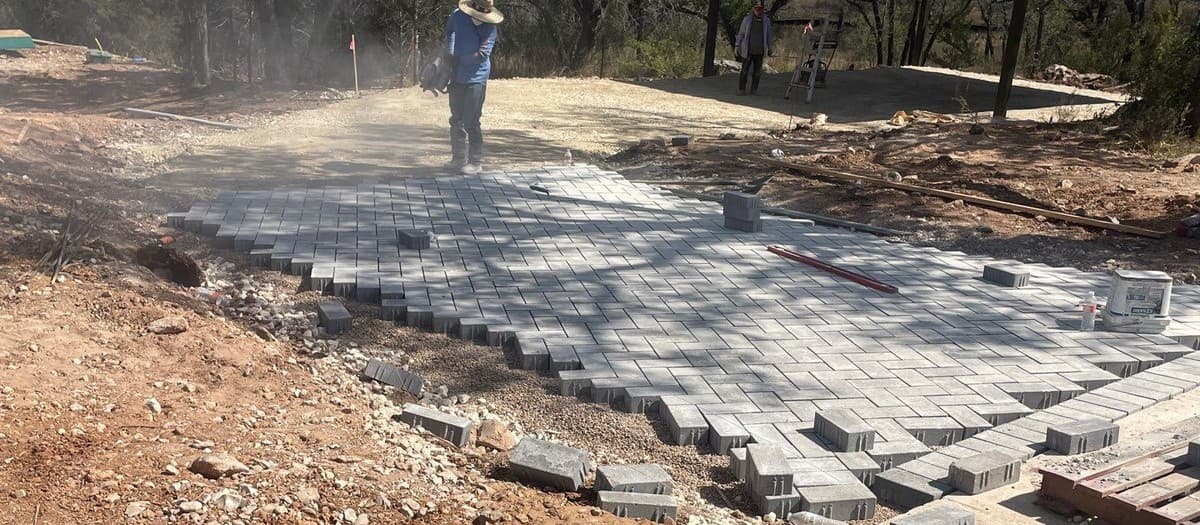
You cannot manage crew performance without a baseline. Here are real production rates for the most common landscape construction tasks — and how to use them to catch problems before they cost you.
Your crew finishes a job two days late. Was that a scope problem, a production problem, or did something go sideways on site? Without production rate benchmarks, you cannot tell. You can only know a crew is behind if you know what on-pace looks like — in measurable numbers, not gut feel.
Production rates do two things: they let you estimate labor accurately before a job starts, and they let you manage performance while a job is running. Neither is possible without a baseline. Here is what that baseline looks like across the most common landscape construction tasks.
Paver Installation Production Rates
These numbers assume base is already compacted and crew is working on a prepared, accessible site. Rates are per two-man team per eight-hour day.
- Running bond pattern, flat grade, good access: 300–380 SF/day
- 45-degree herringbone, flat grade: 200–270 SF/day
- Complex fan or circular pattern with soldier course: 130–180 SF/day
- Backyard access through 36-inch gate, wheelbarrow material: Subtract 20–30% from the above rates
- Steps or risers (per step): 1–2 hours per step depending on cut complexity
Base Preparation and Excavation
Base prep is where most crews lose time — and where production variance is highest. Machine access, soil type, and depth all swing the numbers.
- Machine excavation (mini-ex, good soil, machine access): 600–900 SF/day at 8-inch depth
- Hand excavation (no machine access): 150–250 SF/day at 6-inch depth — this destroys timelines
- Base compaction (plate compactor, 6-inch lifts): 800–1,200 SF/day
- Bedding sand screeding: 500–700 SF/day for a two-man crew
Sod, Mulch, and Planting Rates
- Sod installation (flat, prepared bed, pallet delivery on site): 1,200–1,800 SF/day per two-man crew
- Sod on slopes or irregular shapes: 700–1,000 SF/day
- Mulch spreading (3-inch depth, wheelbarrow delivery): 30–45 cubic yards/day for a two-man crew
- Planting 5-gallon shrubs: 18–30 plants/day depending on spacing and soil conditions
- Planting 15-gallon trees (hand digging): 6–10 per day
Retaining Wall Production Rates
- Segmental retaining wall (Versa-Lok or similar), 2–3 ft height: 50–80 SF of face per day per two-man crew
- Taller walls (4–6 ft with geogrid): 35–55 SF/day — geogrid courses add significant setup time
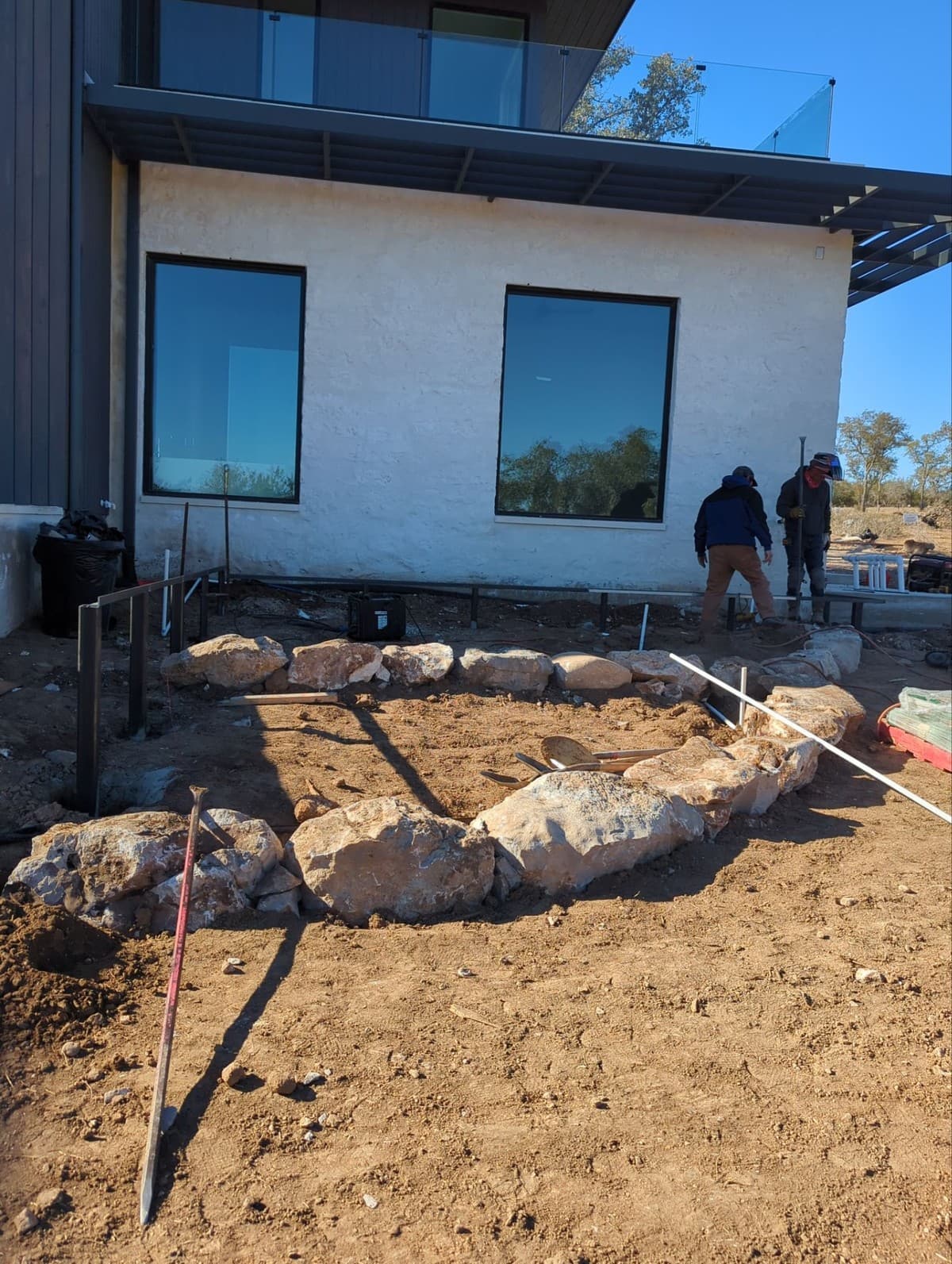
- Natural stone dry-stacked: 20–40 SF/day — requires more fitting time, highly skill-dependent
"If you do not know what on-pace looks like, you cannot know your crew is behind until it is too late to fix it."
How to Use Production Rates to Manage Crew Performance
Set a daily target at the start of each job — in square feet, linear feet, or units depending on the task. Check in at noon, not at end of day. By midday you can still redirect effort, add a person, or adjust scope. By 3pm it is too late.
When production is consistently below your baseline, look for causes before drawing conclusions about crew effort. Is material delivery the bottleneck? Is the equipment being shared? Is there a site access problem nobody mentioned? Solve the constraint first. Most production shortfalls are logistics problems, not effort problems.
Build your own rates over time by recording actual production on each job. After 20 jobs, you will have market-specific, crew-specific numbers that are more accurate than any published benchmark. That data is worth real money — it means your labor estimates stop being guesses.
Run a tighter operation
Ledge gives you visibility into every job without being on-site.
Job tracking, crew assignments, photo documentation, and production notes — all in your phone. Stop managing by walking job sites.
Book a Demo →Frequently Asked Questions
How many square feet of pavers can one person install per day?
One person working solo on paver installation will produce roughly 100–180 SF/day depending on pattern and site conditions. Most of the efficiency in paver work comes from a two-person team — one cuts, one lays. Solo installation is significantly slower per person than a paired crew. Always pair your paver crew when possible.
Why does pattern complexity affect paver production rates so much?
Cuts are the bottleneck. Running bond uses fewer cuts per square foot than herringbone or fan patterns. Every additional cut requires saw time, repositioning, and fitting. On a 45-degree herringbone job, roughly 30–40% of field pavers need at least one cut at a border. That time adds up fast across a large patio.
What is a realistic production rate for mulch installation?
A two-man crew spreading mulch from wheelbarrows can move 30–45 cubic yards in a day under good conditions — flat site, material delivered near the beds, no edging needed. Tight beds with lots of plant material to work around slow this down to 20–30 CY/day. If you are also edging and grading before mulching, plan for less.
How do I build my own production rate database?
After each job, record the quantity installed (SF, CY, LF), the man-hours spent on that specific task, and any conditions that affected pace — access, weather, soil type, pattern. After 15–20 jobs, you have crew-specific, market-specific data that is far more useful than generic industry averages. Build your estimates from your own history, not from someone else's.
Should I use production rates when training new crew members?
Yes — but with a realistic adjustment. New crew members typically produce at 50–70% of your established baseline during their first 30–60 days on a new task. Build that into your labor estimate on jobs where you are using a newer worker. Hold the baseline as the goal, give the adjusted rate as the estimate. Close the gap through pairing with experienced crew and clear daily feedback.
Edgar Galindo
Co-founder, Ledge
Edgar built Ledge while running a landscape design-build company in Central Texas. He has tracked production rates across hundreds of installs and used that data to build better estimates and tighter crews.