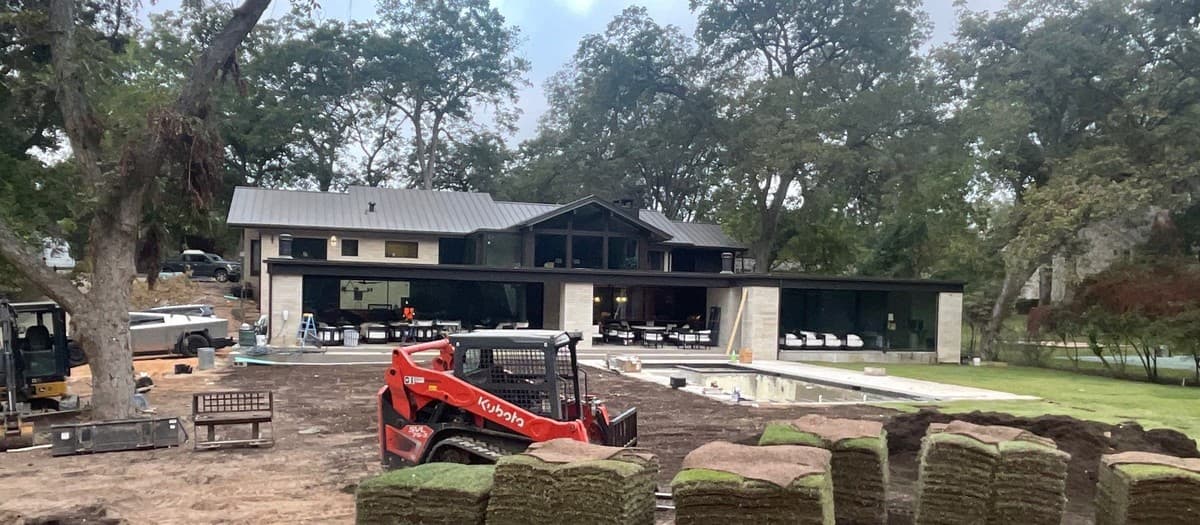
Clients always ask which is cheaper. Contractors know the real answer depends on the site, the season, and who is carrying the risk if the grass does not take.
You bid a 15,000 SF backyard restoration — new grade, erosion control on the slope, and full grass coverage. The client wants green and growing as fast as possible. You have three options in front of you: throw sod, hydroseed it, or broadcast seed and roll. Each one has a different price, a different timeline, and a different risk profile for your warranty call-back rate.
Here is the actual cost comparison — material, labor, and establishment risk — so you can make the right call and price it correctly.
Sod: The Premium Option With the Fastest Timeline
Sod is the most expensive method and produces the fastest result — a client can walk on a sodded yard within 2–3 weeks. For Central Texas, St. Augustine and Bermuda are the dominant varieties. Zoysia is available but slower to establish from sod.
- Sod material cost: $0.35–$0.65 per SF for Bermuda or St. Augustine from a local grower. Zoysia runs $0.55–$0.85/SF. These are grower prices — factor in palletizing and delivery, which adds $80–$150 per pallet depending on haul distance.
- Sod labor cost: $0.20–$0.35/SF for a crew experienced with sod installation on flat ground. Add $0.10–$0.15/SF for sloped areas where cuts and staggering take longer. A two-man crew can lay 4,000–6,000 SF of sod per day on accessible flat ground.
- Total installed cost: $0.60–$1.10/SF for most residential sod jobs. On that 15,000 SF scope, that is $9,000–$16,500 in material and labor before soil prep.
- Soil prep: Sod needs a firm, graded, and fertilized surface. Budget $0.08–$0.15/SF for starter fertilizer and any topdressing. Roto-tilling or grading is a separate scope line item — do not bury it in the sod price.
Hydroseeding: The Mid-Range Option for Slopes and Large Areas
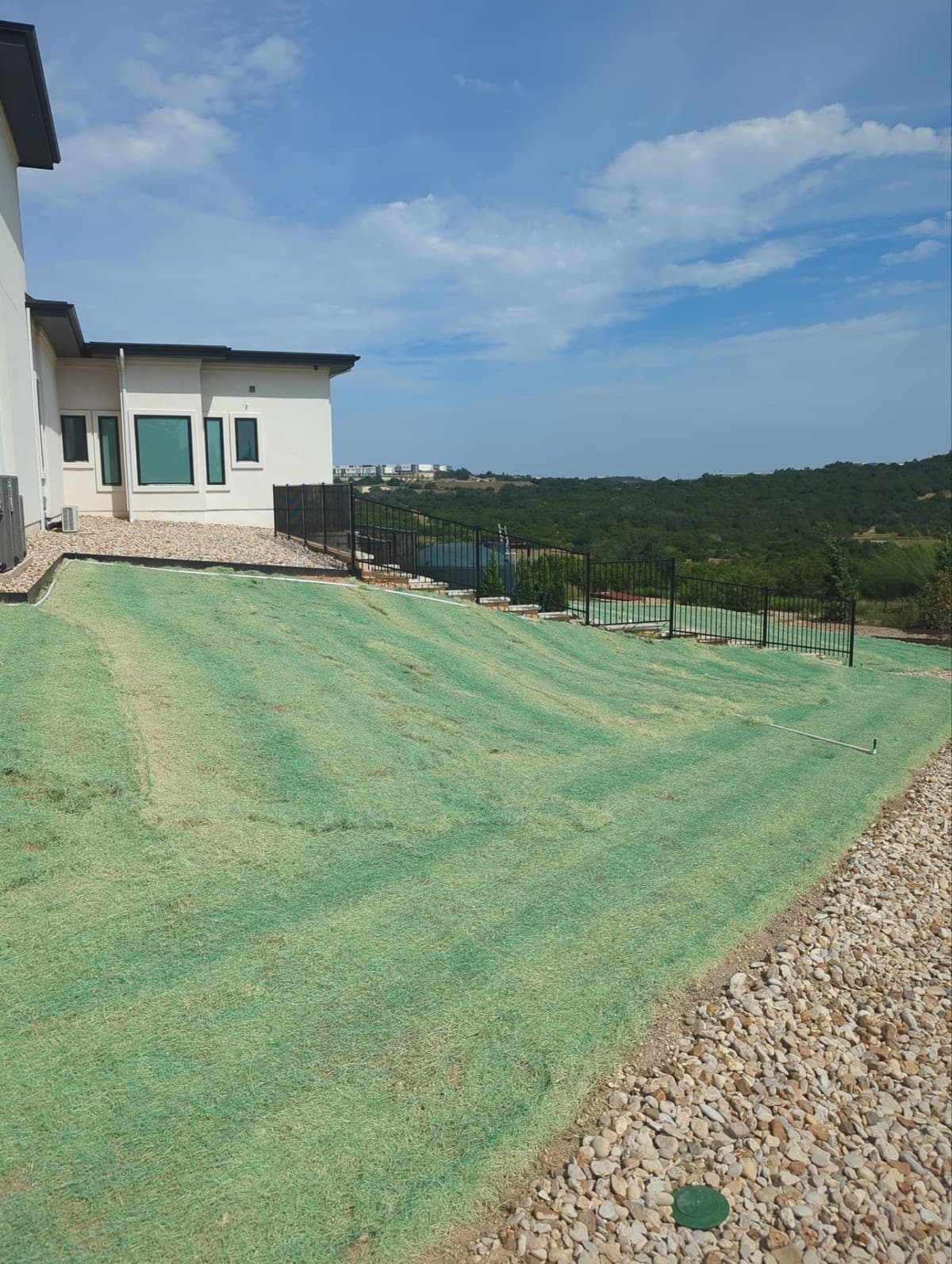
Hydroseeding sprays a slurry of seed, fertilizer, tackifier, and hydromulch onto prepared ground. It establishes faster than broadcast seed, costs significantly less than sod, and performs better than dry seed on slopes over 3:1 grade. Most contractors sub this out — a hydroseeding truck is not a common equipment purchase for a landscape company.
Subcontractor cost: $0.08–$0.18/SF for hydroseeding, depending on site access, slope, and whether the sub is applying a standard mix or a custom erosion-control spec with heavy cellulose mulch. On 15,000 SF, budget $1,200–$2,700 as your sub cost.
Your markup: 25–35% on a hydroseeding sub. You are managing site access, scheduling, and often handling the client conversation about establishment timeline — charge for it.
Timeline: Hydroseeded grass germinates in 7–21 days depending on species and temperature. Full coverage takes 45–90 days. This is the biggest client-expectation problem — set it in writing before the job starts.
Broadcast Seed: Lowest Cost, Highest Risk
Broadcast seeding is the cheapest method on paper. Seed cost runs $0.03–$0.08/SF depending on species. Labor to spread, rake, and roll is $0.05–$0.12/SF. Total cost: $0.08–$0.20/SF installed — a fraction of sod. On 15,000 SF, you are looking at $1,200–$3,000 total.
The problem is establishment failure risk. Dry seed on bare dirt is exposed to birds, wind erosion, uneven germination, and client impatience. If less than 70% coverage comes in, you are likely doing a warranty call-back — at your cost. That potential re-do on a 15,000 SF job can cost you $3,000–$5,000 in labor and material. Suddenly the "cheap" option is not cheap.
When does broadcast seed make sense? Flat sites, low-visibility areas, tolerant clients, jobs where the client takes responsibility for watering, and situations where you are not offering an establishment warranty. Price in the risk or exclude the warranty explicitly in your contract.
"The cheapest install method is never cheapest if you end up paying for it twice."
How to Pick the Right Method for the Job
Run through these four questions before you choose a method:
- What is the slope? Anything over 3:1 needs hydroseeding or sod with erosion pins — broadcast seed will wash away.
- What is the timeline? If the client wants green grass in 30 days, sod is the only answer. Set that expectation before you bid.
- What is the area? Under 3,000 SF, sod is manageable. Over 10,000 SF, hydroseeding is typically the right call unless the client is premium residential and not price-sensitive.
- Who is responsible for watering? If the irrigation system is not in yet, establishment risk skyrockets. Cover yourself in the contract language.
Stop guessing on estimates
Build accurate estimates in minutes, not hours.
Ledge has assembly-based estimating built in — material takeoffs, labor rates, and markup all in one place.
Book a Demo →Frequently Asked Questions
How much does hydroseeding cost per square foot for contractors?
Expect to pay a hydroseeding sub $0.08–$0.18/SF depending on mix spec, site access, and area size. Mark that up 25–35% in your bid. On 10,000 SF, your all-in cost before soil prep is typically $800–$1,800 in sub cost plus $200–$600 in markup depending on your rate. The wide range comes from equipment access, slope, and whether the spec calls for heavy erosion-control mulch.
Is sod worth the extra cost vs. hydroseeding?
Sod costs 4–8x more than hydroseeding but eliminates establishment risk and produces immediate coverage. For high-visibility areas, front lawns, or projects where the client has a move-in deadline, sod is worth the premium. For back slopes, utility areas, or large acreage projects where budget matters more than speed, hydroseeding wins on economics.
What grass species should I specify for Central Texas?
Bermuda grass is the most drought-tolerant and lowest maintenance for full sun. St. Augustine handles partial shade better but needs more water. Zoysia is becoming popular for its density and weed resistance but is expensive to sod and slow to fill in from plugs. For hydroseeding in erosion-control applications, buffalograss and native grass mixes are common for low-maintenance slopes.
Should I offer a warranty on grass establishment?
Offer a limited establishment warranty only when you control the irrigation and the site conditions at time of install. A 30-day warranty on sod is reasonable if irrigation is functional. Never offer an establishment warranty on broadcast seed — the variables are too many. For hydroseeding, a warranty is negotiable but should exclude drought conditions and client irrigation failure.
Edgar Galindo
Co-founder, Ledge
Edgar built Ledge while running a landscape design-build company in Central Texas. He has specified sod, hydroseeding, and broadcast seed on dozens of residential and commercial projects.