French drains are deceptively simple until you start pricing the trench, the aggregate volume, the outlet work, and the restoration. Here is the formula that accounts for every cost.
Clients call it "a French drain" like it is one thing. Your job is to break it into six line items before you write a number. Trench excavation, perforated pipe, drainage aggregate, filter fabric, outlet connection, and surface restoration are all distinct costs — and every one of them swings based on site conditions. The contractor who prices by the linear foot without accounting for trench depth, soil type, or outlet complexity is the one who loses money.
The Six Cost Categories of a French Drain
Price each of these separately. Do not bundle them into a per-linear-foot number until you know what each costs on this specific job.
- Trench excavation — depth, width, soil type, and whether a trenching machine fits the site
- Perforated pipe — diameter (4-inch vs. 6-inch), material (corrugated HDPE vs. rigid PVC), wrapped or unwrapped
- Drainage aggregate — washed gravel volume based on trench dimensions
- Filter fabric — prevents silt migration into the gravel bed
- Outlet — daylight outlet, pop-up emitter, connection to storm system, or dry well
- Surface restoration — sod replacement, topsoil, seed, or hardscape repair over the trench
Trench Excavation: Depth and Access Drive Cost
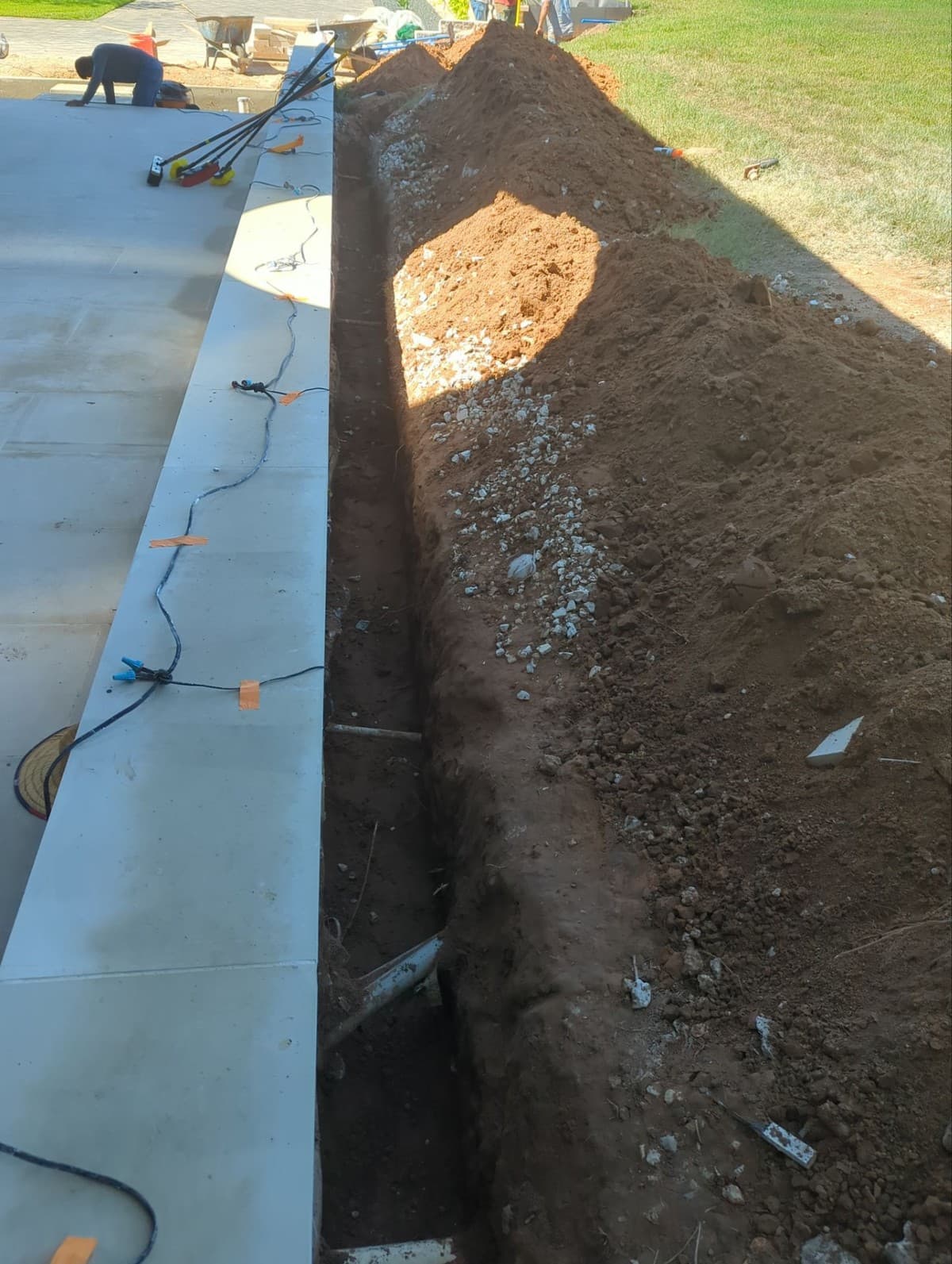
A standard residential French drain runs 18–24 inches deep and 12–18 inches wide. Shallow foundation drainage sometimes goes to 36 inches. The deeper the trench, the slower the progress and the more spoil you have to haul.
Can a walk-behind trencher fit the access? A Ditch Witch RT45 or RT55 trenching machine does 50–80 LF per hour in average soil. Hand-dug trenches in tight access areas run 6–10 LF per hour for one man — an enormous difference in labor cost. Know before you bid.
Trencher rental: $300–$500/day for a walk-behind unit. Add operator time at your burdened labor rate. If you need two days of trenching, that machine cost is $600–$1,000 before labor. It belongs in the estimate.
Pipe Selection: 4-Inch vs. 6-Inch, Corrugated vs. Rigid
4-inch corrugated HDPE perforated pipe is the most common choice for residential French drains — $0.35–$0.55/LF for single-wall, $0.80–$1.20/LF for double-wall. 6-inch handles higher volume but costs more and requires a wider trench. Rigid PVC perforated pipe costs more per foot but lasts longer and is less likely to crush under heavy loads like driveways.
Sock-wrapped pipe (pipe covered in filter fabric at the factory) costs $0.20–$0.40 more per foot but saves labor time on fabric installation. For jobs where you are hand-installing fabric in a tight trench, sock pipe often saves money overall.
Drainage Aggregate: Calculate the Trench Volume
The gravel bed surrounding the pipe is the heart of the system. Use clean washed crushed granite or 57-stone — no fines, no decomposed granite. Fines clog quickly and defeat the purpose.
Formula: Trench volume (CF) = length (LF) × width (ft) × depth (ft). Convert to tons: CF ÷ 27 = CY × 1.35 (tons per CY for washed granite).
Example: 60 LF drain, 12-inch wide, 18-inch deep. Volume = 60 × 1.0 × 1.5 = 90 CF = 3.33 CY = 4.5 tons. At $55–$70/ton delivered, that is $248–$315 in aggregate. Do not forget the haul cost if your supplier charges by the drop.
Outlet Options and Their Real Costs
Where does the water go? That answer determines your outlet cost — and your outlet is frequently the most site-specific variable on the whole job. What works day-light at the back fence costs almost nothing. Connecting to a storm inlet 120 feet away is an entirely different scope.
- Daylight outlet to grade: $80–$150 for outlet pipe and riprap splash pad. Cheapest option, only works when there is grade available.
- Pop-up emitter: $120–$220 installed. Opens under water pressure, closes when dry. Standard residential choice when daylight is not available.
- Dry well (infiltration basin): $400–$900 for a 3–4 foot diameter dry well with gravel fill. Only appropriate when soil percolation supports it.
- Storm drain connection: Price case by case — requires locating the inlet, trenching to it, and potentially a permit. Do not include a lump sum; price after you see the site.
Labor Rate and Production for French Drains
With machine trenching in accessible conditions: a two-man crew can complete 40–60 LF/day of 18-inch deep French drain including pipe, aggregate, and fabric. Hand trenching in clay soil with poor access: 15–25 LF/day for a two-man crew. The difference is dramatic. Get this wrong and you lose days.
Price surface restoration separately from drain installation. Replacing 60 LF of sod over a trench after backfill adds 2–4 hours of labor and the material cost of the sod. If you are restoring over a paver or concrete surface, that scope is larger and needs its own line item.
"The outlet is where French drain jobs become profitable or painful. Price it before you commit."
Sample Estimate: 60 LF French Drain
- Trencher rental (1 day): $380
- 4-inch perf pipe (60 LF @ $0.90 sock-wrap): $54
- Washed gravel aggregate (5 tons @ $62): $310
- Pop-up emitter outlet: $175
- Sod restoration (60 LF × 1.5 ft = 90 SF): $185
- Dump fees (3 loads @ $75): $225
- Labor (2 men × 9 hours @ $80): $1,440
- Total cost: $2,769 | Client price at 45% GM: $5,035
That works out to about $84 per linear foot. Contractors who quote $35–$50/LF flat are skipping equipment, dump fees, and proper restoration. They win the job and lose the margin.
Stop guessing on estimates
Build accurate estimates in minutes, not hours.
Ledge has assembly-based estimating built in — material takeoffs, labor rates, and markup all in one place. No more spreadsheet math.
Book a Demo →Frequently Asked Questions
How much does a French drain cost per linear foot installed?
Well-priced residential French drains run $60–$120 per linear foot installed, depending on depth, outlet type, access for equipment, and surface restoration required. Shallow drains with machine access and daylight outlets come in at the low end. Deep hand-dug drains with dry well outlets and sod restoration push higher. Any quote below $45/LF for a properly built system is leaving something out.
What size pipe should I use for a residential French drain?
4-inch perforated pipe handles most residential French drain applications. Use 6-inch when the drain is receiving runoff from a large collection area, when multiple downspout connections feed the system, or when the client has experienced significant drainage volume. The pipe size matters less than the outlet capacity — a 4-inch pipe draining freely outperforms a 6-inch pipe draining slowly.
Do I need a permit for a French drain?
Most residential French drains do not require a permit unless they connect to the municipal storm system or involve significant grading changes. Check local jurisdiction requirements — some municipalities require permits for any drainage work, others only for connections to infrastructure. If your client is in an HOA community, check deed restrictions separately from local code.
How deep should a French drain be?
Standard residential French drains run 18–24 inches deep. Foundation drainage (draining water away from a house foundation) often goes to 36 inches to intercept water below the footing level. Interceptor drains along hillsides or retaining walls match their depth to the water table. Get a soil probe or talk to the client about where water is entering before you specify depth.
Edgar Galindo
Co-founder, Ledge
Edgar built Ledge while running a landscape design-build company in Central Texas. French drains are some of the most misquoted jobs in the industry — he has seen the losses firsthand.