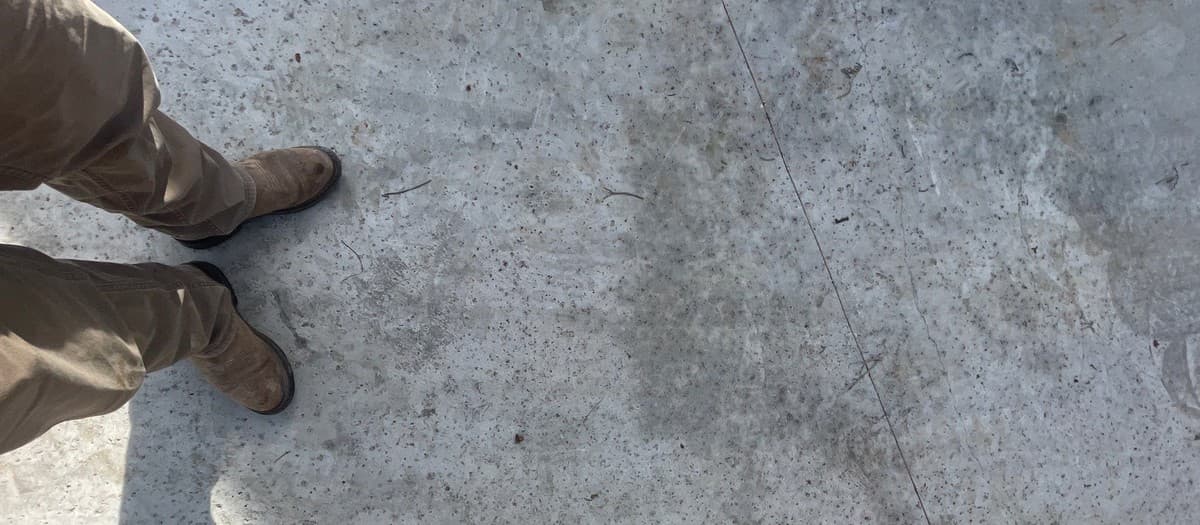
Concrete flatwork is one of the most straightforward scopes to build — and one of the easiest to underbid. The pour is the easy part. Base prep, form work, and finish labor are where most contractors leave money.
Concrete flatwork pricing in most markets runs $8–$16/SF installed for standard 4-inch residential flatwork. Contractors who price at the bottom of that range and wonder why they lose money on concrete jobs almost always have the same problem: they price the concrete, not the whole scope.
A concrete flatwork estimate has six components. Miss any one of them and your margin takes the hit. Here is how to build the number correctly.
The Full Cost Breakdown Per Square Foot
Standard 4-inch residential flatwork (driveway, patio, walkway) with a 4-inch compacted base, wire mesh, broom finish, and two control joints per 10 feet runs $8–$14/SF in most markets. Here is what goes into that:
- Excavation and base prep: $1.00–$2.00/SF. Remove existing material, rough grade, compact subgrade. Rocky or clay-heavy soil adds time and possible equipment rental.
- Crushed aggregate base (4 inches): $0.60–$1.10/SF. Crushed limestone or gravel, compacted to 95% density. Same material math as paver base — SF × 0.33 ft × 1.35 compaction factor ÷ 27 = cubic yards, then convert to tons.
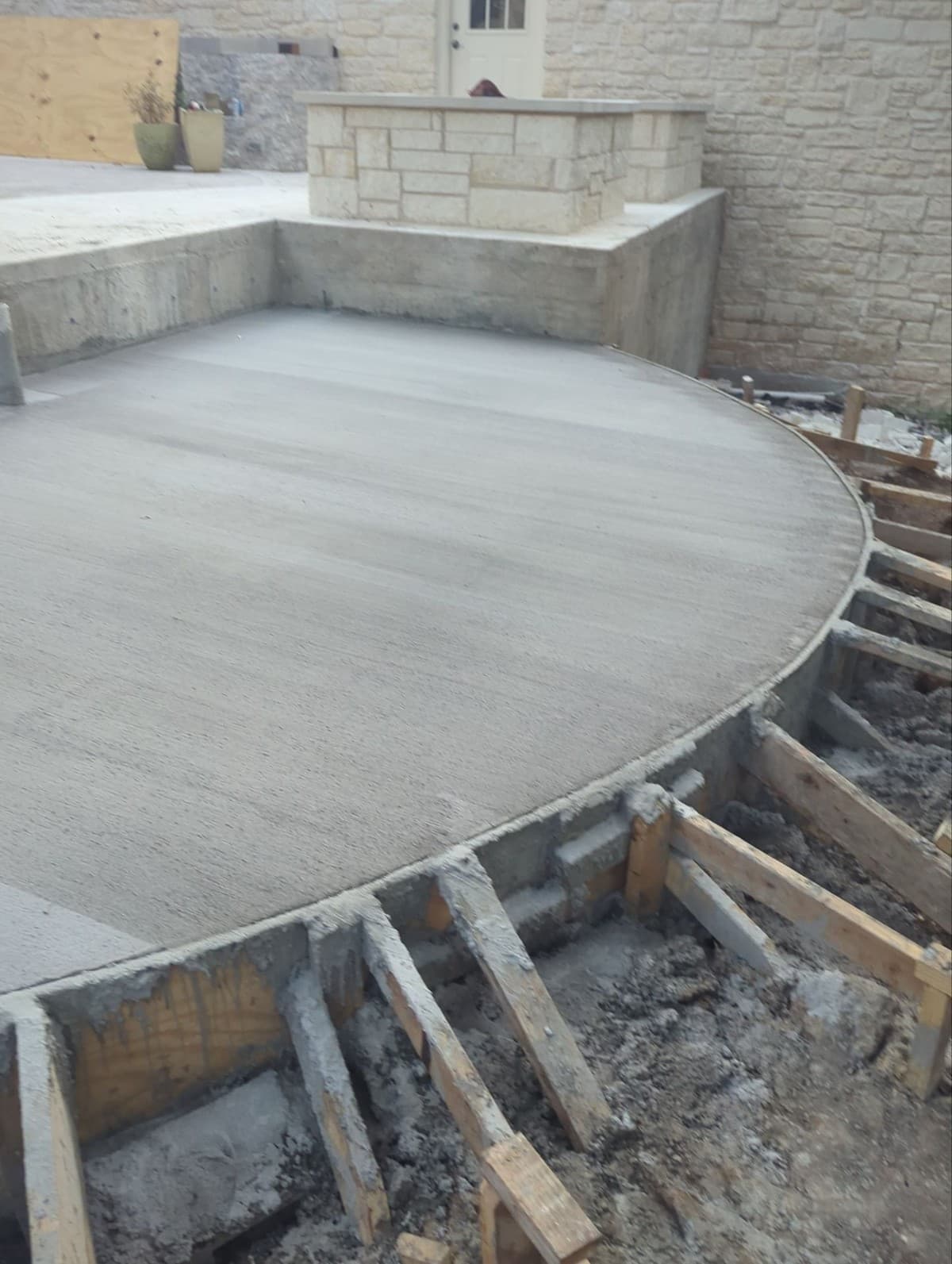
- Form work: $1.20–$2.00 per linear foot of form. Measure all perimeter edges plus any interior curves or changes in elevation. Wood forms (2x4 or 2x6 depending on slab thickness) are standard. Curved forms cost more in time. Do not forget haul-away of form lumber after the pour.
- Wire mesh or rebar: $0.35–$0.80/SF. 6×6 W1.4×W1.4 wire mesh is standard for residential flatwork. Rebar (No. 3 or No. 4 at 18-inch spacing) is required for driveways subject to heavy loads, thickened edge slabs, and some local codes. Know which your jurisdiction requires before bidding.
- Concrete material (ready-mix): $1.80–$3.20/SF for a 4-inch slab. Ready-mix prices vary significantly by market and time of year — always get a current quote from your supplier. Concrete for a 400 SF patio at 4 inches = 400 × 0.333 ÷ 27 = 4.9 cubic yards. Order 5.2 CY — you need overage for waste and curves.
- Finishing labor: $1.50–$3.00/SF depending on finish type. A standard broom finish is fastest. An exposed aggregate finish requires washing before cure and takes 20–30% longer. Stamped concrete (Butterfield Color, Davis Colors) adds $3–$6/SF for the pattern tools, release agent, and color hardener — and requires an experienced finisher to avoid callbacks.
- Control joints: $0.50–$1.00 per linear foot. Saw-cut or hand-tooled. On a 400 SF patio, you will have 60–100 LF of control joints. Price it by the LF — do not absorb it into finishing labor.
- Sealer: $0.40–$0.80/SF. Acrylic or penetrating sealer applied after cure. It is an upsell, but price it as a line item option. Clients who want it will add it — and your margin on sealer is strong.
How to Calculate Concrete Volume
Concrete is ordered by the cubic yard. The calculation:
- SF × slab thickness (in feet) ÷ 27 = cubic yards
- 4-inch slab = 0.333 feet. 6-inch slab = 0.5 feet.
- Example: 600 SF driveway at 4 inches = 600 × 0.333 ÷ 27 = 7.4 CY. Order 7.8 CY — add 5–7% for waste, overage at edges, and irregular shapes.
- Most ready-mix plants have a short-load fee for orders under 5–7 CY. Know your supplier's minimum.
Do not round down on concrete orders. Running short mid-pour is a crisis — the truck leaves and your slab has a cold joint. Running one extra yard costs you $120–$180. The comparison is obvious.
Finish Type Changes Everything
The finish type the client chooses affects labor cost by 30–60%. Know your numbers for each:
- Broom finish: Standard, fastest. A three-man crew finishes 600–900 SF/day of broom finish on flat ground. This is your baseline labor rate.
- Salt finish: Rock salt pressed into the surface before cure, washed out after. Adds 15–20% to finishing labor. Results are weather-dependent — warn clients not to choose this in hot, dry conditions where the concrete sets too fast.
- Exposed aggregate: Seeded aggregate or washed to expose the stone. Adds 20–30% to finishing labor. Requires timing — you wash the surface within 2–4 hours of the pour, before it fully sets. Temperature and humidity affect the window.
- Stamped concrete: Adds $3–$6/SF to the base labor rate. Color hardener, release agent, stamp tools, and pattern-matching require an experienced crew. Do not take a stamped concrete job if your finisher does not have 20+ pours of stamp experience — callbacks are expensive.
"Running short on a concrete pour is not a problem you solve with more concrete. It is a problem you avoid by ordering more than you think you need."
Concrete vs. Pavers: When to Recommend Which
Clients in your market will compare concrete to pavers. Here is the honest answer to give them: concrete costs less upfront but is permanent. If a tree root heaves a concrete slab, you replace a section — which never quite matches. Pavers cost more upfront, are repairable, and tend to hold their appearance longer. In expansive clay soil markets, pavers tolerate movement better.
Giving the honest answer about which material fits the client's situation builds trust. It also positions you to sell the right scope rather than the cheapest one — and the right scope is almost always the higher-margin sale.
Stop pricing concrete by memory
Price base, pour, finish, and sealer as separate line items.
Ledge calculates concrete cubic yards, base tonnage, form LF, and control joint LF from your slab dimensions. Enter the SF and thickness — the formula does the rest.
Book a Demo →Frequently Asked Questions
What does concrete flatwork cost per square foot installed?
Standard 4-inch broom-finish flatwork runs $8–$14/SF installed in most residential markets. Stamped concrete adds $3–$6/SF. Exposed aggregate adds $1.50–$3.00/SF. Pricing varies by region — always get current ready-mix quotes before finalizing a concrete estimate.
How do I calculate how many cubic yards of concrete I need?
Multiply SF by slab thickness in feet, divide by 27. A 4-inch slab is 0.333 feet thick. Add 5–7% for overage. Round up to the nearest 0.5 CY. Never order the exact calculated amount — running short mid-pour creates a cold joint that will crack. The cost of an extra half yard is far less than a callback.
Should I include sealer in a concrete estimate?
Price it as an optional line item at $0.40–$0.80/SF, applied 28 days after the pour when the concrete is fully cured. Clients who want protection against staining and weathering will add it. Sealer margins are strong — material is inexpensive and application is fast. It is a profitable upsell that protects the client's investment.
What thickness should a residential concrete patio be?
4 inches is the standard for residential patios and walkways. Driveways that see light vehicle traffic should be 4–5 inches. Driveways that will have RVs or heavy trucks should be 6 inches with rebar. Thickened edges (6–8 inches at the perimeter) add stability on expansive clay soils — price them as a separate line item when specified.
Edgar Galindo
Co-founder, Ledge
Edgar built Ledge while running a landscape design-build company in Central Texas. Concrete was the scope that taught him to order one extra yard and to price form work by the linear foot, not by square footage.