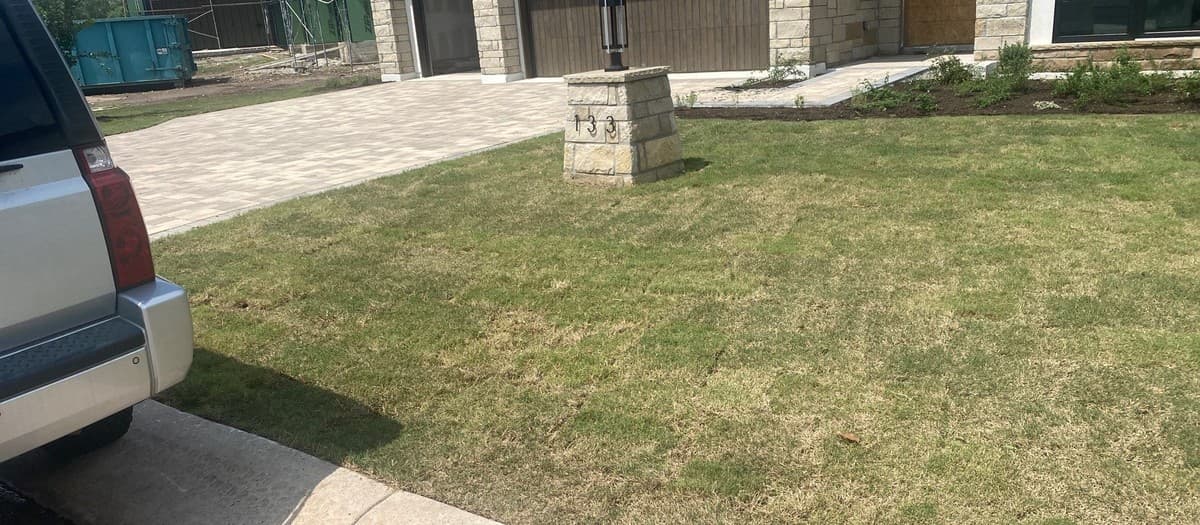
Sod jobs look simple until the site has drainage problems, rocky subsoil, or a grade that fights you the whole time. Here is how to price natural turf from first pass to final roll.
The homeowner wants a lawn. You look at the site — compacted dirt, rocky spots, a drainage swale that runs the wrong direction — and you know this is not a one-day sod job. But the bid has to land somewhere. The question is whether your number covers what you are actually walking into.
Natural turf installation has three cost layers that most contractors blur together: site preparation, soil amendments, and sod itself. When you price them separately, your estimate holds. When you lump them into a per-square-foot number from memory, you are guessing — and the site usually wins.
The Full Cost Breakdown Per Square Foot
A straightforward sod installation on a prepped yard — no grading, no soil amendment, just sod and starter fertilizer — runs $0.90–$1.60/SF installed in most markets. Add grading and soil work and you are looking at $1.80–$3.20/SF. Here is how each line item builds:
- Scalping / kill-off: $0.05–$0.12/SF if existing vegetation needs to be removed. A quick spray-and-wait adds two trips; a mechanical scalp adds equipment time. Price it separately.
- Rough grading: $0.25–$0.65/SF depending on how much dirt moves. Flat fill with a skid steer is cheap. Correcting a slope toward the foundation with a box blade takes time and multiple passes.
- Topsoil: $0.30–$0.55/SF for 2 inches of screened topsoil. If you are in a market where subsoil is clay or caliche, this is not optional — it is what makes the sod survive. One cubic yard covers about 162 SF at 2 inches.
- Sod material: $0.35–$0.75/SF depending on variety. Bermuda comes in cheapest. Zoysia (Empire, Palisades) runs $0.55–$0.75/SF. St. Augustine (Floratam, Palmetto) lands in the middle. Add 5–8% waste for cuts and edges.
- Starter fertilizer: $0.04–$0.08/SF. One 18-lb bag of starter fertilizer covers roughly 5,000 SF. It is a small cost but do not skip it — root establishment depends on phosphorus at planting.
- Installation labor: $0.20–$0.40/SF for sod laying on a flat, accessible site. A two-man crew can lay 4,000–6,000 SF/day in good conditions. Slopes, tight access, and curved edges slow that to 2,500–3,500 SF/day.
- Delivery and haul-off: $75–$200 flat depending on sod farm distance and whether you need a dump run for spoils. Never bury this in your per-SF rate.
What Kills Margins on Turf Jobs
Turf jobs have a deceptively simple scope. That is the trap. Here is where money disappears:
Grading surprises. You walk the site and it looks mostly flat. Your crew shows up and finds a 6-inch low spot that collects water against the foundation. Now you are moving dirt you did not price. Walk every site with a level or a string line before you bid.
Sod delivery timing. Sod must go down within 24–48 hours of delivery. If your crew is split across two jobs, or rain pushes the schedule, that pallet sits and dies. Dead sod is your problem — not the sod farm's. Price a contingency for labor to reschedule or replace it.
Irrigation coordination. If the client has irrigation, someone needs to confirm head placement before you sod. Burying a head under a sod seam causes a callback. That callback is free labor on your tab. Flag irrigation heads before the first roll goes down.
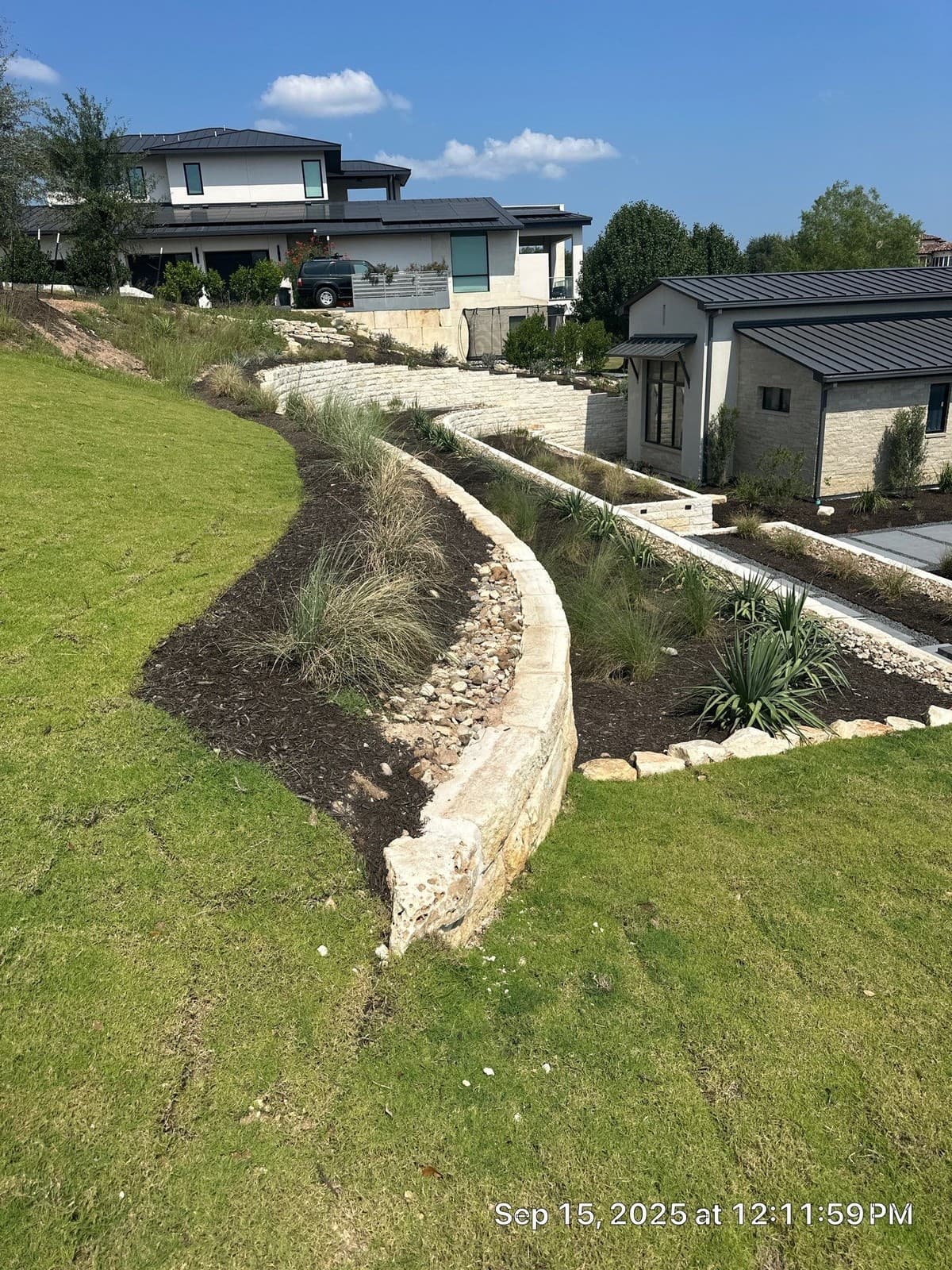
Rocky subsoil. One rock ledge 4 inches down can turn a half-day grading job into a full day. If you are in Central Texas limestone country, ask the homeowner if they have hit rock before. A hand probe takes 90 seconds and can save you a four-hour surprise.
How to Calculate Sod Quantity
Sod is sold by the square foot, square yard, or pallet depending on the supplier. Most pallets hold 450–504 SF. Here is the math:
- Measure total lawn area in square feet. Subtract beds, walkways, and structures.
- Add 5% waste for straight runs; 8% for lots with lots of curves, islands, or bed borders.
- Divide adjusted SF by your supplier's pallet size to get pallet count. Round up — never down.
Example: A 3,200 SF lawn with medium-complexity edging. Add 8% waste: 3,200 × 1.08 = 3,456 SF. At 504 SF/pallet, that is 6.86 pallets. Order 7. Running short and needing a half-pallet rush delivery costs you a delivery fee and crew downtime.
"Sod you run out of always costs more than sod you ordered extra."
Topsoil and Soil Amendment: When Is It Necessary?
In ideal conditions — loamy soil, decent organic content, good drainage — you can sod directly after grading. That is rarely what you find. In Central Texas, you often have caliche or dense clay within the first 3–4 inches. Sod laid directly on that will struggle to root and the client will call you when it dies in August.
The fix is 2–3 inches of screened topsoil tilled into the top layer, or rototilled compost at 3–4 cubic yards per 1,000 SF. Either way, it goes in your estimate as a line item — not absorbed into the sod price. One cubic yard of topsoil costs $35–$65 delivered. Budget your trucking and spreading labor separately.
Is topsoil required? Make the call on-site, then document it. If you include it in your estimate and the site does not need it, offer a credit. If you exclude it and the site needs it, you are either doing it for free or having an uncomfortable conversation about change orders.
Sod Variety Selection and Pricing Impact
The variety the client picks changes your material cost by $0.20–$0.40/SF. That is $600–$1,200 on a 3,000 SF lawn. Walk them through it. Present two or three options with installed pricing for each.
- Common Bermuda: Cheapest option, $0.35–$0.45/SF material. High heat tolerance. Requires sun. Goes dormant and brown in winter — clients who do not expect this will call you.
- St. Augustine (Floratam/Palmetto): $0.45–$0.60/SF material. More shade tolerance than Bermuda. Good for partial-shade yards. Palmetto handles more shade than Floratam.
- Zoysia (Empire/Palisades): $0.55–$0.75/SF material. Denser, slower growing, softer underfoot. Drought-tolerant once established. Worth the upcharge for premium clients.
Stop pricing from memory
Build turf estimates in minutes, not guesswork.
Ledge has assembly-based estimating built in — enter your square footage, pick your sod variety, and the formula handles topsoil, delivery, and labor automatically.
Book a Demo →Frequently Asked Questions
What does natural turf installation cost per square foot?
Sod-only installation on a prepped site runs $0.90–$1.60/SF installed. Add grading, topsoil, and amendments and the full project lands at $1.80–$3.20/SF. Material selection drives the range — Bermuda comes in cheapest, Zoysia at the top. Always build from your supplier's current pallet pricing, not averages.
How many square feet of sod can a crew install per day?
A two-man crew on a flat, accessible site lays 4,000–6,000 SF/day. Slopes, tight access, and complex bed edges drop that to 2,500–3,500 SF/day. Base your labor estimate on site conditions, not a flat per-SF rate.
Do I need to include topsoil in every sod estimate?
Not always, but you should assess on every site visit. In regions with clay or caliche subsoil, 2–3 inches of screened topsoil dramatically improves establishment. If you skip it and the sod fails, you own the callback. Make the call on-site and document it in your estimate notes.
How much waste should I add when ordering sod?
Add 5% for simple rectangular areas, 8% for yards with island beds, curves, or lots of edging detail. Always round up to the nearest full pallet. Ordering short and needing a rush delivery costs more in time and fees than the extra sod.
Edgar Galindo
Co-founder, Ledge
Edgar built Ledge while running a landscape design-build company in Central Texas. He has priced hundreds of turf installations — and learned where the margin goes when you do not price soil prep separately.