Clients want ambiance. What they actually need is the right BTU output, proper setbacks, and a clear explanation of why gas wins in most suburban installs.
Every client who asks for a fire pit imagines the same thing: friends around the fire, cool evening, cold drink. What they haven't thought about is HOA rules, gas line routing, burn bans, or what happens when they try to light a wood fire in an HOA-restricted community and get a code violation notice two weeks after you finish the job.
Your job before the first shovel goes in is to understand the site constraints, ask the right questions, and help the client pick the option that actually works for their situation.
Gas vs. Wood: The Honest Breakdown
Gas fire pits win in most suburban installs for three reasons: no smoke, no ash, no burn ban risk. Clients can turn them on and off with a key valve or electronic ignition. They're cleaner, easier to maintain, and more likely to actually get used.
Wood fire pits are simpler to build and cost less to install. No gas line, no regulator, no burner kit. They're ideal for rural properties without HOA restrictions, properties that already stockpile firewood, and clients who specifically want the crackling wood fire experience and understand the trade-offs.
The conversation goes: "Gas is cleaner, no ash cleanup, works in most HOAs, and you flip a switch. Wood is more traditional, costs less to install, but you're managing ash and wood storage, and during burn bans you can't use it. Which fits your situation better?" Most clients choose gas once they hear that framing.
Code Requirements: LP Gas Setbacks and Safety Rules
LP gas fire pits must maintain a 10-foot minimum setback from any structure, fence, or overhead obstruction. That includes the house, wood fences, pergola posts, and overhead shade sails. This is the NFPA 58 standard and most municipalities adopt it directly or have something stricter.
Measure from the fire bowl edge, not the pit wall. A 48" diameter fire bowl set into a 72" diameter stone surround needs 10 feet of clearance measured from the bowl rim to the nearest combustible structure.
- Natural gas: requires a licensed plumber or gas fitter to run the line and make the connection. Never do this yourself without a license.
- LP (propane): most jurisdictions allow a contractor to install the burner kit and connect to a portable tank. The gas line itself still requires a licensed gas fitter in many states — verify locally.
- Electronic ignition systems require a 120V outdoor-rated outlet within reach of the control module.
- Always check with the local municipality before installation — Austin, for example, has additional restrictions in certain fire hazard zones.
BTU Output: Sizing the Burner for the Space
BTU output determines how much heat the fire pit produces and how large the flame looks. Most residential gas fire pits run 40,000–100,000 BTU. Here's how to think about sizing:
- 40,000–60,000 BTU: Appropriate for smaller patio fire pits, 24–30" bowl diameter. Good for ambiance, modest heat output. Works well in Texas where you're not trying to heat an outdoor space in January.
- 60,000–80,000 BTU: Mid-range, covers most residential installs. 30–36" bowl. Visible flame height of 8–12" looks impressive and provides meaningful warmth in cool weather.
- 80,000–100,000 BTU: Large format or commercial installs. 36–48" bowls. Impressive flame height, significant heat output. Requires larger supply line and regulator to support the flow rate.
Match the burner BTU to the ring diameter. A 60,000 BTU H-burner typically fits a 24" diameter ring. Don't oversize the burner for the bowl — you'll get uneven flame distribution and excessive heat at the fire media.
Fire Pit Ring and Bowl Sizing
The fire ring sits inside the fire bowl and distributes gas to the burner. Size the ring to the interior diameter of the bowl, with 2–4" of clearance on each side for fire media (lava rock, fire glass, or decorative logs).
Common sizing combinations: 18" ring in a 24" bowl, 24" ring in a 30" bowl, 30" ring in a 36" bowl. The depth of the bowl matters too — 6–8" of depth for lava rock media, 8–10" for decorative logs.
For custom stone-built fire pits, the interior bowl dimensions need to be finalized before masonry work begins. Trying to fit a burner kit into an incorrectly sized opening is a frustrating field problem. Know the burner dimensions first, build around them.
"We spec the burner kit before we draw the seat wall. Every time we've done it backward, the stone work needs to change to make the burner fit."
Construction Details for Built-In Fire Pits
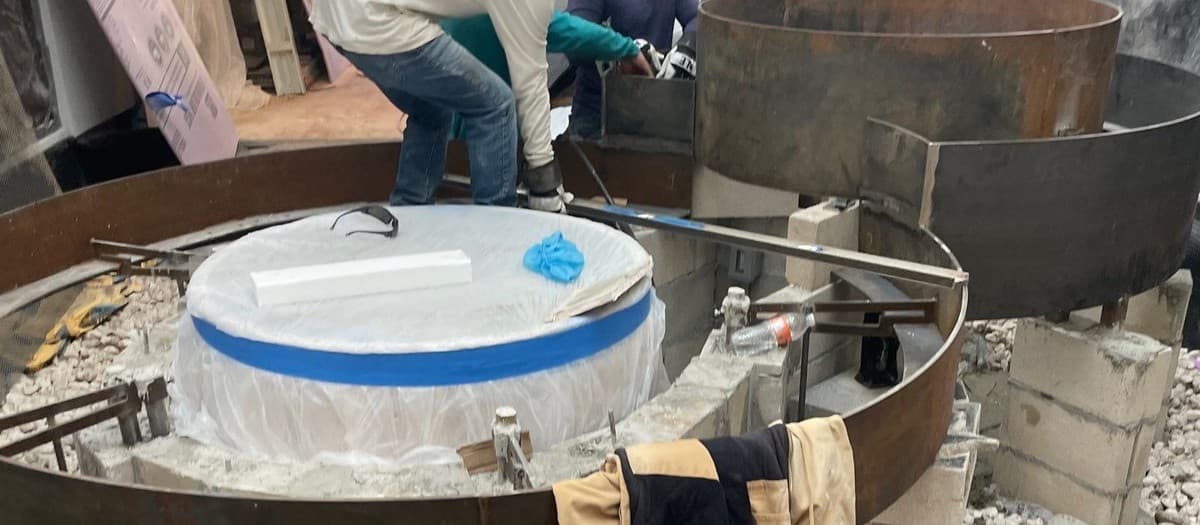
Built-in fire pits with surrounding seat walls are the premium option. They require a concrete footing (4" minimum depth, often 6" in freeze-thaw climates), CMU block core, and a mortar-set stone or concrete cap.
The fire bowl insert must be installed in a refractory liner or surrounded by non-combustible material. Regular mortar will crack from repeated thermal cycling. Use refractory cement (type S or better) for all joints within 12" of the fire bowl.
Gas line access: plan the routing before the concrete work. The supply line typically enters through the base of the fire pit wall — a 1" sleeve embedded in the footing keeps it clean. The shut-off valve goes in an accessible panel or key valve on the outside of the structure.
Estimate fire pits and outdoor living jobs in Ledge
Line out the burner kit, masonry, gas line, and labor in one clean proposal. Clients see the scope, you close faster.
Frequently Asked Questions
Do I need a permit to install a gas fire pit?
Most municipalities require a permit for any gas appliance installation. The permit is typically pulled by the licensed gas fitter or plumber connecting the supply line. Check with your local building department — requirements vary by city and county.
Can a wood fire pit be built against a fence?
No. Wood fire pits require 10 feet of clearance from any combustible material, including wood fences. Concrete, masonry, and steel are non-combustible, but if the fire pit is near those, verify there's no combustible material behind or above them.
What fire media looks best in a gas fire pit?
Fire glass (reflective, tumbled glass media) gives the most visual impact and distributes flame evenly around the burner. Lava rock is more affordable and works fine. Decorative ceramic logs look realistic but can shift and restrict flame distribution if not placed carefully. Avoid using real river rock — it can contain trapped moisture and crack or explode when heated.
How much does a built-in gas fire pit cost to install?
In Central Texas, a built-in gas fire pit with seat wall, flagstone cap, 60,000 BTU burner kit, and gas line connection runs $4,500–$8,000 depending on size, stone selection, and gas line distance. A freestanding insert-style fire pit table installed on an existing patio runs $800–$2,500 plus gas connection.
Can I build a fire pit on top of a paver patio?
Yes, with conditions. The fire pit structure needs its own footing — you can't rely on the paver base alone for a masonry structure. Set a concrete footing below the frost line, build up through the paver base, and bring the masonry to finish grade. The pavers around the perimeter are then cut to fit.
What's the difference between natural gas and LP gas for fire pits?
Natural gas is piped in from the street and billed through the utility — no tanks to refill. LP (propane) uses portable tanks, which can be hidden in a storage compartment or connected to a buried tank. Natural gas burners run at lower pressure and have different orifice sizes than LP burners — they're not interchangeable without a conversion kit.
Edgar Galindo
Co-founder, Ledge
Edgar built Ledge while running a landscape construction company in Central Texas. He writes about installation techniques, estimating, and building a profitable field operation.