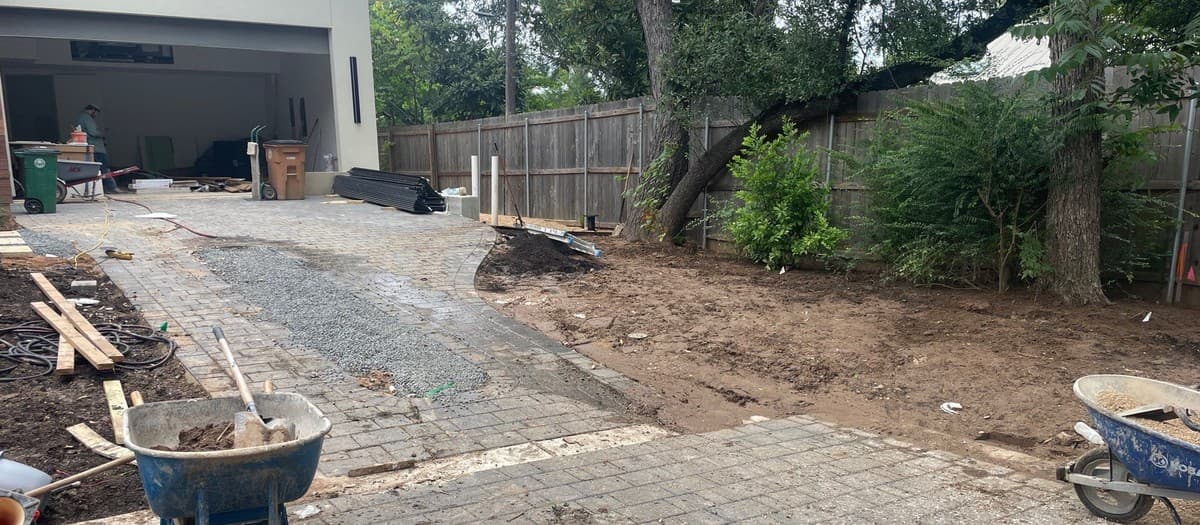
Too many bodies on a job site slow each other down. Too few and the job drags. Here is how to size your crew to the work — by project type, square footage, and site constraints.
Six people standing around a 300 SF patio watching one person cut pavers is not a crew — it is a crowd. But sending two people to install 1,200 SF of sod before a weather window closes is a different kind of mistake. Crew size is not a fixed number. It is a variable you should be calculating based on scope, timeline, and site constraints.
Most contractors default to their standard crew — whatever they have available — and fit the job around the people rather than the people around the job. That habit costs money in two directions: overstaffed jobs eat margin, understaffed jobs blow timelines and create comebacks.
Crew Size by Project Type
These ranges assume an experienced, mixed-skill crew. Adjust down 15–20% when using newer crew members.
- Paver patio under 400 SF: 2–3 people. One cuts, one lays, one handles material and compaction. A fourth person adds cost without a clear productive role unless there are steps or a retaining wall in scope.
- Paver patio 400–800 SF: 3–4 people. The extra person handles base compaction, material running, and poly sand without pulling the installer off the pattern.
- Paver patio over 800 SF or multi-zone layout: 4–5 people. Two-person install team, dedicated cutter, material runner, and a lead managing pattern alignment and quality checks.
- Retaining wall under 100 LF, 2–3 ft height: 2–3 people. Excavation, block setting, and drainage can rotate between two experienced crew members.
- Sod installation under 3,000 SF: 2 people. Over 3,000 SF with a same-day delivery and installation window, go to 3–4 to avoid dry pallet losses.
- Full yard renovation with multiple trades (irrigation, grading, planting, hardscape): 4–6 people in coordinated phases — not all on the same task at once. Sequence the work, not the headcount.
The Law of Diminishing Returns on Crew Size
There is a point on every job where adding another person stops helping and starts hurting. On a standard paver patio, that point is usually four to five people. Beyond that, crew members start getting in each other's way — especially on sites with limited staging area, narrow access, or sequential tasks where the next step cannot start until the prior one is done.
Think about what actually limits speed on a paver job. The bottleneck is almost always the installer and the cutter, not the number of people handling material. Adding a third material runner when the installer can only lay 300 SF/day does not accelerate the job. It just costs more labor dollars for the same output.
"The right crew size is the one where every person on site has a productive task for at least 80% of the day."
Site Constraints That Override Standard Crew Size
Tight backyard access. If the only access is through a 36-inch gate, more bodies do not help. You are rate-limited by the throughput of that gate. Two people with wheelbarrows is often the same speed as three — and three people on a narrow path creates congestion and safety issues.
Weather windows on sod or seeding. This is where you actually want more crew. Sod dries out on a pallet in Texas heat in 3–4 hours. If you have 5,000 SF to lay, size up to four people and run it fast. The plant health risk from under-staffing a sod job costs more than an extra day of labor.
HOA or permit windows. Some residential jobs have noise restrictions, access windows, or permit-required inspection timelines. If you need a task done by Friday to pass inspection, size the crew to finish Wednesday. Build in a buffer you control.
How to Calculate Crew Size From Your Estimate
Start with your total man-hours from the estimate. Divide by the number of workdays available (accounting for site access, deliveries, and inspection dependencies). That gives you the minimum crew size needed to hit your schedule. Round up to account for coordination overhead and unplanned delays. That is your target crew size — not who is available, but who the job actually needs.
Example: A 600 SF paver patio estimated at 42 man-hours, with a 3-day installation window. 42 ÷ 3 = 14 man-hours/day. That is a two-person crew working a normal day, or a three-person crew with buffer. Three people is the right call for a job this size — two gives you no room for a bad material delivery or a compactor breakdown.
Run a tighter operation
Ledge gives you visibility into every job without being on-site.
Job tracking, crew assignments, photo documentation, and production notes — all in your phone. Stop managing by walking job sites.
Book a Demo →Frequently Asked Questions
What is the ideal crew size for a standard residential paver patio?
For most residential paver patios under 500 SF, a three-person crew is the sweet spot: one cutter, one installer, one handling material and compaction. Above 500 SF, four people keeps everyone productive without creating congestion. Going to five or more on a standard residential patio rarely improves daily output and usually just raises your labor cost per square foot.
Does crew size affect job profitability?
Directly. Every person on site who does not have a full productive task reduces your labor efficiency ratio — you are paying burdened labor cost for lower than expected output. On the other side, under-staffing causes schedule overruns that create indirect costs: delayed next jobs, unhappy clients, and emergency overtime. Crew size is a margin lever, not just a logistics question.
How do I handle it when a crew member calls in sick on a paver job?
On a two-person crew, one absence is a real problem — you may need to reschedule or pull from another job. On a three-person crew, losing one person usually means slowing pace rather than stopping. This is one of the arguments for three-person crews on installation work: one absence does not kill the day. Build the coverage math into how you staff your jobs.
When does it make sense to split crew across two job sites in one day?
When at least one site has a half-day task — final punch, poly sand, cleanup, or a small planting install that does not justify a full crew for a full day. Split the crew when both sites can absorb the reduced headcount productively. Do not split if it means neither site can complete a meaningful phase that day. Partial days burn drive time and coordination overhead without much production to show for it.
Edgar Galindo
Co-founder, Ledge
Edgar built Ledge while running a landscape design-build company in Central Texas. He has sized crews for hundreds of residential jobs and tracked the margin impact of getting it right — and wrong.